Wolfgang Van Halen Credits Early Drum Training for His Guitar Playing Style
Wolfgang Van Halen told Rick Beato he plays "guitar like a drummer" - and Eddie Van Halen's very first lesson used nothing but a kitchen table and two magazines.
Wolfgang Van Halen's sharpest line from his March 31 Rick Beato interview is the kind that gets screenshotted and forwarded to every guitarist in a group chat: "I play guitar like a drummer, I play bass like a drummer." Coming from the founder and sole multi-instrumentalist behind Mammoth WVH, someone who writes and tracks every guitar, bass, drum, and vocal part on the band's records, that isn't a compliment to rhythm players. It's a description of how the music actually gets built.
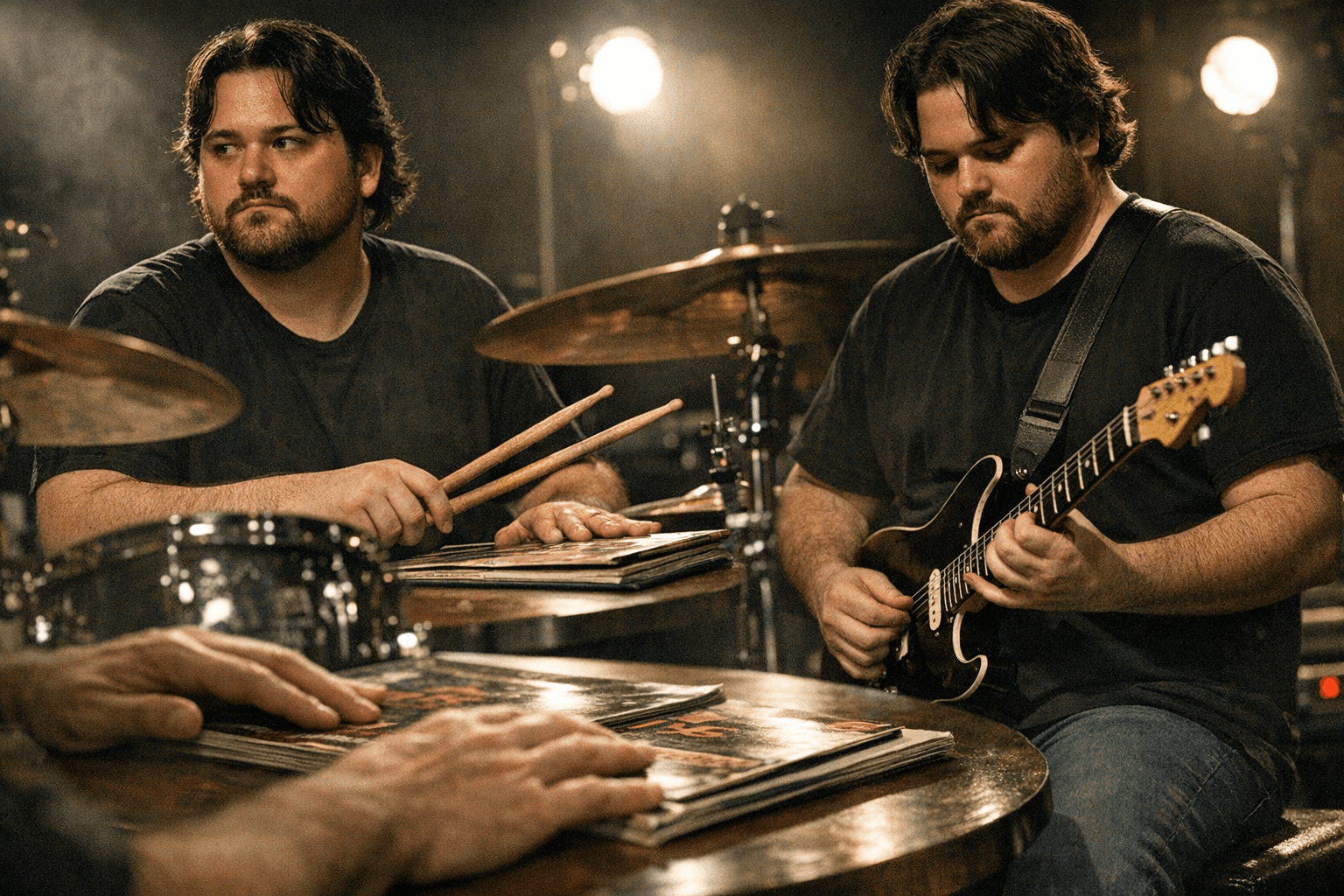
The foundation was laid at around age nine. Eddie Van Halen, rather than hand his son a guitar first, sat Wolfgang at a kitchen table with two magazines serving as makeshift drum pads. The lesson was pure limb coordination: quarter notes with the right hand, a backbeat accent on beats two and four with the left, and a foot tap on the one and three. "If you can do your foot on the one and the three and do that all together at the same time, you're playing Highway to Hell," Wolfgang recalled Eddie telling him. The moment he nailed the combination, Eddie bought him a V-drum kit. An acoustic kit followed for his next birthday. Guitar, notably, came after that, and almost entirely without formal instruction - Wolfgang taught himself from tabs on the internet by replicating favorite songs.
"I think my dad was right to start me on drums," Wolfgang told Beato. "It's a really good place to start rhythmically. You just understand music from that dynamic first, and you kind of grow from there." The clip, which circulated across music and drumming outlets within hours of posting, makes the pedagogical sequence explicit: rhythm first, instrument second.
For drummers coaching younger players or multi-instrumentalists looking to tighten their feel, three exercises emerge directly from what Wolfgang described. The first is the exact exercise Eddie used: tap quarter notes with your dominant hand on any flat surface, add a left-hand accent on two and four, then coordinate a foot tap on one and three. Start at 60 bpm. Build tempo only when all three limbs feel locked, not just simultaneous. That gap between "I can do it" and "it's automatic" is the whole game.
The second exercise moves the concept to guitar: before picking up the instrument to learn or write a riff, tap its rhythm on a practice pad. If the pattern feels awkward to drum out, it will likely feel stiff in the pocket too. This is the "drums first" filter Wolfgang described when he said "everything I start with is the rhythm of it."
The third is subdivision internalization: practice eighth notes by hand over a 60 bpm click, then sixteenth notes, then return to quarter notes without the metronome running. Being able to feel where the smaller subdivisions live inside a pulse, without counting aloud, is the internal clock that makes a drummer's guitar phrasing sound locked to the kit.
Beato's technically minded audience, which skews heavily toward guitarists and producers, makes this a high-visibility endorsement for drum-first instruction. When Wolfgang says "the rhythm section is tight because it's my instincts," he's describing exactly what those early magazine-pad sessions were building, one coordination drill at a time.
SUMMARY: Wolfgang Van Halen told Rick Beato he plays "guitar like a drummer" - and Eddie Van Halen's first lesson used nothing but a kitchen table and two magazines.
CONTENT:
Wolfgang Van Halen's sharpest line from his March 31 Rick Beato interview is the kind that gets screenshotted and forwarded to every guitarist in a group chat: "I play guitar like a drummer, I play bass like a drummer." Coming from the founder and sole multi-instrumentalist behind Mammoth WVH, someone who writes and tracks every guitar, bass, drum, and vocal part on the band's records, that isn't a compliment to rhythm players. It's a description of how the music actually gets built.
The foundation was laid at around age nine. Eddie Van Halen, rather than hand his son a guitar first, sat Wolfgang at a kitchen table with two magazines serving as makeshift drum pads. The lesson was pure limb coordination: quarter notes with the right hand, a backbeat accent on beats two and four with the left, and a foot tap on the one and three. "If you can do your foot on the one and the three and do that all together at the same time, you're playing Highway to Hell," Wolfgang recalled Eddie telling him. The moment he nailed the combination, Eddie bought him a V-drum kit. An acoustic kit followed for his next birthday. Guitar came after that, and almost entirely without formal instruction. Wolfgang taught himself from tabs on the internet by replicating favorite songs.
"I think my dad was right to start me on drums," Wolfgang told Beato. "It's a really good place to start rhythmically. You just understand music from that dynamic first, and you kind of grow from there." The clip, which circulated across music and drumming outlets within hours of posting, makes the pedagogical sequence explicit: rhythm first, instrument second.
For drummers coaching younger players or multi-instrumentalists looking to tighten their feel, three exercises emerge directly from what Wolfgang described. The first is the exact exercise Eddie used: tap quarter notes with your dominant hand on any flat surface, add a left-hand accent on two and four, then coordinate a foot tap on one and three. Start at 60 bpm and build tempo only when all three limbs feel locked, not merely simultaneous. That gap between "I can do it" and "it's automatic" is the whole point.
The second exercise moves the concept to guitar: before picking up the instrument to learn or write a riff, tap its rhythm on a practice pad. If the pattern feels awkward to drum, it will likely feel stiff in the pocket too. This is the "drums first" filter Wolfgang described when he said "Everything I start with is the rhythm of it."
The third is subdivision internalization: practice eighth notes by hand over a 60 bpm click, then sixteenth notes, then return to quarter notes without the metronome. Being able to feel where the smaller subdivisions live inside a pulse, without counting aloud, is the internal clock that makes a drummer's guitar phrasing sit locked to the kit.
Wolfgang has previously said "Drums are, to me, the most important part. It's the backbone of everything," and the Beato conversation gives that claim a specific origin story: two magazines on a kitchen table, and a father who understood that timing can't be retrofitted once bad habits are set. "The rhythm section is tight because it's my instincts," Wolfgang said. That's not something he learned later. It's something Eddie built into him before he ever touched a fretboard.
Know something we missed? Have a correction or additional information?
Submit a Tip