2024 Dungeons & Dragons glossary clarifies core rules terms
The 2024 glossary gives D&D tables a shared rules language, turning prone, hidden, and grappled into exact states that stop arguments before they start.
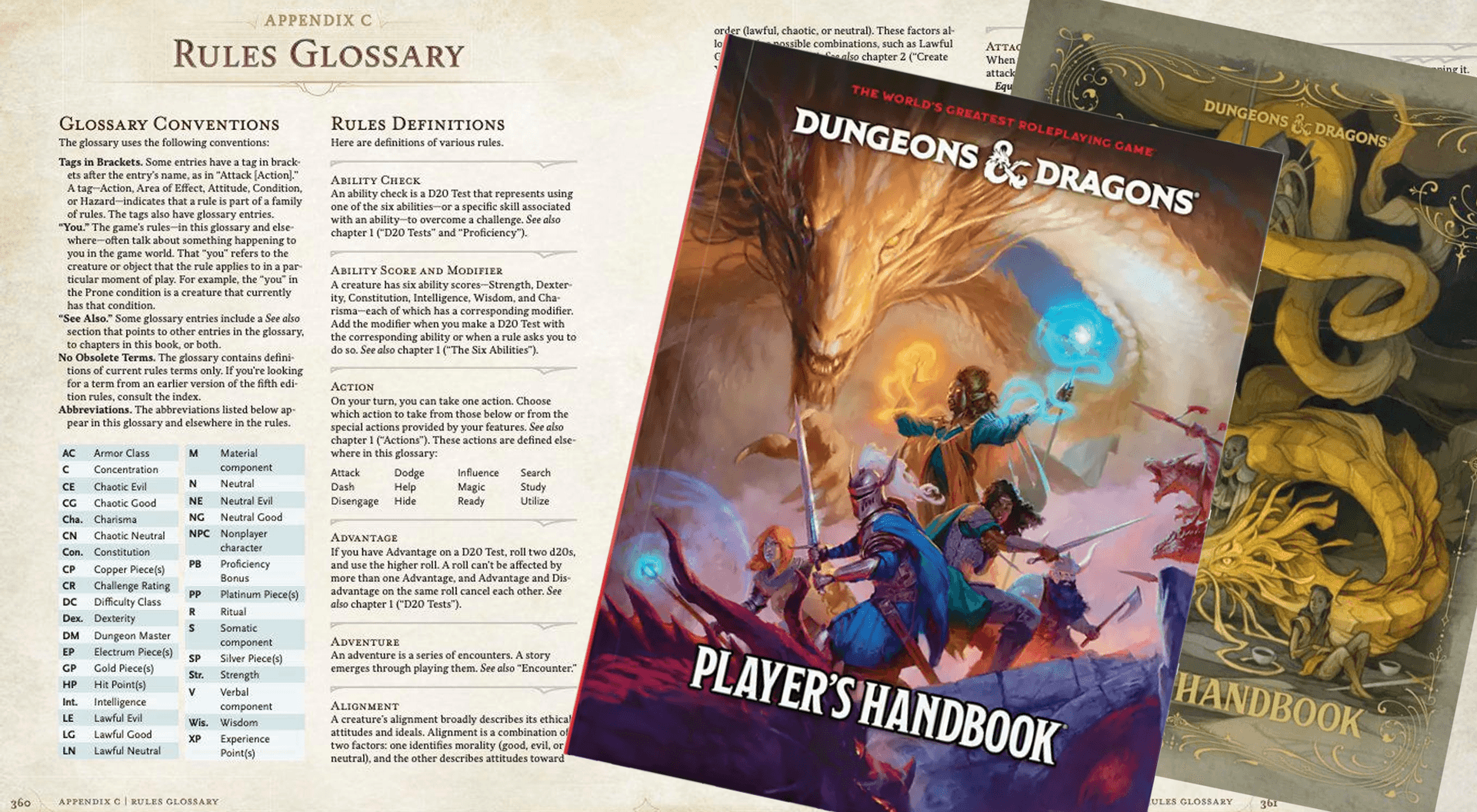
The fastest way to stop a table argument is often not a house rule, but a definition. The 2024 Dungeons & Dragons rules glossary does that work by locking down what the game means when it says a creature is prone, invisible, restrained, or grappled, so the outcome is determined before anyone starts debating plain English.
The glossary is the rules language under the fiction
A lot of friction in D&D comes from the gap between how players naturally talk and how the rules actually operate. In everyday speech, “invisible” sounds like a story beat and “grappled” sounds like two creatures wrestling in the mud; in the 2024 rules, those words are mechanical states with consequences that affect combat, exploration, and spell effects. The glossary is where those consequences live, which makes it more than a reference page tucked at the back of the book.
That matters because fifth edition and the 2024 refresh lean hard on exact terminology. A feature might care about whether you make an attack or take the Attack action, and those are not interchangeable. The same goes for hidden versus unseen, or surprised versus simply not acting yet. The glossary exists to settle those distinctions before they turn into a mid-turn discussion that eats up the round.
Why everyday English keeps causing bad rulings
The biggest value of the glossary is that it turns vague table language into consistent rulings. If a spell or monster ability references a condition, the DM does not have to invent a fresh interpretation on the spot, and the player does not have to guess what the designer meant. That is especially useful when a feature depends on precise timing, movement, senses, cover, or combat states.
Take prone, for example. At a casual table, that word can sound like a flavor description for somebody knocked down. In the rules, it affects positioning and how other creatures interact with that target, which changes both tactics and action economy. Restrained and grappled work the same way: the words carry exact in-game consequences, so a player who treats them as synonyms for “held still” is already one ruling off track.
The same is true with invisible and unseen. A creature can be hidden without being literally unseen in the broader narrative sense, and a creature can be unseen without automatically being hidden in the game’s mechanical sense. The glossary keeps those ideas separate, which is what prevents a stealth check, a perception check, or a spell effect from being stretched into whatever feels fair in the moment.
Where the 2024 rules put the glossary
This is not a side appendix sitting outside the current rules update. D&D Beyond hosts a dedicated Rules Glossary within the 2024 Basic Rules, and it also maintains a separate 2024 Player’s Handbook source page. That placement tells you exactly how the official rules team wants players to use it: as core infrastructure, not optional background reading.
The rollout around the 2024 books reinforces that point. Wizards of the Coast and D&D Beyond published What’s New in the 2024 Player’s Handbook on June 18, 2024, then followed with Updates in the Player’s Handbook (2024) on September 5, 2024, and Start Playing Today with the 2024 D&D Free Rules on September 6, 2024. The cadence shows the glossary arriving as part of a staged transition into the new rules, with the free rules and source pages helping players move into the updated framework without guessing where the definitions live.
That same official ecosystem also extends to organized play. D&D Beyond published a 2024 Adventurers League update for the core rules, which points to the glossary’s role beyond home tables. When shared play environments align around the same definitions, the game gets less dependent on local interpretation and more dependent on the text everyone is using.
What it changes when the dice hit the table
For Dungeon Masters, the glossary is a shortcut to fair rulings that hold up under pressure. Instead of arguing over what a condition “really means,” you can check the defined term and keep the session moving. That is especially valuable in scenes where combat timing is tight and a single wording mistake can snowball into a bad initiative order, a missed reaction, or a misunderstood spell effect.
For players, the payoff is just as concrete. Class features, monster abilities, and spell descriptions often lean on glossary terms as their foundation, so knowing those definitions helps you use your character correctly the first time. If a build depends on grappling, stealth, or a condition-based feature, reading the glossary before the session cuts down on do-overs and protects your turn from being derailed by a semantics fight.
The grappling rules show why this became such a visible topic during the edition transition. The 2024 grappling changes drew attention because the grappled condition and escape mechanics were being discussed in relation to the 2014 rules, and the official 2024 materials put that terminology front and center. When a single condition changes how a whole tactic works, the glossary becomes the difference between a clean ruling and a half-hour of retroactive interpretation.
- It helps settle whether an ability triggers off an action or an attack.
- It keeps condition-based effects like prone, restrained, and grappled consistent from table to table.
- It gives stealth, visibility, and surprise their own mechanical lanes instead of one shared blur.
- It speeds up calls on combat timing, movement, senses, and cover.
Why the glossary became part of the wider D&D conversation
The rules glossary did not just quietly appear and disappear into the back matter. It became a talking point because experienced players could see exactly how much work it was doing. The Alexandrian published a critique called D&D 5E 2024 - Why Rules Glossaries Kinda Suck, while EN World hosted a thread titled D&D 5E (2024) - Let’s talk about the Rules Glossary in the PHB. That mix of criticism and discussion is a sign that the glossary is not a minor editorial tweak, but a visible part of the 2024 rules identity.
That debate makes sense because glossaries change how the game is read. They do not just explain words; they decide which words are loaded and which are merely descriptive. In a system where one turn can hinge on whether a creature is hidden, unseen, prone, or grappled, a defined vocabulary is not cosmetic. It is the thing that keeps the table speaking the same language when the initiative order starts and the arguments begin to climb.
This article was produced by Prism’s automated news system from verified source data, official records, and press releases, then run through automated quality and moderation checks before publishing. The system is built and supervised by the people who set the standards it runs under. Read our full AI policy.
Did this article answer your question?