Dungeons & Dragons alignment explained as a guide, not a rule
Alignment survives because it speeds up play, not because it polices it. In 2024 D&D, it is a quick read on motives for characters, monsters, and factions.
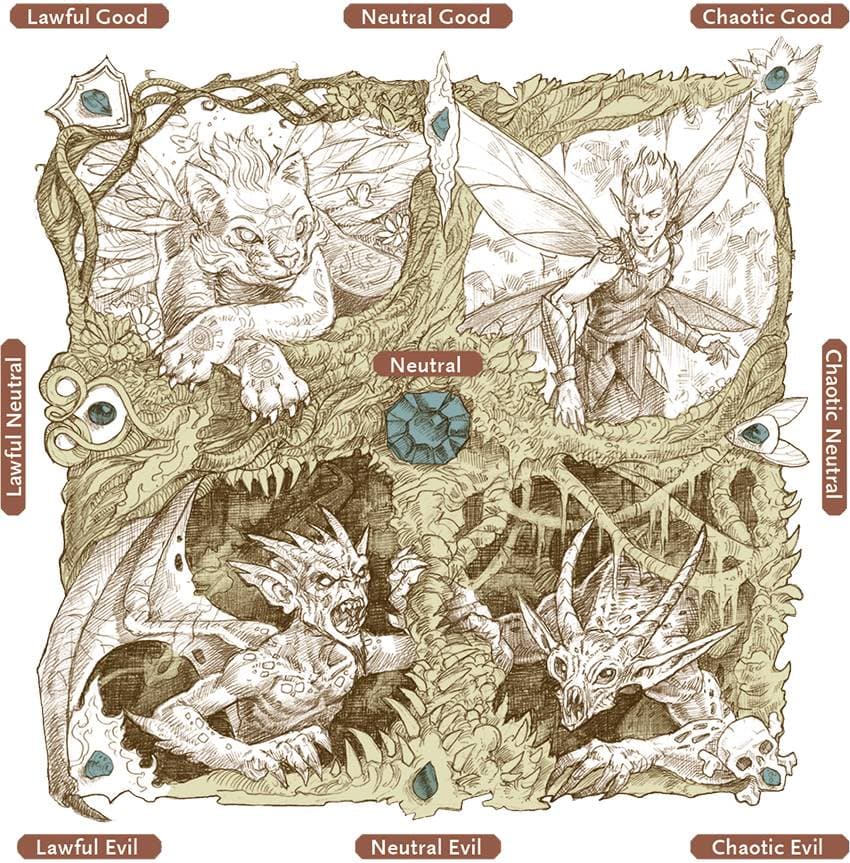
In the 2024 rules, alignment still sits in character creation, and the glossary defines it as a creature’s ethical attitudes and ideals. D&D Beyond calls it a roleplaying tool rather than a burden. It gives you a shared way to read what a character, monster, or faction is likely to do next.
From three boxes to nine
Alignment has been part of D&D since the game’s earliest days, but the chart people know now was not the original shape of it. The 1974 materials sit at the start of the game’s origin story, and early Basic D&D used a three-way lawful, chaotic, or neutral setup before later rules expanded the system into the familiar nine-box grid. By the time you reach the modern rules glossary, the system has settled into two axes, morality and order, with nine combinations like Lawful Good and Neutral Evil.
Alignment works as both lore and shorthand. It is a coordinate system that compresses a worldview into something the whole table can grasp in a second.
How to use it when you make a character
The cleanest way to use alignment is to let it come after the important building blocks, not before them. In the 2024 rules, Step 4 is still Choose an Alignment, after class, origin, and ability scores, and the rules describe it as a shorthand for a character’s moral compass. Alignment is not a mechanical shackle; it describes how the character approaches the world, not a list of permissions and prohibitions.

That gives you a practical test at the table: when the choice gets messy, ask what your character habitually protects, excuses, or refuses to do. A lawful good rogue can still lie to a guard to get a sibling out of trouble, but if that same rogue keeps choosing family, duty, and rescue over convenience, the alignment still makes sense because the pattern has not changed. Alignment guidance points you toward ideals and bonds because the label only works when it is tied to actual behavior.
The other useful habit is to treat alignment as something that can move. The 2024 article on alignment treats it as something that can change and not as a restrictive definition of what a character can or cannot do. If the character keeps making the same kind of hard choice over several sessions, the sheet should catch up to the story, not the other way around.
How DMs should use it for monsters and NPCs
For DMs, alignment is even more valuable as a shortcut. The alignment in a monster’s stat block is a default suggestion for how to roleplay the creature, and you can change it when the story needs a different result. That means a good-aligned green dragon or an evil storm giant is not a rules problem, it is a campaign choice.
Many low-intelligence creatures are unaligned and act on instinct instead of making moral choices. A wolf pack, a gelatinous cube, or an animal with no real sense of law or chaos does not need the same moral framing as a devil, a knight, or a cult leader.
Alignment also scales up to organizations. It can summarize a creature’s demeanor, a player character’s outlook, and an organization’s ethos. It works for factions, churches, mercenary companies, and kingdoms. If you know a group is lawful, chaotic, or somewhere in between, you can play its responses faster: what does it protect, what does it punish, and what kind of betrayal makes it break?

Why the arguments never really died
The hobby has always had two ways to read alignment, and both still show up at modern tables. One treats it as a cosmic force woven into the setting, the kind of thing that shows up in the planes and their inhabitants; the other treats it as a character’s personal worldview that emerges from choices.
Unearthed Arcana’s variant rules frame the system as the push and pull between good and evil, and between law and chaos, while still allowing friction inside a good-aligned party. Alignment gives a group a compact language for the kind of disagreement that matters in play, the sort where one character wants order, another wants mercy, and the DM needs a quick way to decide how the NPCs in the room react.
A workable table rule
Use alignment once to get a baseline, then let the campaign do the rest. Write it on the sheet after the character’s class, origin, and ability scores, use it to answer the next hard decision, and revisit it when the character’s choices have clearly shifted. For monsters and factions, start with the stat block or the setting note, then change the alignment when the story needs a cleaner villain, a stranger ally, or a cult that does not behave the way the trope says it should.
This article was produced by Prism’s automated news system from verified source data, official records, and press releases, then run through automated quality and moderation checks before publishing. The system is built and supervised by the people who set the standards it runs under. Read our full AI policy.
Did this article answer your question?

