Glass Cannon Network grows by skipping Dungeons & Dragons entirely
Glass Cannon grew by making Pathfinder and Cthulhu the point, and its 13-show 2026 tour shows how far that bet has taken it.
The contrarian play: build a tabletop brand without making D&D the center
Glass Cannon Network’s sharpest business move is also its least expected one: it built a recognizable tabletop brand by not centering Dungeons & Dragons. In a hobby where D&D is still the default shorthand for many new players and many actual-play shows, that choice is not a limitation. It is the strategy.
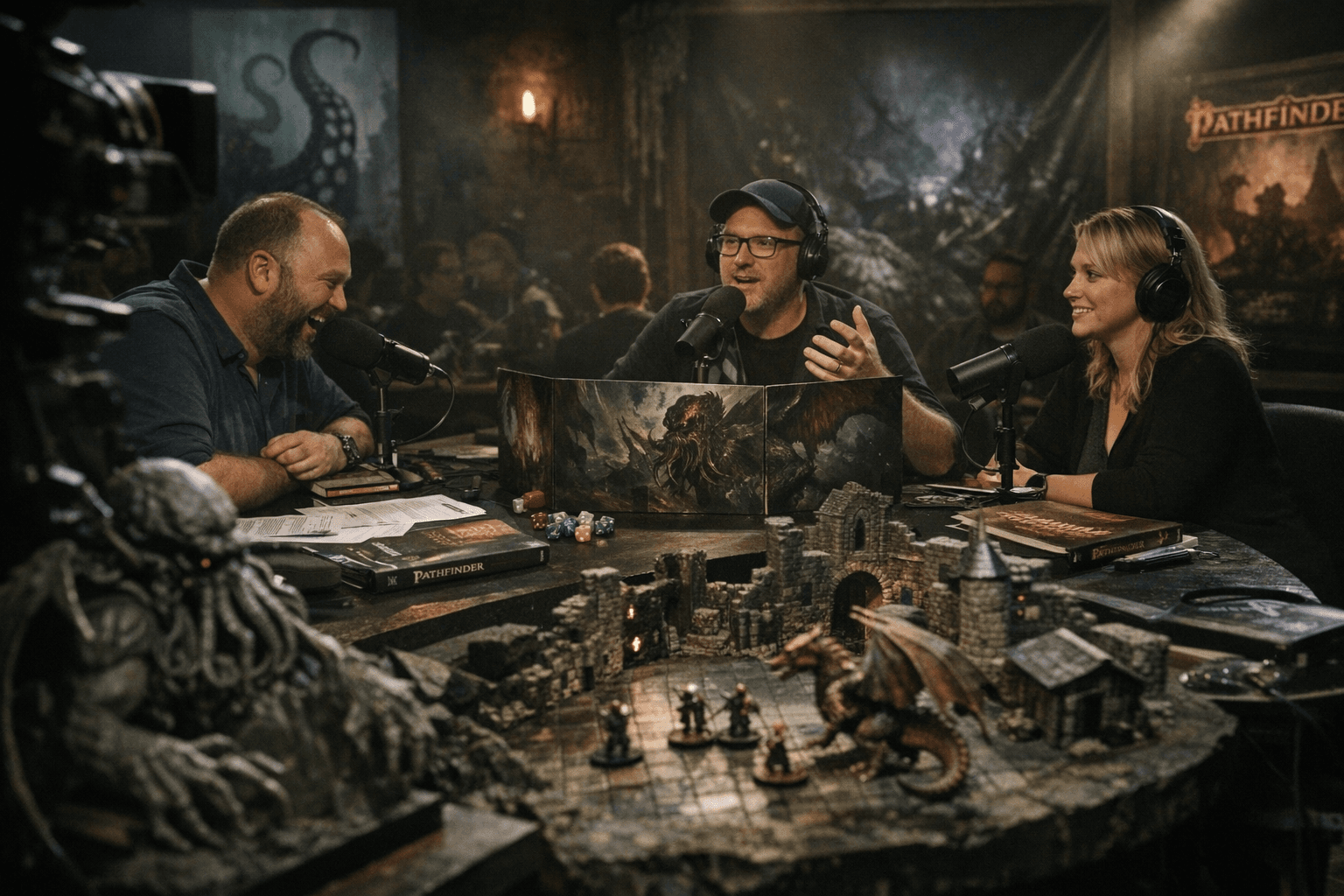
That matters because Glass Cannon is not hiding from the biggest game in the room out of necessity. It is choosing to stand apart, using Pathfinder, Call of Cthulhu, Blades in the Dark, Delta Green, and other systems to create a distinct identity. The result is a network that feels like its own lane, with its own tone and audience expectations, instead of another creator trying to win the same crowded race under the same label.
How the brand identity was built on purpose
The foundation goes back before the podcast existed. Troy Lavallee met Joe O’Brien in spring 2011, and that relationship eventually became the engine behind the network. By March 15, 2015, the group launched The Glass Cannon Podcast with the Giantslayer Pathfinder Adventure Path, turning a home game into something that could live as entertainment, community, and business at once.
That launch timing matters. Critical Role’s first public D&D stream also began in March 2015, which helps show how quickly actual-play was becoming a real media category. Glass Cannon entered at the same moment the format was exploding, but it made a different bet: instead of tying its future to the most familiar fantasy brand, it leaned into a rules identity that would let it sound like itself.
The company doubled down on that approach in May 2017, when it signed what it describes as the first officially licensed Pathfinder podcast deal of its kind with Paizo, Inc. That deal was important for more than branding. It gave the show a path to monetization without loading the flagship feed with ads, which helped preserve the feel of the show while making the business more durable.
The live show is where the strategy becomes impossible to ignore
If the podcast established Glass Cannon’s voice, the live circuit proved the audience would follow it. The network says its live shows have been touring rock clubs around the country since 2018, and that detail says a lot about the kind of tabletop brand it has become. This is not a studio-only fandom. It is a ticket-buying, travel-ready, in-person crowd.
That live identity has now become part of the product itself. Glass Cannon Live! Ascension is a brand-new Pathfinder 2E campaign that debuted in 2025, extending the network’s long-running live-show continuity into a fresh story world. The show’s existence reinforces the larger point: Glass Cannon is not simply streaming games, it is building a touring franchise with recurring characters, continuity, and enough fan recognition to fill rooms.
The 2026 slate makes the scale even clearer. Glass Cannon’s Call of Cthulhu Live tour is a 13-show nationwide run that opens on March 23, 2026 in Los Angeles and closes on December 5, 2026 in Philadelphia. The route also reaches cities including Chicago, St. Louis, Dallas, St. Paul, Indianapolis, New Orleans, Atlanta, and Madison, which gives the tour the feel of a real road operation rather than a one-off novelty. Chaosium says the run is being produced in conjunction with the publisher of Call of Cthulhu, another sign that this is a serious partnership, not just a themed detour.
The choice of material is part of the business story too. Instead of leaning on D&D branding to sell the rooms, Glass Cannon is leaning into Lovecraftian horror and its own house style. That lets the network sell an experience, not just a ruleset.
Why this works in a D&D-shaped market
The lesson for the wider tabletop ecosystem is not that D&D is weak. It is the opposite. D&D is so dominant that it has become the benchmark every adjacent creator must decide whether to chase, borrow from, or define against. Glass Cannon chose the third option, and that decision appears to have given it room to develop a stronger identity than if it had entered as another D&D-first show.
That can be risky. D&D still brings enormous cultural familiarity and the easiest on-ramp for casual audiences. But a creator who is not fighting in the most saturated lane may find it easier to build loyalty, shape tone, and turn a fandom into a live-event business. Glass Cannon’s Patreon page offers a clean snapshot of that model in motion, listing 715 paid members and 1,228 posts. That is the kind of membership base that supports recurring production and rewards a community that wants more than one campaign and one format.
Glass Cannon’s own framing captures the philosophy neatly: it says the network plays multiple systems and uses them to demystify how different rulesets work while telling stories with memorable characters. That is a very different pitch from “we do D&D, but more of it.” It is a pitch about taste, curation, and trust.
For D&D fans, the significance is bigger than one network’s booking calendar. Glass Cannon shows that the market around D&D is large enough to create something adjacent, not just derivative. In a hobby where the biggest brand can sometimes feel like the only address, Glass Cannon has built proof that a different door can still lead to a packed room.
Know something we missed? Have a correction or additional information?
Submit a Tip