How Dungeons & Dragons evolved from war games into roleplaying
D&D began as a war-game argument in Lake Geneva and became a new way to play one hero instead of an army. The original three-booklet box was tiny, but the idea was huge.
%2Fhttps%3A%2F%2Ftf-cmsv2-smithsonianmag-media.s3.amazonaws.com%2Ffiler_public%2F4d%2F77%2F4d77afb8-ecba-4fe3-80f8-48727cd84480%2Fjulaug2024_c11_prologue.jpg&w=1920&q=75)
Dungeons & Dragons did not start as a polished fantasy product. It started as two war-game minds, Gary Gygax and Dave Arneson, deciding that moving armies around a map was less interesting than stepping into the skin of one hero and seeing what happened next. That shift, from tactical command to shared invention, is why the game still feels different at the table: you are not just winning a fight, you are building a story with dice, a referee, and a party that has to survive the next room together.
From miniatures to a shared adventure
The crucial meeting happened in February 1973, when Arneson traveled from the Twin Cities to Lake Geneva, Wisconsin, to meet Gygax. Gygax was already known in the hobby as a serious war-game player and, by day, an insurance underwriter, while Arneson had been pushing the same hobby in a more imaginative direction. The two quickly saw that the real leap was not a bigger battle system but a different point of view: instead of player-versus-player combat, they would frame play as a fantasy expedition overseen by a referee.
That detail matters because it is the DNA of modern D&D. War games ask you to think like a commander; roleplaying asks you to think like a single person in danger, making choices under pressure. Once the game centered on a referee and a party moving through a fantasy world, the table stopped feeling like a map exercise and started feeling like a campaign.
The first D&D was tiny, and that was the point
The first public version arrived in 1974 through Tactical Studies Rules, the company Gygax and Donald Kaye founded in 1973 after outside publishers passed on the game. The original boxed set was not the glossy, overloaded product people picture today. It was a digest-sized set of three slim booklets: *Men & Magic*, *Monsters & Treasure*, and *The Underworld & Wilderness Adventures*.
That stripped-down format tells you almost everything about early D&D. The game did not hand you a finished world; it gave you enough structure to make one. Character creation lived in one booklet, creatures and loot in another, and adventure procedures in the third, which meant imagination and improvisation were not side effects. They were the engine.
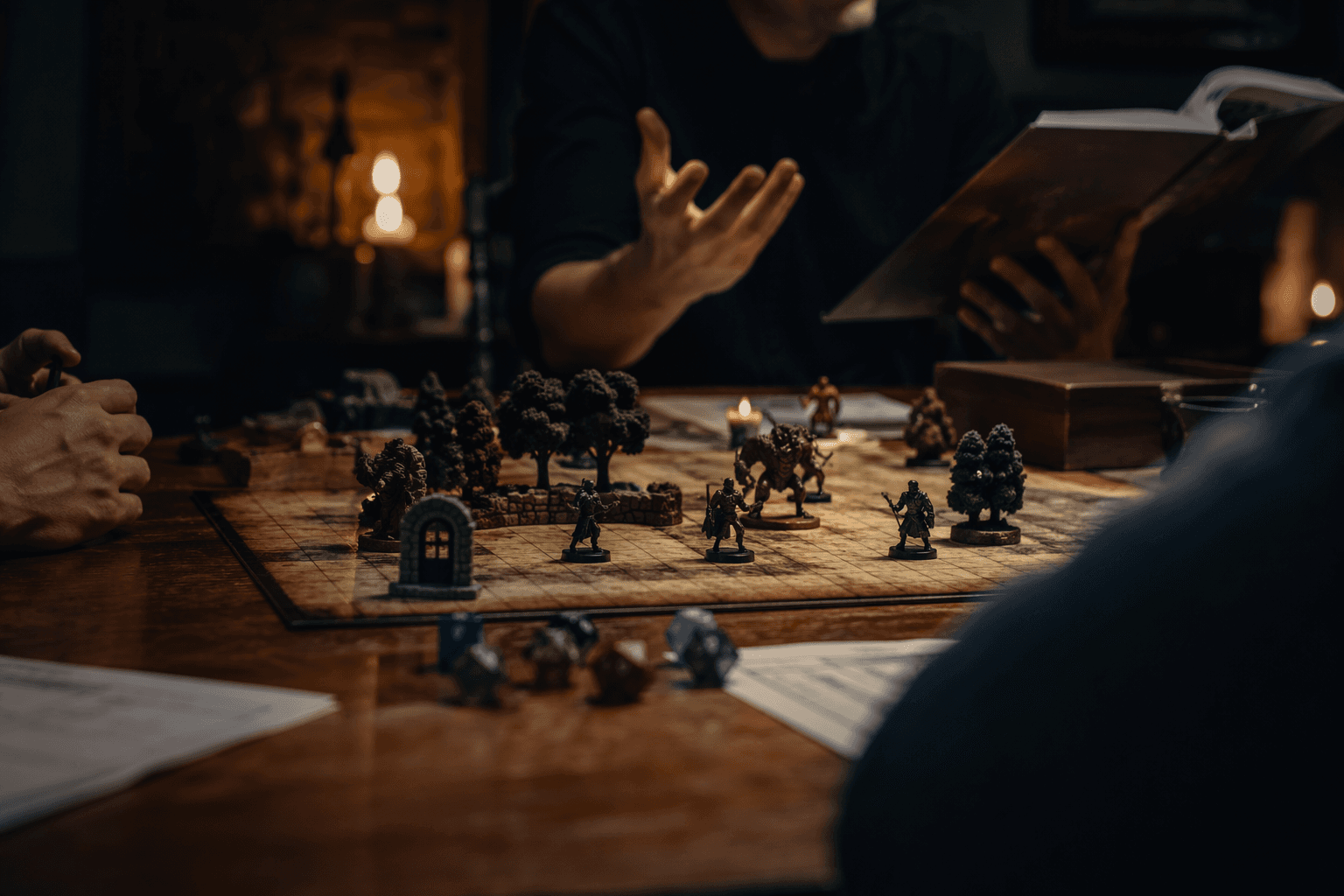
For modern players, this is the moment that explains dungeon crawls. The earliest D&D was built around exploring danger room by room, not around a fixed battlefield or a scripted novel. The party dynamic, the referee’s judgment, and the slow accumulation of treasure and experience all grew out of that bare-bones box.
Why the rough edges helped the hobby grow
The early game looked homemade because it was homemade, and that gave it room to spread. It moved through conventions, fanzines, and a national network of players who tried the rules, bent them, argued over them, and improved them in public. That kind of feedback loop is hard to replicate in a sealed product, but D&D had it from the beginning.
That is also why the game became more than a set of mechanics. It was a conversation between creators and fans, one that kept changing the ruleset while the hobby was still young. The Strong National Museum of Play has described the 1970s version as a new form built when Gygax and Arneson added role-playing to the strategy games they already loved, and that is exactly how it played out at the table: the map mattered, but the people around it mattered more.
The rules had a predecessor, but the experience was new
D&D did not appear out of nowhere. Britannica identifies Gygax’s 1971 game *Chainmail* as an important precursor, and that makes sense if you look at how the hobby was evolving. *Chainmail* belonged to the miniature-war-game tradition, where units, tactics, and positioning ruled the day.
D&D took that machinery and pointed it at a different fantasy. Instead of commanding a formation, you inhabited one character. Instead of a one-off match, you carried the same hero from session to session, letting experience points and advancement turn a skirmish game into a long-running campaign. That is the reason the game feels more personal now than a standard strategy game ever could. You are not replacing pieces on a board. You are keeping one person alive long enough to matter.

The authorship fight showed how important the invention became
Once D&D took off, the question of who owned it got messy. In 1979, Arneson sued TSR and Gygax over royalties and credit, a sign that the game’s success had already outgrown the tidy origin story people like to tell. The dispute was settled out of court on March 6, 1981, and after that Arneson received royalties on *Advanced Dungeons & Dragons* and was credited as co-creator on later D&D products.
That legal fight matters because it shows how quickly a basement experiment became an institution. People do not fight over royalties from a pastime that never escaped the garage. They fight over something that has become culturally valuable, and D&D had already crossed that line by the early 1980s.
The legacy is now part of the game’s identity
The hobby that began with three booklets and a referee’s imagination is now treated as cultural history. The Strong National Museum of Play inducted Dungeons & Dragons into the Toy Hall of Fame in 2016, and on September 21, 2024, it opened *Dungeons & Dragons: 50 Years of Storytelling*. That is a long way from Lake Geneva, but the through line is still the same: a group of players deciding that the most interesting thing at the table is not the battle itself, but the character who survives it, changes because of it, and comes back for the next session.
That is the real origin story. D&D did not simply add dragons to war games. It changed the job of the player, from moving units to inhabiting a hero, and every dungeon crawl, every campaign journal, and every hard-won roll at the table still traces back to that February 1973 meeting in Wisconsin.
This article was produced by Prism’s automated news system from verified source data, official records, and press releases, then run through automated quality and moderation checks before publishing. The system is built and supervised by the people who set the standards it runs under. Read our full AI policy.
Did this article answer your question?

