How to Run a D&D Campaign Where Monsters Are the Heroes
Five monsters escaping a dead wizard's lair is the freshest party premise in D&D right now, and you don't need heavy homebrew to run it.
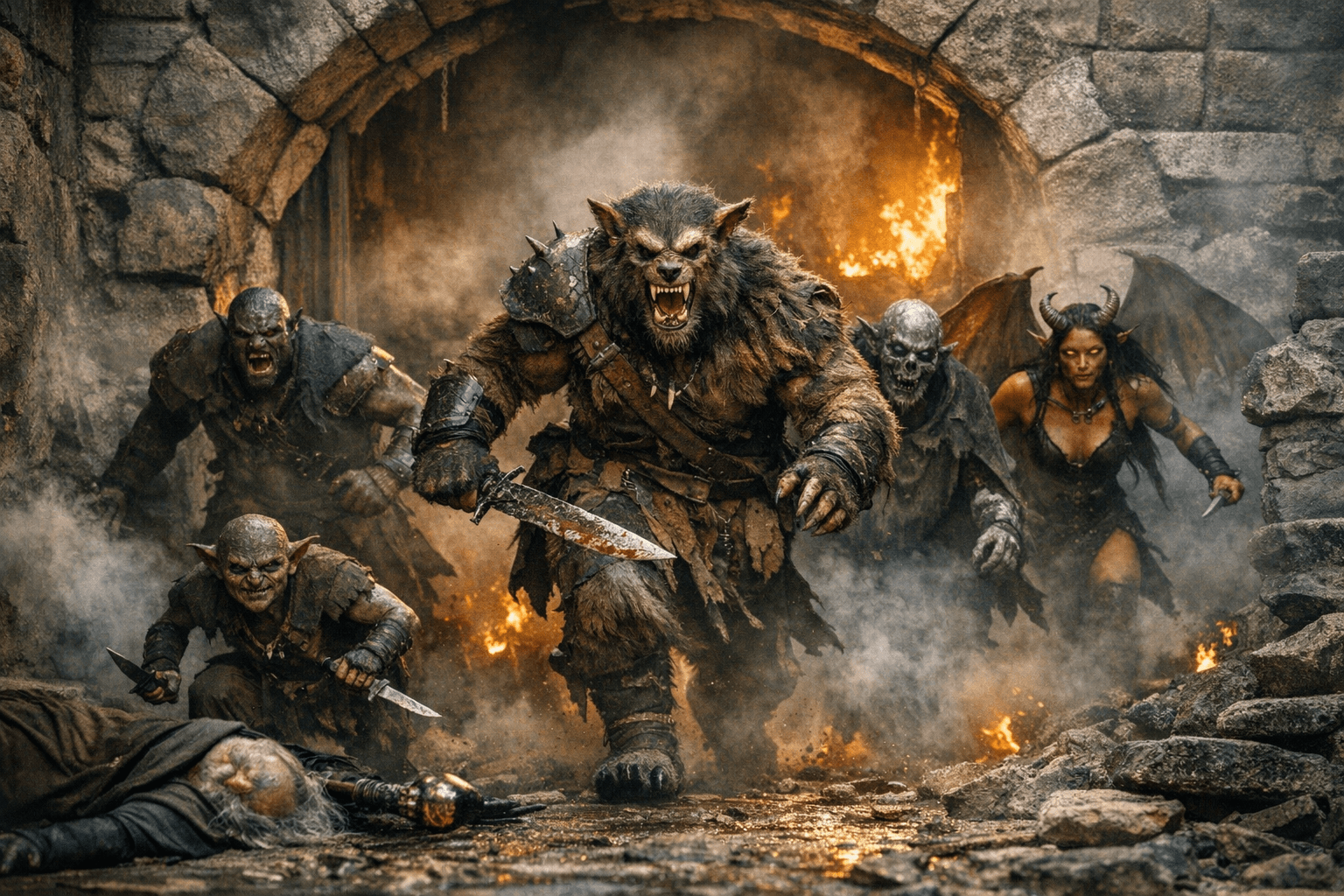
The wizard Custos is dead. His lair is being looted. And five creatures he enthralled in life, a lycanthrope, a gelatinous cube, a mind flayer, a death knight, and a baby beholder, have exactly one shot at freedom before adventurers cut them down on sight. That's the premise driving Christopher Hastings' *Dungeons & Dragons: Total Party Killers*, the upcoming four-issue Dark Horse miniseries illustrated by Denis Medri that drops summer 2026. It's also, stripped to its bones, one of the most DM-ready campaign premises in recent memory: a shared origin, a clear antagonist structure, and an instant reason for wildly incompatible creatures to cooperate. You don't need the comic to use the template. Here's how to build it at your own table without drowning in homebrew.
Set Tone Before You Touch a Statblock
The single biggest mistake DMs make with monster parties is jumping straight into mechanical conversion before deciding what kind of story they're telling. A gelatinous cube as a tragic antihero in a horror survival campaign requires completely different rules than that same cube played for absurdist comedy. Tone governs everything downstream: how much you preserve monstrous immunities, what moral stakes you introduce, and whether a mind flayer's psychic abilities are a tool of villainy the party must reckon with or a utility power everyone takes for granted.
The *Total Party Killers* premise leans deliberately comedic, with Hastings known for his work on *The Unbelievable Gwenpool* and the satirical webcomic *The Adventures of Dr. McNinja*. That tone choice means the lair-defense premise plays as heist comedy rather than ethical horror. At your table, "enthralled by a dead wizard" can pivot toward tragedy (the monsters are grieving, or have developed Stockholm-syndrome loyalty), toward horror (the enthrallment left psychological scars that manifest mechanically), or toward pure tactical fun. Pick one and anchor your Session 0 conversation there.
Session Zero: The Three Agreements That Prevent Collapse
Monster party campaigns collapse in predictable ways. The three most common: players drift toward "murder everything" because their characters have no social stakes, mechanical imbalance creates resentment when one monster dominates every encounter, and the group can't agree on what "evil roleplay" is acceptable at the table. All three are Session 0 problems with Session 0 solutions.
First, establish a shared party goal explicit enough that it shapes every session. The *Total Party Killers* structure is almost perfectly engineered here: "win our freedom in a hostile world" is a goal specific enough to generate decisions but flexible enough to accommodate any encounter type. Write that goal on an index card and put it where everyone can see it. When someone tries to murder a villager for their rations, the table has a referent: does this serve the goal, or does it blow up the only lead you have on breaking the enthrallment?
Second, set mechanical limits on iconic abilities up front. Decide in Session 0 whether the mind flayer can mind blast the other PCs, whether the lycanthrope can infect party members, and whether the death knight's aura affects allies. Converting those abilities into short-term resources rather than always-on effects, a mind blast that requires a recharge roll or a petrify that costs a ritual action, gives players agency and prevents the table from grinding to a halt every time someone uses a signature move.
Third, use safety tools. The X-card and Lines and Veils are especially relevant here because monster parties naturally produce scenarios involving predation, consumption, and coercion. Agreeing in advance on what's off the table lets players lean into the discomfort that makes these campaigns memorable without crossing into genuine distress.
Monster Archetypes as Character Classes
There are two clean mechanical approaches, and the choice depends entirely on your table's tolerance for crunch.
The first is class conversion: build each monster as a custom racial template grafted onto a standard class chassis. A mind flayer built as a Warlock with a custom Illithid Heritage background retains tentacles and psychic abilities while leveling up on a familiar progression track. A lycanthrope works well as a Barbarian subclass where the Rage feature becomes the lycanthropic transformation, gated by a moon-cycle resource. This approach preserves the familiar feel of D&D advancement but requires careful balancing of resistances and immunities, because stacking monster immunities on top of class features breaks action economy fast.
The second approach keeps the monster statblock intact and designs a growth-tier system instead of class levels. At each tier, players unlock new options: a gelatinous cube might gain the ability to selectively filter objects it has engulfed, choose a lair-action variant, or develop a "crystallization" feature that lets it harden temporarily as a defense. This preserves monster identity more faithfully but demands that the DM create meaningful choices at each tier rather than defaulting to "+1 to attacks." The *Total Party Killers* model suggests a hybrid often lands best: retain two or three signature traits as non-negotiable identity markers and scale everything else to the party's effective level.
The First Three Encounters: Building Party Identity
The first encounter should be designed to fail socially. Put the party in a situation where their default approach, violence or intimidation, produces a result that undermines the shared goal. A village militia that retreats and alerts the local lord, a merchant whose wagon they need who dies before giving them information, or a rival adventuring party that escapes to spread word of "a monster gang operating in the Forgotten Realms." This establishes early that murderhobo drift has real costs in this campaign.
The second encounter should reward creative use of monster traits for non-combat problem solving. The gelatinous cube is an exceptional environmental sensor: it can ooze under a door and "taste" the composition of what's on the other side. The mind flayer can extract information from a prisoner without leaving a mark. The death knight's presence can cow undead that would otherwise require a pitched battle. Build a scenario explicitly designed so that the clever application of monster abilities produces a better outcome than fighting, and your players will start thinking about their characters differently.
The third encounter is the first true test of party cohesion under pressure. Introduce competing motivations: the lycanthrope scents prey and must make a resource check to stay in control; the mind flayer identifies a creature whose memories would be tactically valuable but extracting them is lethal; the baby beholder wants to flee the moment things go sideways. Design this encounter so the party's ability to manage those tensions, not their combat power, determines the outcome.
Surviving a Humanoid World
The social friction of moving through cities, negotiating with merchants, and building faction relationships is where monster party campaigns earn their texture. Most humanoid societies in the Forgotten Realms kill mind flayers on sight. Build that into the game as a resource problem rather than a narrative wall: the party needs disguise magic, allied NPCs willing to run interference, or leverage over figures who know their secret. The cost of maintaining that social camouflage, the time, the gold, the favors owed, becomes a campaign resource as meaningful as hit points.
Design NPCs who see through the disguise and don't immediately reach for weapons. A fence who deals in cursed objects, a wizard who studies aberrations, a thieves' guild that cares only about competence: these figures give the party a foothold in humanoid society without erasing the tension of what the monsters actually are. When the gelatinous cube's cover is blown in a crowded tavern, the fallout should be specific and consequential, not an automatic combat encounter.
Loot, Gear, and the Action Economy Problem
Conventional loot tables break immediately in monster parties. A mind flayer doesn't equip a +2 longsword. A gelatinous cube cannot wear boots of speed. Solve this by redesigning treasure to reward monster-specific progression: a preserved brain in a jar that grants the mind flayer a bonus memory-extraction use, a lycanthrope-specific amulet that extends the window of controlled transformation, a crystalline lens that gives the baby beholder an extra eye ray per short rest. Tying loot to character identity keeps every player invested in what drops from an encounter.
On action economy: monsters built for solo encounters become either dominant or useless in a party context because their abilities weren't designed around party synergy. Lair-based environmental modifiers, advantages and vulnerabilities tied to terrain rather than flat immunities, help calibrate this. A mind flayer in a cramped underground corridor is genuinely terrifying; the same mind flayer in an open field is much less so. Designing encounters with terrain that benefits or penalizes specific party members keeps combat dynamic without requiring per-ability house rulings after every session.
Treat your monster party rules as a living document. The most successful DMs running these campaigns iterate between sessions, adjusting resource systems and tier-progression choices based on what's actually fun at the table. The premise doesn't need to be perfect from Session 1; it needs to be honest, specific, and grounded in a goal all five monsters, or all five players, actually care about.
This article was produced by Prism’s automated news system from verified source data, official records, and press releases, then run through automated quality and moderation checks before publishing. The system is built and supervised by the people who set the standards it runs under. Read our full AI policy.
Did this article answer your question?