Percy the Harris's hawk spotlights summer Hawk Walks at Bird of Prey Project
Percy, a fast-thinking Harris’s hawk, turns a summer Hawk Walk into a lesson in training, trust and the real work behind falconry.

Percy does more than front a seasonal spotlight at The Bird of Prey Project. As the centre’s June Bird of the Month, the Harris’s hawk becomes a working example of what falconry asks of both bird and handler: intelligence, stamina, and a relationship built on daily repetition rather than novelty.
Percy as a working bird
Percy was named June Bird of the Month on 23 June 2026, and the project describes him as very intelligent, fast, and the sort of hawk that keeps his handlers on their toes. He has also been flying especially well through the spring, which matters because a bird like Percy is never just a display piece. In a Hawk Walk setting, that kind of consistency tells you as much about the quality of the training as it does about the bird’s temperament.
That is where Percy becomes useful to anyone who knows falconry. He is a reminder that a good hawk is not simply obedient or impressive on cue. He is a partner with a distinct style, one that shows up in the air, on the glove, and in the tiny adjustments handlers make from one session to the next.
Why Harris’s hawks fit the work
Percy’s species explains a lot of why he fits so naturally into public flying work. The Bird of Prey Project describes Harris’s hawks as highly adaptable birds that can thrive in both deserts and the edges of rainforests. That flexibility helps explain why they have become such a familiar sight in Hawk Walk-style experiences and educational flying sessions.
Their behavior in the wild also sets them apart. Audubon describes Harris’s hawks as more sociable than most raptors and notes that they can hunt in groups. Animal Diversity Web adds that they may practice cooperative breeding, with several birds helping with nest building, incubation, feeding, and defense. For falconers, that social intelligence is part of the appeal: it is a species that can work closely with people without losing the sharpness that makes a raptor a raptor.
The Bird of Prey Project’s handling style
Percy’s public role sits inside a larger method at The Bird of Prey Project, which presents itself as a multi-award-winning visitor attraction and registered charity in Bath, Somerset. The centre houses 24 resident birds of prey and owls, runs multiple conservation programmes, and maintains an accredited Rehabilitation Hospital. It also says it works with its birds using consent-based, high-trust behaviours, a phrase that matters because it points to a modern handling approach built on cooperation rather than force.
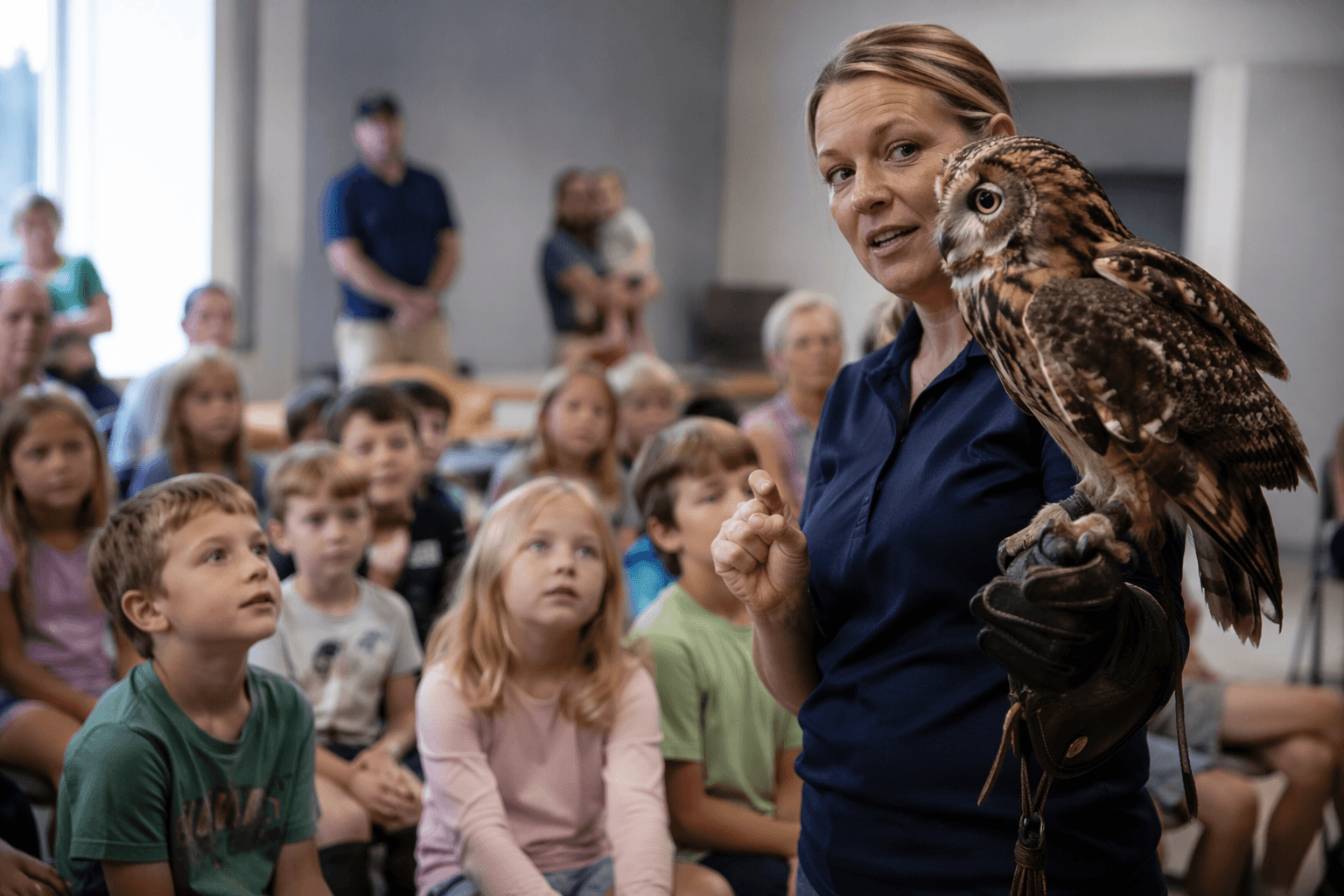
That approach is part of why Percy can be both a star and a teacher. He helps visitors understand that falconry is not a costume exercise or a casual photo opportunity. It is animal management, conditioning, and reading the bird in front of you, day after day, until the partnership becomes reliable enough for public flying and educational work.
What a Hawk Walk supports
Percy is also being used to pull people into the project’s summer Hawk Walks, and the centre makes the conservation link plain. It says 100% of visit proceeds support its conservation, research, and welfare work. It also says one Hawk Walk pays for one nest box for local amber-listed species as part of its cavity-nesting species programme.
That gives the experience a second layer. A Hawk Walk is not only a chance to watch Percy work at close range, it also funds practical habitat support for local wildlife. In a field where public fascination can easily stop at spectacle, that connection keeps the walk tied to the broader responsibility falconry culture has always carried toward birds and land.
Falconry in a changing conservation climate
The wider policy backdrop makes that responsibility even clearer. The British Falconers’ Club defines falconry as the traditional art of hunting quarry in its natural state and habitat by means of trained hawks. At the same time, Natural England and Defra have adopted a presumption against issuing new licences to take wild birds of prey from the wild for falconry and aviculture in England, after a review that began in early 2022 and concluded with an outcome published on 6 March 2025.
That shift reflects conservation concerns around wild take, and it places greater emphasis on the birds already in managed care, the standards around their handling, and the educational role of centres like The Bird of Prey Project. Percy fits squarely into that moment: a bird whose public visibility depends on trust, training, and the care structure around him.
Planning a visit
The Bird of Prey Project is based at The Grain Store, Workshop Lane, Newton St Loe, Bath BA2 9BT. It is open Wednesday to Sunday from 10am to 4pm, and every day in the school holidays. Visitors can see over 20 species of birds of prey and owls, meet keepers, and watch a free-flight display.
- School trips are available for groups of up to 60 children.
- Children’s wildlife workshops are offered for ages 6 to 11.
- Hawk Walk bookings directly support the charity’s work.
Percy makes the point the best hawks always make: the appeal is not only in the sight of the bird in flight, but in the discipline that gets him there. A summer Hawk Walk with a Harris’s hawk like Percy shows the craft in motion, and it shows why falconry still rests on the same thing it always has, the careful bond between handler and bird.
This article was produced by Prism’s automated news system from verified source data, official records, and press releases, then run through automated quality and moderation checks before publishing. The system is built and supervised by the people who set the standards it runs under. Read our full AI policy.
Did this article answer your question?