Adam Bennetts rides Bordeaux’s tidal bore on foil for endless glide
Adam Bennetts turns Bordeaux’s tidal bore into an almost endless foil run, showing how Le Mascaret rewards pumping, balance, and timing over ordinary surf chops.
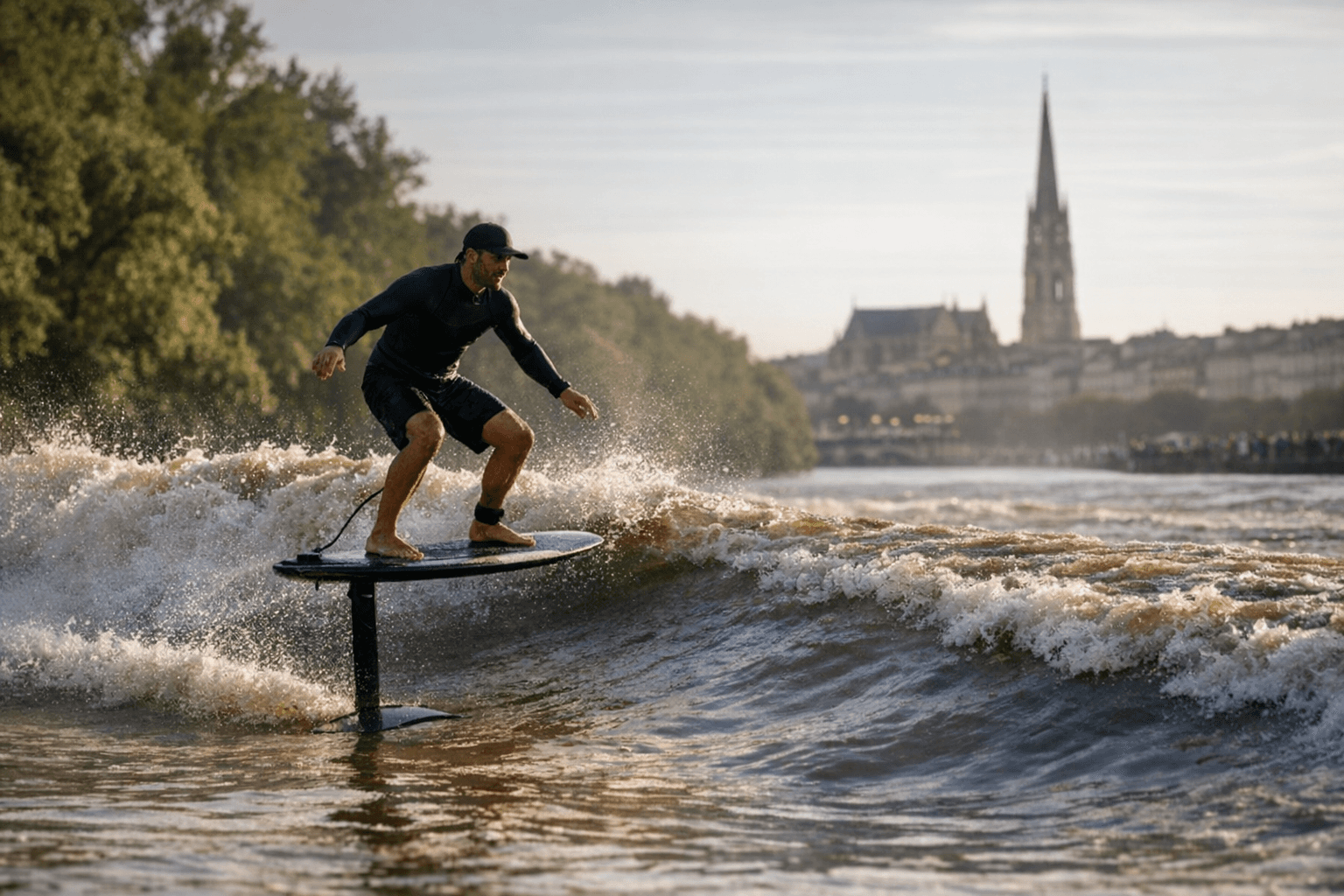
Le Mascaret turns river energy into a foil runway
Adam Bennetts does not treat Bordeaux’s tidal bore like a normal wave. On Le Mascaret, he rides the moving wall of water as a long, living conveyor belt of lift, staying in the pocket as the river keeps feeding him speed. That is exactly why tidal bores feel so different on foil: the ride is not about a single peak and fade, but about linking energy across a moving line that can keep going well beyond what a standard surfboard can hold.
A tidal bore, in the Britannica sense, is the leading edge of an incoming tide that forms a wave and pushes up a river or narrow bay against the current. In a confined channel, that wave can keep traveling, and for a foiler that opens the door to something rare in surfing: a ride that can stay playful, efficient, and extended if the rider can pump cleanly and keep the board settled on foil. Bennetts’ clip makes that look almost effortless, but the real story is the setup itself, not just the stunt.
Why tidal bores are such a foil-surfing sweet spot
Foils are built for exactly the sort of energy a bore supplies. Instead of relying only on the shape of an open-ocean wave, a foil rider can convert the river’s push, current, and moving lift into forward glide, then use pumping to stitch together speed when the line softens. That means a bore rewards rhythm, timing, and balance more than brute force, and it can turn a short-lived river wave into a long run that feels closer to flight than surfing.
That is also why the setting matters so much. A conventional surfboard would have a harder time holding position and maintaining speed on the same feature, especially as the bore shifts and the channel changes beneath it. Foil surfing, by contrast, lets a rider stay light on the water and take advantage of hidden energy that is invisible until the tide arrives in force.
What makes Le Mascaret in Bordeaux special
Le Mascaret is one of the few tidal bores in the world, and the Garonne River is one of the rare rivers that actually produces one. Tourism guidance says the best season to see it runs from June to October, with local Bordeaux-area information pointing to August and September as especially good at Macau when the water is low but the current remains strong. The bore depends on a combination of large tidal coefficients, river narrowing, and low river levels, which is why it can feel both predictable on paper and fickle in the real world.
The geography gives the phenomenon its scale. Britannica places Bordeaux about 60 miles from the Garonne’s mouth and says the river is roughly 1,800 feet wide there. The same source notes that about 34 miles above Bordeaux, the river passes through Castets, its highest tidal point. Other local references say surfers and jet skiers have ridden the bore at least as far as Cambes, about 120 kilometers from the Atlantic, and sometimes even farther upstream toward Cadillac-sur-Garonne.
That distance is what makes Le Mascaret so compelling on foil. The wave is not just breaking in place; it is traveling upriver, drawing riders into a moving corridor of energy that can last long enough to feel like a session inside a session.
Where the crowd gathers and why it matters
Saint-Pardon in Vayres is widely described as the best-known surf spot for the tidal bore, and Margaux Médoc Tourisme calls it the star of the bore, prized by surfers from around the world. That shared lineup is part of the appeal. Le Mascaret is not only a foil playground; it is a communal wave where surfers, kayakers, and other wave-riding craft all try to match the tide and make the most of one of the few moving-water events that can draw a crowd on command.
Surfer framed Le Mascaret as a kind of “party wave,” and that description fits the atmosphere as much as the ride. In 2024, crowds were still piling onto the wave along the Dordogne River, which underlines how the bore functions as both a sporting event and a shared local spectacle. The point is not just that people are watching. It is that the whole session feels like a temporary migration of energy through the river system.
Why Adam Bennetts is the right rider for the job
Bennetts brings the exact background this kind of session rewards. Fliteboard describes him as a professional foiler from Australia’s Gold Coast with a surf background and a deep passion for eFoiling, while the World Surf League profile lists his birth date as June 12, 1987. That mix of surf instincts and foil control matters on a bore, where the rider has to read subtle changes in flow, stay composed through chop, and keep generating lift without wasting a single movement.
His approach in France makes the session feel bigger than one clip. He is not simply chasing a novelty wave; he is showing how a skilled foiler can use an unusual river feature to stretch a ride, stay in rhythm, and turn a rare tide event into a high-skill glide. For readers tracking where the sport is headed, that is the real development: foiling is no longer tied to reefs, points, or beach breaks. It is expanding into river bores, estuaries, and any terrain where moving water can be converted into rideable speed.
How to read a bore like Le Mascaret
The practical lesson from Bordeaux is that bore-riding starts long before the wave shows up. Tide tables, tidal coefficients, river shape, and water level all matter, and the strongest displays usually come when the tide is large enough to push a clean, defined wall upstream. One Gironde guide says the bore can still exist at coefficients as low as 80, but bigger coefficients generally produce stronger, more usable waves.
That makes the session part forecast, part patience, part timing puzzle. The bore can be visible only when several conditions line up, which is why it retains a sense of rarity even in a place that knows it well. A guide for Libournais says there are only around 60 places on the planet where a tidal bore can be witnessed, and that scarcity is a big reason riders treat Le Mascaret as something special rather than just another surfable river feature.
What Le Mascaret says about the future of foil surfing
Adam Bennetts’ Bordeaux run is more than a standout clip. It is a reminder that foil surfing keeps widening the map of what counts as a wave. In a place best known for wine, the river can suddenly deliver an almost endless line of lift, and a rider with the right timing can turn that into one of the longest, loosest, most playful rides in the sport.
That is the promise of tidal bores for foilers: not just novelty, but possibility. Le Mascaret shows that when current, tide, and channel all line up, the ocean is no longer the only place where a surfer can chase flow, speed, and glide.
Know something we missed? Have a correction or additional information?
Submit a Tip