BlueCape Launches South Africa's First eFoiling Instructor Course in Hout Bay
South Africa now has its first formal eFoiling instructor course, launched in Hout Bay by BlueCape to close a safety gap that's left charter guests learning from crews who've never been taught how to teach.
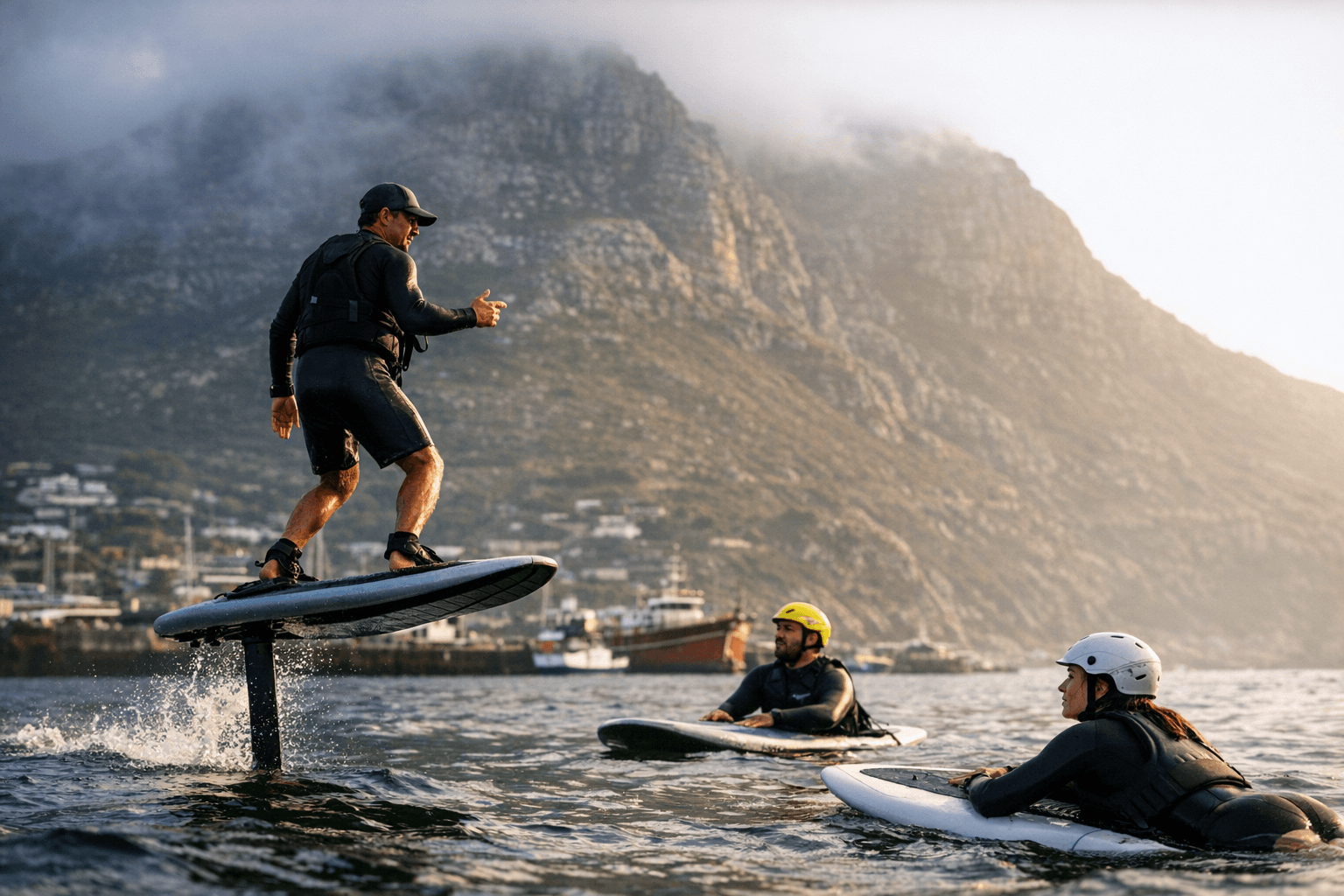
If you've been handed an eFoil off the back of a charter boat in Cape Town and left to figure it out with a grinning deckhand pointing at the trigger, BlueCape's new instructor certification just changed the equation. The non-profit maritime training group launched South Africa's first dedicated eFoiling instructor course in Hout Bay in early April, creating the country's first formal pathway for crews to learn how to actually teach the discipline rather than simply supervise it.
The course targets deckhands, maritime academy students, and existing watersports instructors: precisely the people who've been handed eFoils by superyacht and charter operators and expected to run sessions without structured training. BlueCape co-founder Bruce Tedder, a former superyacht captain and current Chairman of the South African Boatbuilders Export Council, identified the gap plainly. Crews across the charter fleet can ferry and store eFoils, but very few have been trained to instruct guests safely or progressively. Adapting existing eFoil teaching curricula, BlueCape built an instructor module around three pillars: practical on-water skills, equipment care covering battery and propulsion maintenance, and professional teaching methodology.
At the Hout Bay launch, Tedder himself stepped onto an eFoil and played the reluctant charter guest, working through a beginner's progression in front of course participants to demonstrate exactly what the training is designed to replicate. It's the kind of live proof-of-concept that makes pedagogy credible rather than theoretical.
What the publicly available course details do not yet specify are exact on-water hours, structured rescue modules, or minimum assessment thresholds required to pass. That matters when measuring BlueCape's qualification against established international instructor pathways. The IKO kiteboarding instructor route requires a minimum five-day training course with rescue competence assessed as a standalone element. The RYA powerboat instructor pathway demands documented supervised teaching time before candidates can qualify independently. Those benchmarks provide a useful frame: BlueCape's course enters a space that has no dedicated global governing body, since neither IKO, RYA, nor any equivalent organization currently certifies eFoil instructors specifically.
That absence cuts both ways. BlueCape is building something real where no standard yet exists, which is worth recognizing. It also means that until a recognized maritime or watersports authority formally audits the curriculum, the qualification's portability across insurers and international employers remains an open question. If BlueCape secures that kind of external endorsement, the model becomes exportable to other major charter hubs in the Mediterranean, the Caribbean, and Southeast Asia.
For riders in the Western Cape booking eFoil sessions this season, the practical question is how to tell a BlueCape-certified instructor from someone who learned by trial and error on a superyacht's stern platform. Ask directly whether they completed the BlueCape program. Ask how they would respond to a battery failure or propulsion issue mid-session — equipment maintenance is a core module, so a trained instructor should answer without hesitation. Confirm that the session begins with a structured safety briefing before you're in the water, not after. And ask for a clear progression plan from kneeling to riding before standing is ever on the table. A confident, specific answer to each of those questions is the clearest signal that the person handing you that trigger has actually been taught how to teach.
Know something we missed? Have a correction or additional information?
Submit a Tip