DIY Builders on FOIL.zone Are Pushing Efoil Innovation Forward Fast
FOIL.zone logged dozens of technical threads in 72 hours as DIY builders openly shared STL files, VESC profiles, and 21700 battery schematics for building efoils at home.
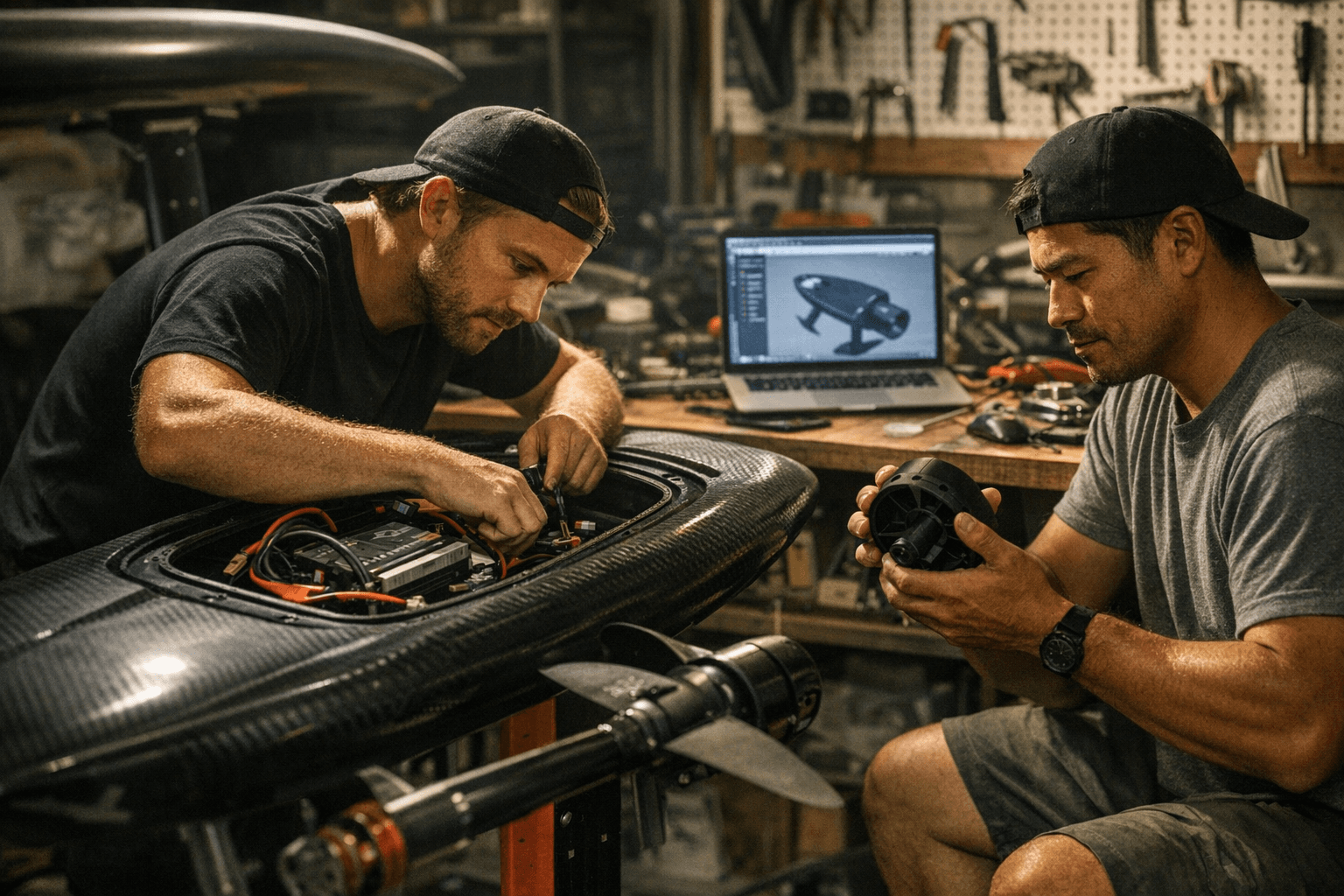
Three technical clusters drove an unusual surge on FOIL.zone between April 3 and 6, 2026: ESC configuration for VESC-based controllers, 3D-printed propeller geometry, and lithium cell pack design. The convergence of activity across those four days points to where a large portion of the sport's low-cost hardware innovation is actually happening, well away from factory announcements and press releases.
The electronics category saw the sharpest engagement. A thread titled "75200 VESC settings with 6384 motor help/advice," posted April 5, drew detailed discussion around the Flipsky 75200 VESC paired with the Flipsky 6384 waterproof motor and a 12s3p battery capable of pulling 135 amps. That pairing has become a de-facto starting point in the DIY community: the 6384 runs a rated 2,800W, peaks at 4,400W, and draws up to 88A at maximum, all at a price point that undercuts commercial pod systems significantly. The VESC's open-source firmware, originally developed by Benjamin Vedder under a Creative Commons Attribution-ShareAlike license, allows builders to set absolute maximum current values, field-weakening parameters, and throttle curves that commercial eFoils ship locked. The thread included telemetry screen captures showing current and voltage spikes under load, which is exactly why getting absolute maximum current thresholds right is treated as non-negotiable before any water session. Flipsky's own documentation recommends the 75200 board run between 250A and 400A absolute maximum, and builders arriving from VESC's default auto-setup routinely discover those values have been auto-reduced to levels that trigger ABS alarms at full throttle.
Propeller design generated equally dense discussion. On April 4, a thread titled "DIY full carbon mast & blue carbon fiber wings from 3d printed molds ! (free for efoil builders)" dropped free CAD and STL files into the community without charge. Separate Prop & Duct category threads on April 4 through 6 show builders iterating on blade count, pitch, and diameter to shift the motor's peak efficiency band toward earlier foil-out speeds. Three-bladed folding designs appeared repeatedly, with specific geometry shared as printable files. The limitation builders flag most consistently is material selection: FDM-printed props in standard PLA or PETG carry real cavitation and delamination risk at the RPM ranges a 6384 motor produces. Carbon-fiber-reinforced filament is the emerging middle ground, but the community's prevailing position treats printed props as developmental hardware, not production-ready components. Test in controlled conditions, log telemetry, and verify geometry before trusting a printed blade at speed.
Battery architecture was the third major cluster. Posts across April 3 to 6 cited 21700-cell layouts in 12s3p configurations, with builders attaching voltage-sag telemetry logs as evidence of pack behavior under sustained load. The 21700 format has largely replaced 18650 cells in newer DIY builds because of higher energy density and current delivery. Waterproof enclosure integrity and a properly calibrated BMS are the two elements the most experienced contributors treat as genuinely non-negotiable, with connector choice, particularly around anti-spark options for high-amp applications, appearing as a recurring sub-topic in nearly every battery thread.
The most telling pattern across those four days is the iterative cycle itself. Builders who opened a prop geometry thread on April 4 were posting VESC tuning questions by April 5, then following up with mast or fuselage CAD questions shortly after. A thread titled "Building an Efoil From Scratch (Need Help)" attracted experienced contributors offering structured part lists alongside frank cautions about common first-build failure points. The forum's Build, Repair & Mod and Electronics categories logged dozens of posts with downloadable attachments, including CAD snippets, STL references, and motor telemetry files.
For brands monitoring community sentiment, the specificity of those failure points carries as much signal as the builds themselves. Repeated requests for cleaner motor-swap procedures and more robust mast-plate mounting designs identify exactly where commercial products still fall short of what active DIY builders consider baseline. The April 2026 surge on FOIL.zone is less a hobbyist moment than a rapid-fire product requirements document, and right now it is updating faster than any R&D calendar a manufacturer runs.
Know something we missed? Have a correction or additional information?
Submit a Tip