Starboard Unveils 2026 Foil Range With New Auto-Optimisation Process and Universal Connection System
Tiesda You called it a "leap" after water-testing Starboard's 2026 foils, built on America's Cup engineer Martin Fischer's 7000x Auto-Optimisation and an open-patent UCS connection standard.

Starboard founder Tiesda You admitted he "was skeptical" when America's Cup foil engineer Martin Fischer first explained the process. After getting on the water with the new shapes, he described being "blown away," adding: "The process not only works, but it's a leap. There will be a time before and after this milestone." That quote does a lot of work for the 2026 Starboard Foils range, which the company unveiled April 6 and is now rolling to dealers.
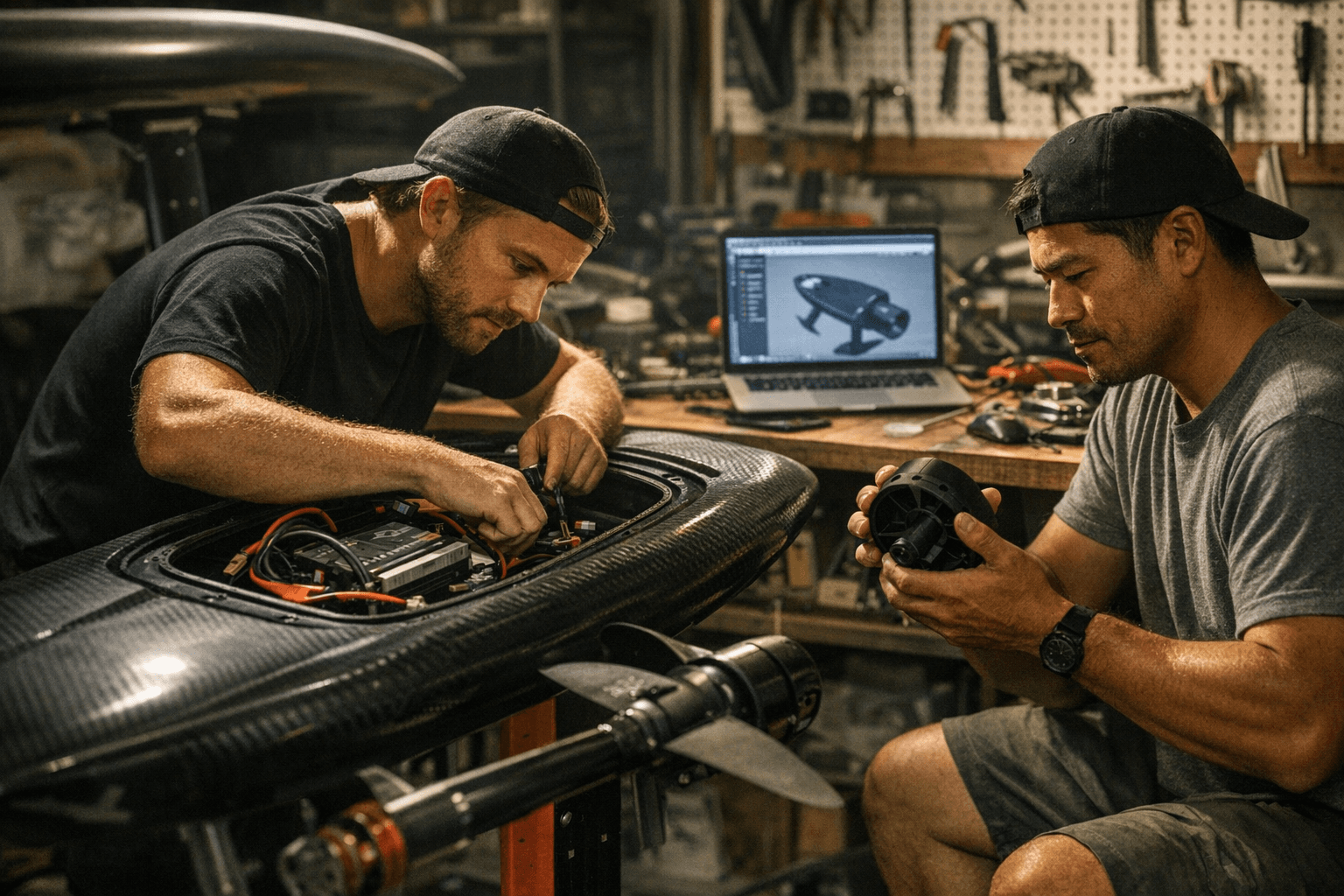
The engineering center of gravity is the 7000x Auto-Optimisation workflow, developed in partnership with Fischer, whose foil credentials run to the America's Cup. Rather than conventional CAD iteration, the process cycles through thousands of shape permutations across foil outlines and section profiles, producing what Starboard calls a step-change in lift-to-drag efficiency, control, and glide. Fischer's background is the reason to weigh that claim seriously: the optimisation resolution he applies is the same kind that separates America's Cup hardware from production gear.
The resulting range spans every discipline with specific intent. The Fusion family blends Benoit Carpentier's new surf-specific shapes, running 625 to 925, with progression-oriented sizes from 1100 to 2200. Glider 3 replaces the Glider 2 at 750, 900, and 1050 for long-glide downwind. New MF sizes of 640 and 580 push further into high-performance prone and downwind territory. The BC 155 Short tightens the turning radius for pocket-surf work, and the SLX 190 adds stability at race speeds.
The second major development is the UCS (Universal Connection System), and this is where Starboard's 2026 case parts ways from Armstrong, Axis, and Duotone most decisively. UCS connects mast to fuselage via two pairs of side-by-side bolts, aligned by a V-shape mating surface, with internal angle spacers and fuselage collars for precise wing-angle and fuselage-length tuning. Starboard filed it under an open patent, explicitly inviting other brands to adopt the spec, and promoting a "Works With UCS" logo for third-party components. The USB-C analogy is Starboard's own, and it's accurate.
That context makes the competitor landscape worth naming directly. Armstrong's A+ System uses full-width titanium barrel nuts and proprietary mast geometry: functional hardware, but a closed ecosystem with no open-adoption path. Axis runs its own closed interface. Duotone's 3BS connection requires a dedicated fuselage adapter for even partial Armstrong cross-compatibility. None of those three brands has framed their connection standard as something the broader industry should join. Starboard has, and backed it with the open-patent filing.

The future-proofing argument follows from that: if additional manufacturers adopt the UCS spec, a Starboard mast becomes a platform rather than a lock-in. Every subsequent "Works With UCS" wing adds value to hardware already in the garage.
For current Starboard owners on pre-UCS gear, a hybrid fuselage at a reduced rate lets you run UCS wings on older masts without a full system replacement. The upgrade path is real.
For riders currently on Armstrong or Axis weighing a move: the 7000x-optimised shapes make a performance argument that stands independently of the connectivity pitch. When the two reasons reinforce each other, the switching math is worth running.
Know something we missed? Have a correction or additional information?
Submit a Tip