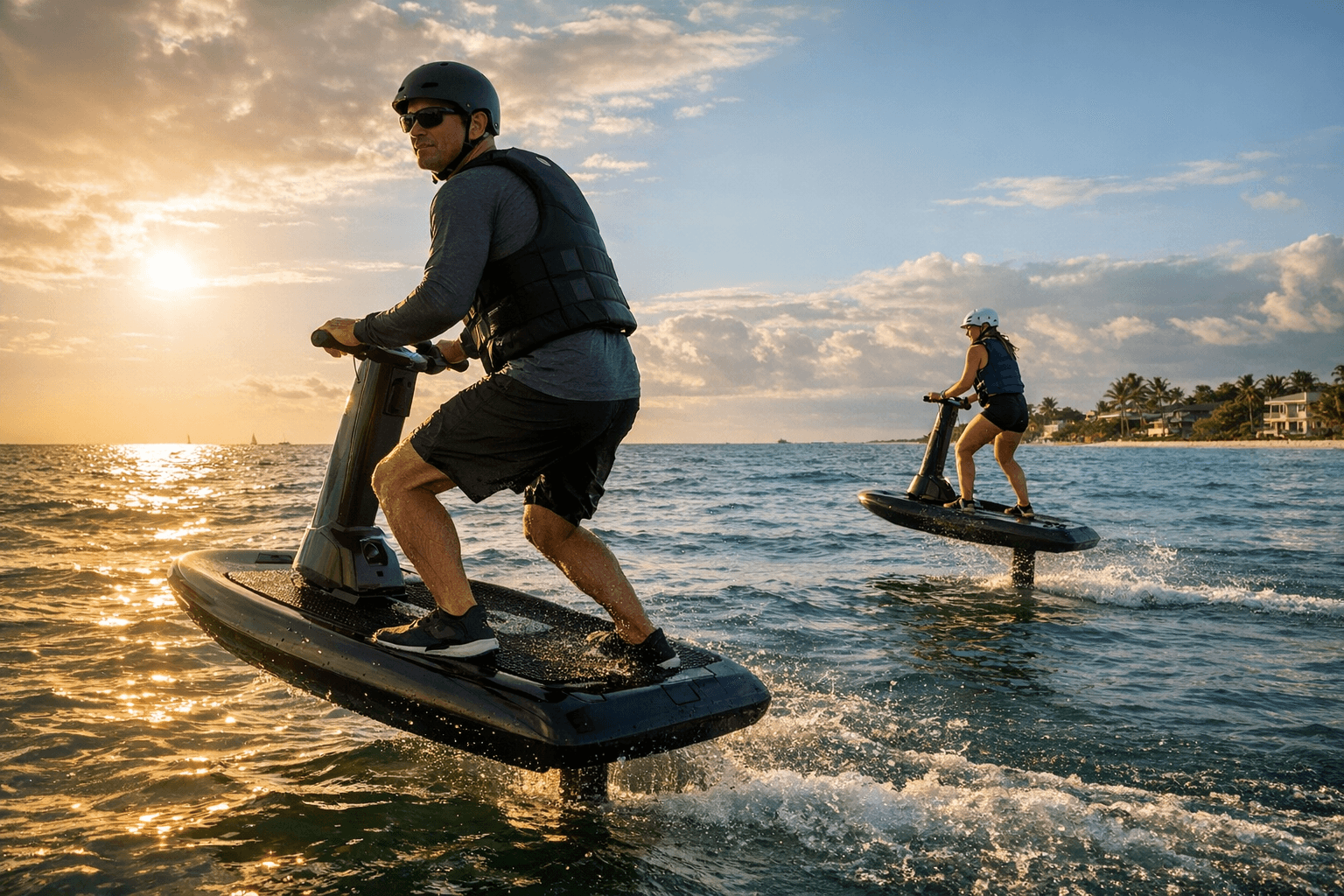
Evergreen guide: E‑foil buyer’s checklist — seven technical factors that decide the right electric hydrofoil
Seven specs separate happy eFoil owners from expensive regrets: battery Wh, real range, mast options, wing modularity, controller feel, charger speed, and warranty reach.

Buying an eFoil wrong costs you twice: once when you pay, and again every time the board sits in the garage because the range is too short, the dealer is three states away, or the battery format you bought has already been discontinued. The market now spans from the sub-€9,000 Flite Air to fully kitted performance rigs that push €15,000, and headline specs rarely tell you which one actually fits your life on the water. Seven technical factors separate the happy owners from the regretful ones. Work through them in order before you commit.
Motor and peak power: continuous is the number that matters
Every brand publishes a peak power figure. The number that governs your daily experience is continuous output, which is what the motor sustains during a real cruise rather than a momentary sprint. The Waydoo Flyer EVO Standard delivers up to 4,000W of output power and is rated for riders up to 90kg; that figure gives you a concrete benchmark to compare against. Beyond raw wattage, check the battery voltage architecture: 43V systems and 86V systems both exist in the market, and they behave differently in terms of torque delivery and how large the battery pack needs to be to store the same energy. Motor housings also split into enclosed and exposed designs. Enclosed pods reduce corrosion and cut drag; exposed motors are lighter and easier to service at home. Neither is universally better; rental operators tend to prefer enclosed for durability, while performance riders often favor exposed for weight savings and ease of propeller swaps.
Battery capacity and real range: Wh first, marketing copy second
Watt-hours (Wh) are the honest unit. Lift's Full Range Battery delivers up to 100 minutes of ride time and weighs 27.5 lbs (12.5 kg). The Lift Light Battery trades roughly 40 minutes of runtime for a 7-lb weight reduction, which matters enormously if you're portaging across a beach or flying with gear. Waydoo offers two Flyer EVO packs: a 1,800Wh option for agility and a 2,300Wh option for extended sessions. Fliteboard gives its customers even more granularity with three Flitecell tiers (Nano, Sport, and Explore), allowing riders to dial in the range vs. weight tradeoff. Crucially, depth-of-discharge policy affects usable capacity; a battery advertised at a given Wh rating may only deliver 80 to 85 percent of that in real use if the brand runs a conservative discharge curve to protect cell longevity. Ask the dealer for actual ride-time data at cruise speed, not just the ceiling figure. Charge speed matters equally: Lift's Full Range Battery charges in under two hours, which is the threshold below which back-to-back sessions in a single afternoon become realistic.
Flight control and stability systems: the hidden spec beginners overlook
Modern eFoils do significantly more than transfer motor power to the foil. Flight-assist algorithms now smooth take-off, manage flight height, and reduce the oscillation (pumping) that exhausts new riders. For beginners, built-in stability modes compress the learning curve dramatically. The SiFly Rider, for example, pairs a 110L foam soft-top deck with a 55cm mast and a large 1,900 cm² front wing for its entry configuration, a geometry that rewards stability over speed. When a rider's skills develop, upgrading to a 75cm mast and a smaller wing is straightforward on the same board. For advanced or race-oriented buyers, the ability to reduce or disable flight assistance is equally important since full computer control can mask the feel that experienced foilers rely on for carving. Confirm that firmware updates are available over the air or via a simple USB connection and check whether a brand's support team can push remote software fixes, because a flight controller issue should not require a factory return.
Foil design and modularity: one board, multiple disciplines
Wing shape is not a cosmetic choice. High-aspect wings generate more lift per unit of speed, suit flatwater cruising and downwinding, and allow lower cruise speeds; surf-oriented wings have a shorter span, feel looser, and hold through turns on a wave face the way a carved surfboard does. The best systems let you move between wing families on the same mast and fuselage. Lift offers front wings across a wide performance spectrum, ranging from $769 to $999 each, with rear stabilizers from $295 to $330, so a single board can genuinely cover beginner flatwater, intermediate carving, and surf sessions by swapping parts. Fliteboard's conical wing connection system is designed explicitly for forward compatibility, meaning wings bought today are expected to work with future FliteLAB non-powered foil products. If you ride in both flat reservoirs and ocean surf zones, modularity is not a luxury feature; it is the factor that determines whether you own one board or eventually buy two.
Build quality and service network: the spec that saves you money long-term
Carbon fiber mast quality, interface tolerances, and coating finish differ meaningfully between brands even when specs look similar on paper. A loose mast-to-fuselage connection adds flex that translates into unpredictable pitch response. Beyond build quality, geographic dealer density is the factor most buyers underestimate at purchase time. Fliteboard operates more than 350 dealer locations globally, which means most riders can reach a certified service center for a sea trial before buying and for parts replacement after. Warranty terms deserve equally close reading: understand what voids coverage (saltwater exposure, third-party parts, crash damage) and what the turnaround time is on motor or battery warranty claims. For remote-area owners and commercial operators, a brand with a thin service footprint is a compounding risk that grows every season.
Weight, volume, and travel logistics: the spec that hits at the airport
Total system weight determines whether an eFoil is something you take everywhere or something that lives at a single location. The Lift 3F weighs approximately 30 lbs (13.6 kg) with the Light Battery installed, which is manageable for most car-transport scenarios. Flying with lithium batteries, however, introduces airline Wh regulations that can restrict or prohibit the packs entirely depending on configuration and airline policy. Check whether the brand offers a three-piece breakdown mast, a packable travel bag with board padding, and battery cases designed for airline compliance. Volume, meanwhile, determines ease of pop-up on the water: a board should carry no more than 10 liters less volume than the rider's weight in kilograms as a rough rule for manageable learning, so a 90kg rider wants at least an 80L board. The SiFly Rider's 110L deck is explicitly designed with generous volume to reduce the physical effort of the learning phase.
Safety and kill-switch systems: non-negotiable redundancies
Every eFoil in 2026 should ship with a physical kill switch, an automatic remote timeout (motor stops if the controller signal drops), and documented procedures for falling away from the foil safely. Foil guards and propeller shrouds vary between brands and matter most in rental contexts where the skill range among users is wide. For commercial operators, demand written rider-brief templates and session protocols from the brand or dealer; insurers increasingly require documented safety procedures. The remote kill mechanism, whether wrist tether or proximity-based, should be tested in-water before any session, not assumed to work because the spec sheet says so.
The decision tree: screenshot this before you go to a dealer
- Rental or charter operation: Prioritize hot-swap or quick-charge batteries, enclosed motor, dense dealer network (Fliteboard's 350+ locations or Lift's certified center map), and written safety procedures. Battery turnaround under two hours is the threshold for back-to-back daily bookings.
- Recreational flatwater cruising: Match board volume to rider weight (at least within 10L), choose a high-aspect wing for efficiency, and confirm flight-assist modes are available. The Lift 3F and SiFly Rider both sit comfortably in this category. Budget €6,000 to €9,000.
- Surf-style carving: Prioritize an exposed motor (lighter, better pivot feel), a surf-oriented short-span wing, low overall board weight, and a modular system that lets you swap to different wing families as your style evolves.
- Frequent traveler: Confirm airline battery compliance before purchase, check for breakdown mast options and padded travel bags, and weight every major component individually rather than accepting a single "system weight" figure.
- High-performance or race: Look for selectable or disableable flight-assist, high-voltage architecture (86V for torque headroom), and a dealer with demo inventory so you can test top-speed feel before buying.
The single most expensive mistake in the eFoil market is optimizing for the spec printed largest on the product page: top speed. Real daily satisfaction tracks much more closely with charge time, service access, and whether the flight controller inspires confidence at the moment of take-off. The brands that consistently score well across all seven categories hold their residual value on the used market too, which means the buy-once-cry-once math eventually works in your favor.
Know something we missed? Have a correction or additional information?
Submit a Tip