Fliteboard and the Business of Making Foiling Feel Inevitable
How an Australian startup turned a complex water sport into a global product category by focusing on design, accessibility, and structured growth

Fliteboard is interesting for almost the opposite reason. Where Lift feels rooted in rider culture and technical obsession, Flite feels like the company that understood early that eFoiling would only grow if it became approachable, structured, and desirable to people outside the core scene.
The company was founded in 2016 by David Trewern, a serial entrepreneur and experienced kite surfer. The initial idea came from watching kitefoiling and asking a simple question. What if you could remove the dependency on wind. Within a year, Flite had moved from concept to prototype, and by 2017 it was already sharing early riding footage that generated global attention.
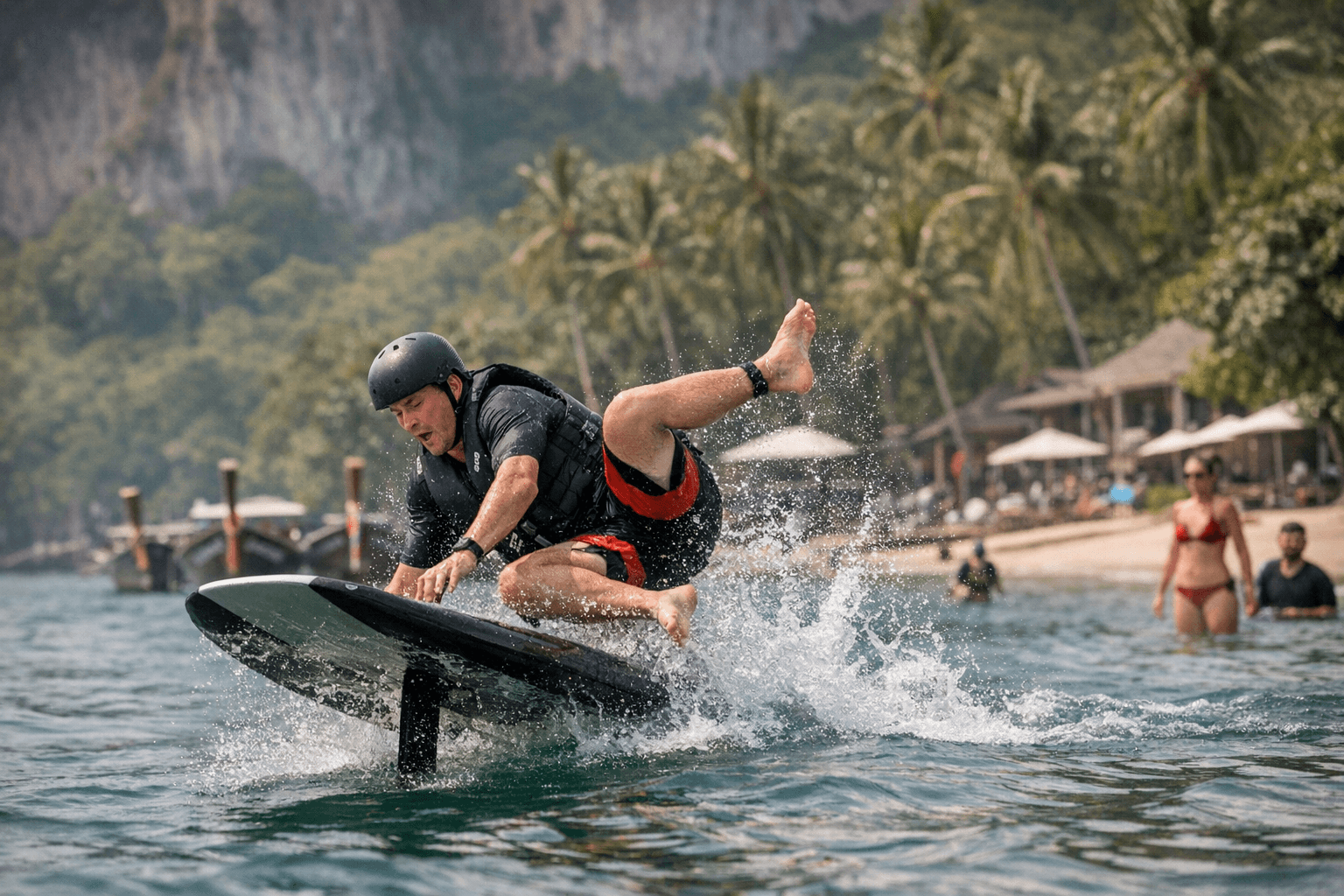
From the beginning, Flite moved like a category builder rather than a niche brand. It quickly built a global presence, with hundreds of authorized partners and dedicated schools that allow new riders to try the product in controlled environments. This network plays a critical role. It lowers the psychological barrier of entry and makes the sport feel accessible rather than intimidating.

The structure of Flite’s product lineup reveals the strategy clearly. Instead of focusing on a single flagship board, the company created a range that maps different levels of experience. Entry level products are designed for stability and ease of use. Intermediate models balance performance and control. Advanced boards focus on speed, weight reduction, and responsiveness.
Recent performance models can reach speeds of around 55 kilometers per hour, pushing the limits of what was originally seen as a novelty into something closer to a serious water sport. At the same time, beginner friendly options are designed so that new users can learn within minutes under guidance.

Design is central to how Flite presents all of this. The company has invested heavily in making its boards look and feel like finished products rather than experimental gear. That approach has earned major design recognition and positioned Flite closer to premium consumer brands than traditional surf companies.
A defining moment in that direction was the collaboration with industrial designer Marc Newson. Limited edition boards were presented not just as equipment, but as collectible objects, even being showcased in a gallery setting. This move signaled that eFoiling could exist in the same cultural space as high end design and technology.

The business side reinforced that trajectory. In 2023, Fliteboard was acquired by Brunswick Corporation, a major player in the marine industry. This move placed the brand inside a larger ecosystem focused on electrification and innovation in water mobility. Since then, Flite has continued to expand its product lines and invest in new technologies.
The deeper story is not just about growth. It is about translation. Flite took a complex, unfamiliar activity and turned it into something that people can understand quickly. It built a system around the product, including training, distribution, and clear progression.

That is what makes Fliteboard a strong subject. It shows how a new sport can move from the edge into the mainstream. Not by simplifying it completely, but by packaging it in a way that feels intuitive, safe, and desirable.
In the end, Lift and Flite are not just competing companies. They represent two different answers to the same question. One asks how to stay true to the roots of a sport. The other asks how to make that sport inevitable.
Know something we missed? Have a correction or additional information?
Submit a Tip