Stoke Foil Boost Helps Parawing Riders Stay Up in Light Wind
Stoke Foil Boost's 57-lb-thrust motor clamps to your mast in under two minutes and banks 50 boosts per charge, keeping parawing and wing foil sessions alive when the wind goes soft.
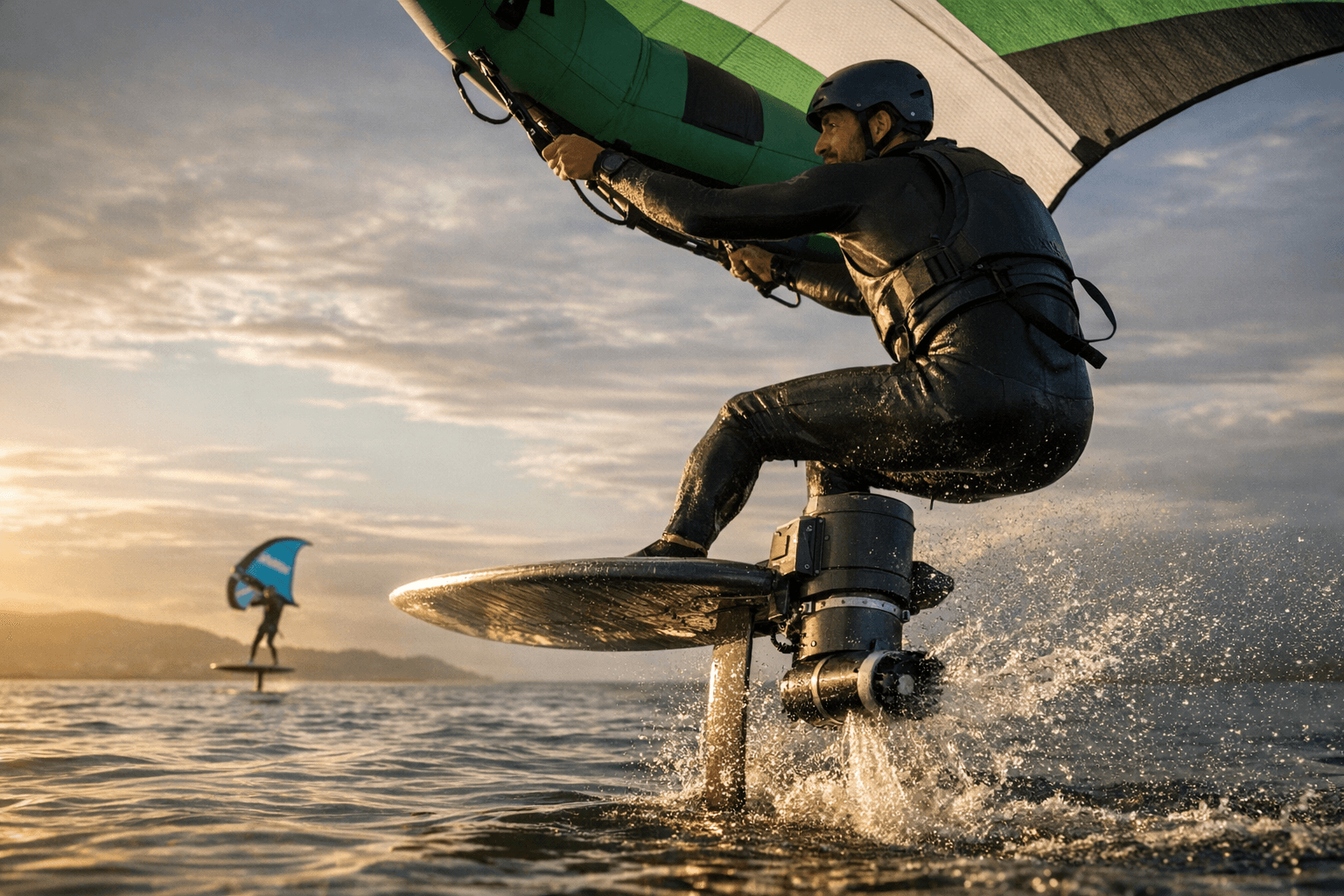
Light wind days just got a lot harder to write off. The Stoke Foil Boost, a detachable battery-powered propulsion unit from Stoke Foiling, is built specifically for foil disciplines where getting on foil depends on conditions you can't control, including parawinging, wing foiling, SUP foiling, windsurf foiling, and prone foiling.
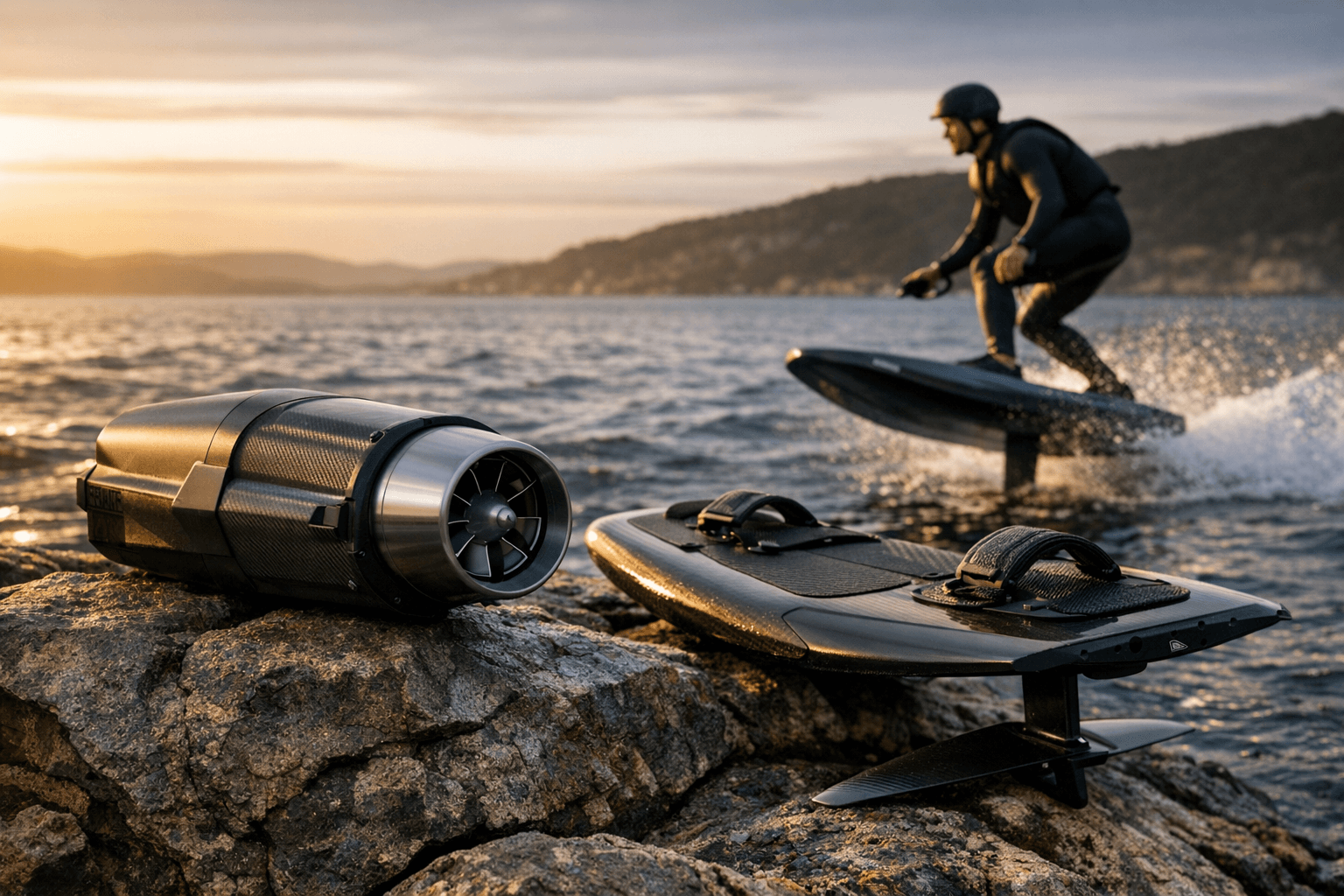
The unit is powered by a custom-designed brushless motor capable of 57 lbs of thrust, 4,000W, and 9Nm of torque. Its high-capacity battery provides 50 boosts and charges in two hours, and the whole system weighs just 3.8 kg. That's the kind of power-to-weight ratio that changes your calculus on a 10-knot morning.
The hardware is designed around one principle: add propulsion without messing with what already works. It sits high on the mast just below the board so it doesn't change the dynamics of your ride, and it's engineered for minimum water resistance, giving you a boost on the water with no drag when the foil is flying. Propulsion is delivered via a two-blade 188mm diameter folding propeller that collapses to 55mm when folded. When you're flying, the prop folds away and disappears into the ride.
Mounting is straightforward. The universal mast mount fits every mast, aluminium or carbon, using small interchangeable silicon rubber side pressure pads, and can be fitted or removed in less than two minutes. The wireless controller is less than 10cm long and 4cm wide, attaches securely to a wide range of wings and paddles, and works just as comfortably handheld when prone foiling.
Where this matters most for parawing riders is the window it opens on suboptimal days. The propulsion system lifts the foil with fingertip control, letting you fly on days when you previously thought you couldn't, and puts you in charge of the conditions. That translates to more days in light winds and smaller surf, with the ability to get off the beach when wind is offshore and back to the beach when it drops out. For parawing specifically, those offshore light-wind sessions that end in a long paddle home become a different conversation entirely.
The learning angle is real too. Practicing new moves knowing you can get back on the foil faster and without fatigue is a genuine shift in how you approach a session. Jack Abbott, 2022 Victorian Sailor of the Year, put it plainly: "Stoke transformed my learning curve. It quite literally gave it a boost." Chris Thomas, a foiling novice, zeroed in on what endurance-limited riders feel immediately: "I can now enjoy longer sessions because I save my energy for the ride and not the grind."
Karl Lapwood, described by Stoke Foiling as a wing foiling addict, reached for the closest analogy the broader electric-assist world offers: "This is like an E mountain bike for foils. You just enjoy the ride more knowing you can easily get back up again." The comparison holds. Like a pedal-assist e-bike, the Boost doesn't replace the skill or the sensation; it extends the time you spend practicing both.
Third-party coverage has been consistent. Wind Surfing Mag UK described it as "a small, beautifully designed, detachable electric propulsion system that gets you foiling at the push of a button," adding that it delivers around fifty boosts per session, "enough to get you well and truly foiling more." Foiling Magazine Issue #19 was equally direct: "The Stoke Foil Boost does exactly what it needs to in a refined and beautifully engineered package."
The standard Sports Battery is calibrated for approximately 50 boosts of around 15 seconds each, which maps to roughly 50 takeoffs or wave catches per session. If that's not enough, a quick-change battery connection is available, and the lithium battery itself charges in two hours. For riders pushing high-aspect foils or smaller boards that drain power faster, the XR Battery is the better option.
The system was engineered and tested for use in the harshest marine environments, and it straddles all foiling disciplines with the ability to fly earlier and for longer regardless of skill and environment. That last part matters for parawing riders who already know the frustration of watching a session die when the wind does.
Know something we missed? Have a correction or additional information?
Submit a Tip