Waydoo EVO Pro Plus Review Covers Motor Specs, Battery Life, and Foil Performance
Waydoo's EVO Pro Plus pairs a 6000W motor and 2300Wh battery for sessions up to 120 minutes, and Calderon Bridger's hands-on review is one of the most detailed early-2026 breakdowns yet.
The Waydoo EVO Pro Plus lands in a competitive spot on the eFoil market: not the cheapest option, not the most exotic, but arguably the most considered platform for riders who want more than entry-level hardware without paying flagship prices. Reviewer Calderon Bridger put the board through a full field and bench evaluation, publishing his findings in late March 2026, just as spring demo season kicks into gear and resorts start configuring their rental fleets. His breakdown covers the three areas that matter most when sizing up an eFoil upgrade: motor and power delivery, real-world battery performance, and the mast and foil package that determines how the board actually feels underfoot.
Motor and Power Delivery
The EVO Pro Plus runs a 6000W Performance Unit motor, and Bridger's review focuses specifically on how that power is delivered rather than just peak output numbers. The Performance Unit is capable of propelling rider weights up to 170kg, which matters for rental and resort contexts where you cannot always control who steps on the board. What the review highlights, though, is the character of the torque curve at low speeds. That first phase, where a rider is dragging through displacement mode before the foil lifts, is where underpowered platforms stall or surge unpredictably. The EVO Pro Plus's smoother low-end thrust makes the lift phase more forgiving, reducing the tendency to over-throttle and lose balance on the way up. For instructors running back-to-back beginner sessions, that consistency across different rider weights is a practical operational advantage.
Battery Life and Charging
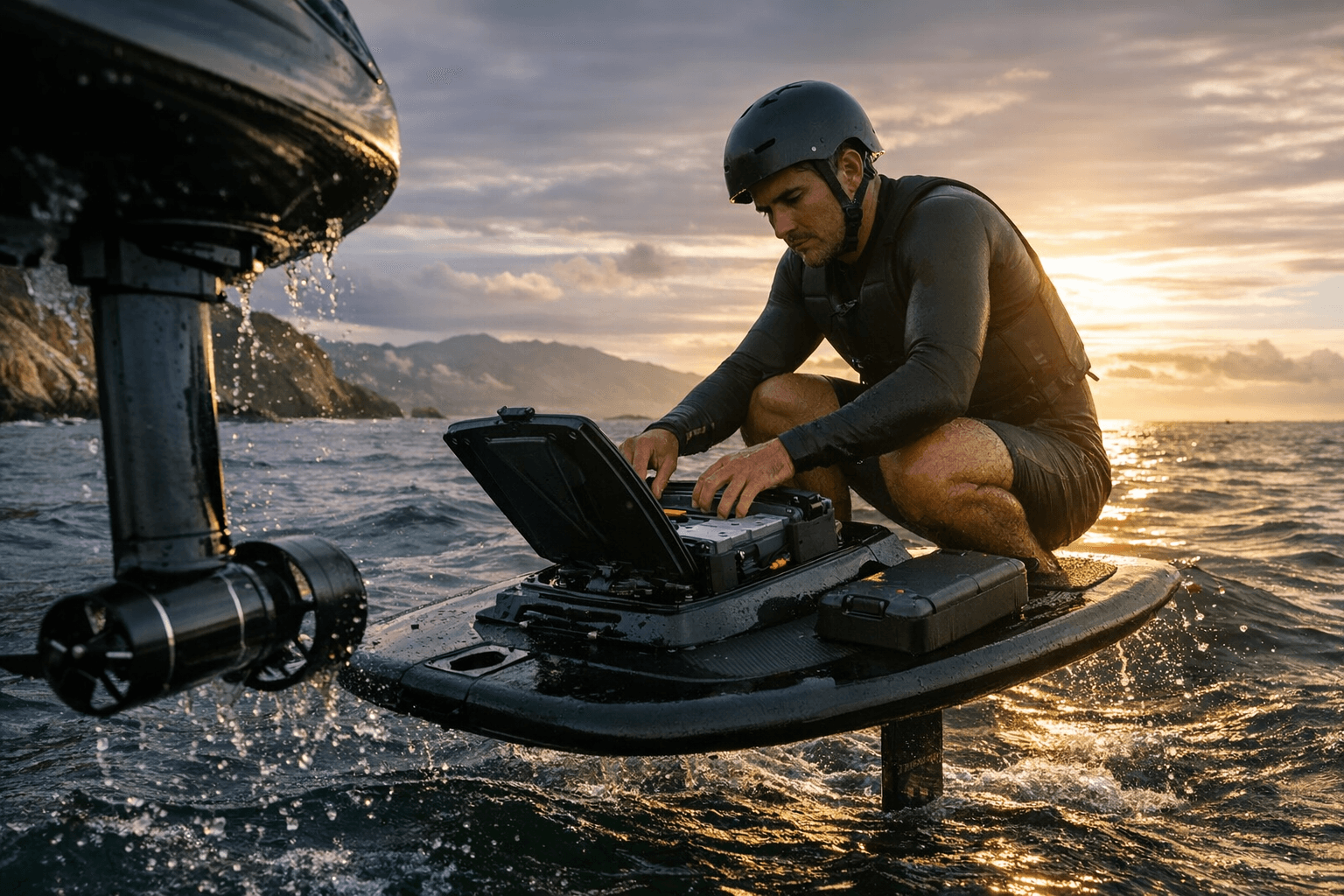
The large battery option is a 2300Wh pack, and Waydoo rates the EVO Pro Plus for up to 120 minutes of ride time. Real-world numbers, as Bridger notes, shift depending on rider weight and riding mode, but mixed-condition testing confirmed meaningful improvement over older Waydoo models. The 45Ah Powerflight unit charges in roughly an hour and provides a real-time percentage display, which eliminates one of the most frustrating uncertainties in eFoiling: not knowing how much ride time you actually have left. The batteries also come with an LCD display featuring leak detection alerts, better heat management, and waterproofing. For a rental operator running four or five boards through a full day of lessons, charging speed is almost as important as capacity. An hour turnaround means a board can realistically complete two full sessions in a half-day window.
Mast, Foil Package, and Ride Characteristics
The 90L board is compact enough for tight turns yet stable enough for learning, and is ideal for riders in the 150-210 lb range. The aluminum mast comes in multiple size options, with a carbon mast available as an upgrade alongside a range of wings in fiberglass and carbon. Bridger's on-water impressions focus on the refined mast and foil package that gives beginners a more forgiving baseline while still rewarding intermediate riders who want to carve or explore basic freestyle moves.
The aluminum mast provides adequate stiffness without the premium feel of carbon alternatives; vibration is well-controlled, and the overall experience feels solid if not refined. That characterization is honest and useful: riders coming from a carbon-mast platform will notice the difference, but riders stepping up from a budget eFoil or trying the platform for the first time will find it more than capable. The included Glide 320 stabilizer wing pairs with the front wing selection to deliver a stable pitch axis, which is exactly what beginners need to stay in trim during their first flights.
Smart Flight Assist and Remote
One of the differentiators of the Pro Plus configuration is the Smart Flight Assistance System. The eFoil uses the Smart Flight Assistance System to help riders maintain stability through automatic throttle adjustments. This is not a feature found on every Waydoo variant: the EVO Pro model, for example, runs without it. For a school or resort operator, flight assist can meaningfully compress the learning curve for first-timers, particularly riders who struggle with the instinctive tendency to over-throttle when they feel the board start to rise.
The upgraded EVO remote delivers an intuitive UI with day/night display and fast Bluetooth pairing for effortless control, finished with a secure silicone wrist strap and integrated magnetic key. The magnetic key detail matters more than it sounds: it is a kill-switch mechanism that shuts the motor if the remote separates from the rider, a critical safety feature in a shared-water environment.
Modular Setup and Fleet Considerations
Waydoo has retained the plug-and-play design for the battery and mast, which seamlessly sandwich the board together, making the EVO the fastest and easiest board to set up. For a resort with instructors managing multiple boards and back-to-back lessons, setup time at the water's edge is a real operational variable. A system that doesn't require tools or complex assembly translates directly into more time in the water per session.
The EVO platform is fully modular: wings, motors, and masts can be swapped as skill level progresses, which shifts the calculus for buyers who might otherwise hesitate to invest in a mid-tier platform. Rather than outgrowing the board, riders can reconfigure it. That modularity also means rental operators can standardize on one hull and swap components to match the ability level of incoming riders.
Waydoo also includes an advanced geofencing system that allows riders to set a safe riding zone for extra protection, a feature that becomes genuinely useful in instructional settings where the goal is to keep a student within a manageable area while they find their footing.
Where the EVO Pro Plus Fits
Bridger's review lands at a timely moment. Early-2026 buyer guides and side-by-side comparisons are actively shaping purchasing decisions ahead of spring deliveries, and an independent hands-on video that covers motor behavior, measured battery performance, and real riding impressions carries more weight than a spec sheet alone. The EVO Pro Plus is not trying to compete with top-tier platforms on peak performance; it is competing on the combination of run time, ease of setup, beginner accessibility, and a modular upgrade path that keeps the platform relevant as a rider's skills develop.
For instructors at a waterfront school, the 120-minute battery rating combined with rapid charging and the Smart Flight Assistance System makes this a credible fleet board. For the family buyer who wants range without paying for a carbon-everything race setup, the 6000W motor, 2300Wh pack, and plug-and-play assembly hit the target. Bridger's conclusion, that the Pro Plus balances accessibility with upgraded hardware, holds up against the specs: the numbers justify the platform's mid/high-tier positioning, and the ride characteristics make that hardware accessible to riders who are still learning to use it.
Know something we missed? Have a correction or additional information?
Submit a Tip