Canyonlands National Park Advises AWD, 4WD on Multiple Routes This March
Canyonlands warned that commercial towing below the Flint Trail starts at over $2,000 — and rangers won't winch you out.

Deep ruts, loose rock, and patches of deep sand greeted anyone venturing into Canyonlands National Park's backcountry this week, as the park's March 16 road-conditions advisory confirmed that nearly every route in the Island in the Sky district was open but demanding serious hardware to run safely.
The advisory, updated across all districts on March 16, 2026, placed AWD or 4WD recommendations on Shafer Trail and Potash Road, while escalating to a hard requirement on White Rim Road, Taylor Canyon Road, and Lathrop Road, all of which called for high-clearance 4WD. Mineral Bottom added a specific caution for its switchbacks, advising high-clearance 4WD and noting visitors should expect conditions similar to Shafer Trail. The Scenic Drive remained the one straightforward option, listed simply as open with no vehicle restrictions.
White Rim Road carried the most layered set of requirements in the advisory. High-clearance 4WD with a low range gear (4LO) is required, and the park was explicit that AWD-only vehicles and low- or high-clearance two-wheel-drive vehicles "are not permitted upon the White Rim Road" because of the rough slickrock, loose rocks, deep sand, and steep switchbacks. Vehicles taller than 9 feet 6 inches are not recommended due to overhangs. Permits are also required on White Rim Road, and some Needles roads require permits as well. The advisory noted areas with deep ruts and loose rock and directed visitors to stay on designated roads at all times.
Potash Road carried an additional specific warning: some washouts existed before the park boundary, with rough conditions expected after snowfall. Lathrop Road, while open and accessible, had deep sand in places and a flooding risk in the day-use area.
The stakes for getting it wrong are steep. The park's advisory stated plainly that "visitors whose vehicles become disabled in the backcountry can expect commercial towing fees in excess of $1,000." In the Maze district, that figure climbs sharply: commercial towing fees below the Flint Trail start at over $2,000.
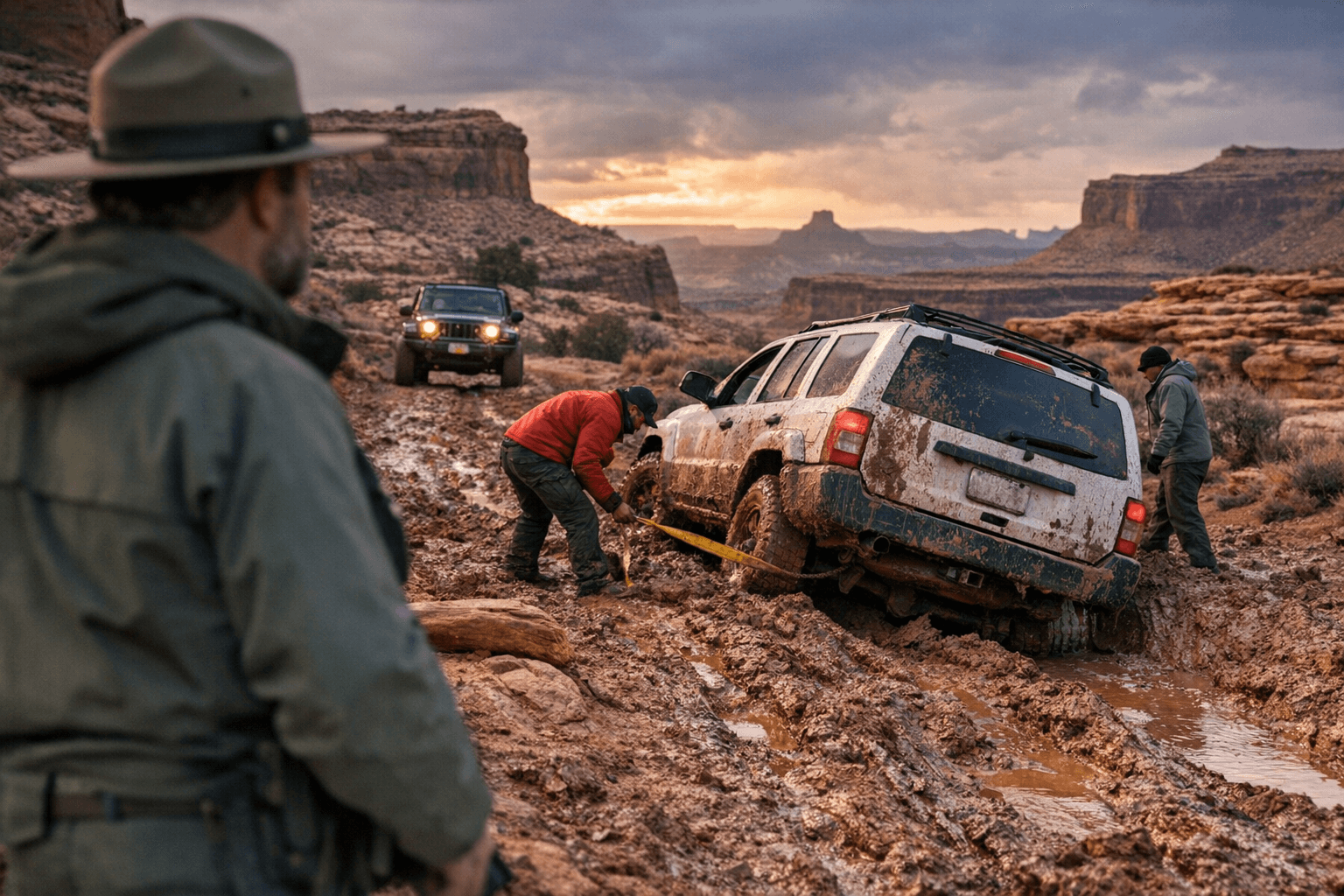
The Maze section of the advisory read more like a survival briefing than a road-conditions update. "Maze roads are challenging and visitors must be prepared with the proper equipment to facilitate self-rescue," the advisory stated. Cell phone communication is not reliable in the Maze, park rangers do not winch vehicles out, and the advisory recommended carrying extra supplies in case it takes a day or two for roads to dry out after wet weather. Roads rated 4WD in the Maze require 4WD with low range gear (4LO) and high clearance; AWD and lower-clearance vehicles cannot navigate the rough slickrock, steep ledges, loose rocks, deep sand, and steep switchbacks.
The hazards on Taylor Canyon Road in particular have a documented history. A March 17, 2005 correction filed by then-Chief Ranger Peter C. Fitzmaurice described what became one of the most significant flash flood events in the district's recorded history. A family of four from Provo, Utah, was driving up Taylor Canyon at around 6 p.m. when they spotted a four-inch-high curb of water moving toward them down the wash. Within a minute, water had reached the middle of the windshield of their 1998 Humvee. Peak flow in the wash reached an estimated 2,000 cubic feet per second, nearly double the Colorado River's flow at the time, across a channel 300 feet wide with 55-degree water. The Humvee floated downstream for roughly four miles over 15 minutes. The father swam to shore with his five-month-old and three-year-old sons tucked under his arms while his wife exited through a window. The family sheltered in an alcove until nearby campers heard their cries for help that night and brought them out to the district visitor center the following morning. The $60,000 Humvee was recovered but declared a total loss. Fitzmaurice noted that the flash floods that season were "the most significant documented in the district's history."
Check the Canyonlands National Park official website or contact the park's visitor centers for current permit information and the full advisory before heading out.
This article was produced by Prism’s automated news system from verified source data, official records, and press releases, then run through automated quality and moderation checks before publishing. The system is built and supervised by the people who set the standards it runs under. Read our full AI policy.
Did this article answer your question?