Evergreen Guide — Visiting Navajo‑Managed Sites (Monument Valley & Four Corners): Permits, Hours, and Cultural Etiquette
Your National Parks pass won't work here. Both Four Corners Monument and Monument Valley operate under Navajo Nation rules — fees, permits, and etiquette that catch unprepared visitors off guard.

Who Manages These Sites and Why It Changes Everything
Four Corners Monument and Monument Valley are not federal parks. Both sit on sovereign Navajo Nation land and are managed by the Navajo Nation Parks & Recreation Department, whose mission is to protect, preserve, and maintain all Navajo Tribal Park locations. That distinction matters from the moment you pull up to the fee booth: your National Park pass, America the Beautiful pass, or Golden Age card carries no weight here. Entry fees are paid directly to Navajo Nation Parks, and the rules on signage, permits, and conduct reflect tribal governance rather than NPS standards. Plan accordingly.
Four Corners Monument: Hours, Fees, and What's On-Site
The granite-and-brass marker at Four Corners, the only quadripoint in the United States where Arizona, Colorado, New Mexico, and Utah converge, sits at roughly 5,000 feet of high desert elevation. The original cement pad marker was erected in 1912; the current granite disk and bronze inlay came later. Entry is $8 per person, credit or debit card only, for visitors aged 7 and older. Children 6 and under are free.
Hours shift with the seasons:
- October 1 through March 31: 8 a.m. to 4:45 p.m.
- April 1 through April 30: 8 a.m. to 5:45 p.m.
- Summer peak season extends hours further into the evening
The site is closed on New Year's Day, Thanksgiving Day, the day after Thanksgiving (Navajo Nation Day), Christmas Day, and all other Navajo Nation holidays. The Main Office runs 8 a.m. to 5 p.m. daily. Always verify current hours directly through Navajo Nation Parks before you drive out, because this is a remote location and an unexpected closure wastes a significant amount of mileage.
On-site, you'll find Navajo artisan vendors selling handmade jewelry, crafts, and traditional Navajo foods. There's also a demonstration center with Navajo artisans. A Trading Post sits about 6.5 miles from the monument and sells groceries and gas, but services within the immediate area are essentially nonexistent. Bring your own water and food. The nearest gas station in the direction of Teec Nos Pos, Arizona is your best bet for last-minute supplies before arrival.
Monument Valley: Hours, Fees, and Permits
Monument Valley Navajo Tribal Park operates on a two-season schedule. During the summer season (May 1 through September 30), the fee booth and Visitor Center are open Monday through Sunday from 6 a.m. to 8 p.m., with last entry for the scenic drive at 3:30 p.m. During the winter season (October 1 through April 30), hours run 8 a.m. to 5 p.m., with last entry at 2:30 p.m. The park is closed on Thanksgiving Day, Christmas Day, New Year's Day, and during the two annual marathons held in November and March.
Navajo Nation Parks also announced a fee increase across all locations effective January 1, 2026, so confirm current pricing at the gate or directly with the department before your trip.
There are two permit categories you need to know:
Backcountry Permit: Required if you intend to hike or camp beyond the standard visitor areas. These are obtainable at the Visitor Center. General admission does not cover backcountry access. If you are found hiking or camping without one, or in unauthorized areas, additional fees apply.
Special Use Permit: Required for photography shoots, filming, weddings, and paintings. Stop by the Visitor Center for current pricing and coordination; costs are invoiced per request.
Commercial tour operators and independent photographers conducting professional work should secure these permits well before arrival rather than assuming on-the-spot availability.
The 17-Mile Loop and Getting Into the Backcountry
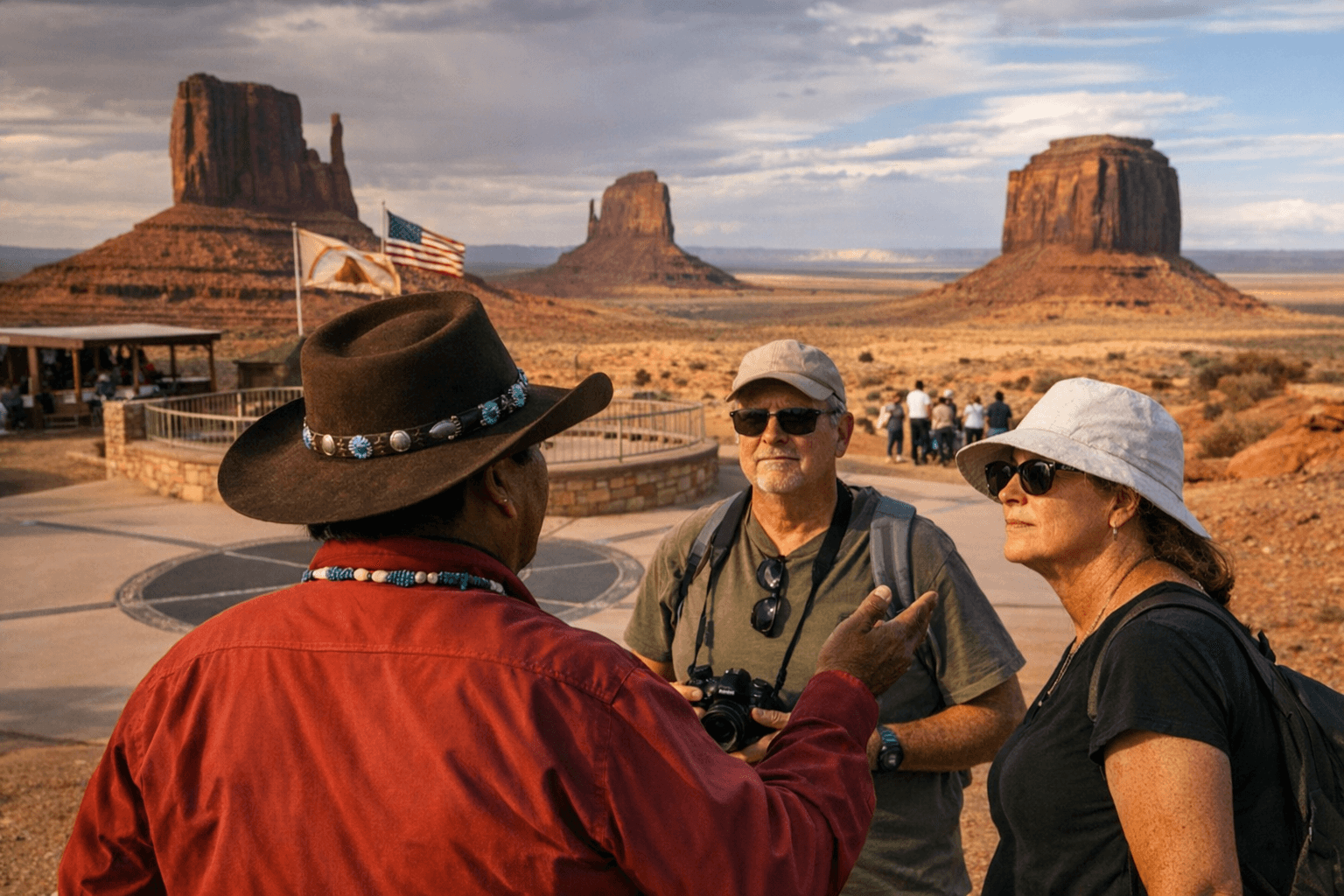
The 17-mile scenic loop is self-driveable, and the stop at John Ford Point and The Mittens will validate every mile of the drive. That said, Monument Valley is 4WD-recommended terrain and not suitable for all vehicles. RVs, ATVs, UTVs, motorcycles, and large trailer vehicles are prohibited on the loop due to rough terrain and deep sand sections. Drivers are responsible for their own vehicles and personal safety; Navajo Nation Parks accepts no liability for damage to vehicles on tribal park land.
For anything beyond the loop, a Navajo-licensed guide is not optional, it's the access mechanism. The deeper backcountry dirt tracks and restricted corridors require coordination with licensed Navajo guide companies. Independent drivers should not assume that unmarked roads are open routes. Many pass through private grazing lands and culturally significant areas. Guided tours run $60 to $120 or more per person depending on length and format (jeep, horseback, sunrise, and others), with tour guides available at the lower-level parking lot upon arrival. Booking ahead during peak season is strongly recommended.
Beyond the logistical benefit, booking a Navajo-led backcountry tour routes revenue directly into the community and gives you interpretive access to the valley's history that no signage can replicate.
Cultural Etiquette: The Non-Negotiables
Rock climbing is explicitly prohibited on Navajo land, and the Parks Department has made clear that Navajo law will be strictly enforced. Do not attempt to climb the monuments under any circumstances.
For vendors and artisans at both sites, a few norms matter:
- Ask before photographing vendors, artisans, or children. This is non-negotiable and shows basic respect.
- Refrain from aggressive bargaining. A polite, measured inquiry about price and provenance is appropriate.
- Do not treat vendor stalls as a photo backdrop rather than someone's livelihood.
When it comes to sacred or culturally sensitive locations, your Navajo guide will flag them. Honor those requests immediately. Some places cannot be entered or photographed, and a guide's direction on this point is not a suggestion. Stay on designated routes, respect all posted signage, and comply with requests from tribal officers and staff without pushback.
Practical Planning Checklist
Before you leave for either site, run through this:
- Confirm current hours and holiday closures directly with Navajo Nation Parks, especially around Navajo Nation Holidays
- Credit card required at Four Corners; confirm payment options at Monument Valley at time of visit
- Pre-book commercial tours for Monument Valley during spring and summer high season
- Secure a Backcountry Permit before entering restricted areas
- Obtain a Special Use Permit for any professional photography or filming
- Bring water, sun protection, and layered clothing (the high desert swings hard between midday heat and cold mornings)
- Verify whether any health or access restrictions are in effect at the time of your trip
- Pack in, pack out; leave no trace is explicitly stated by Navajo Nation Parks
The broader principle here is straightforward. Visitors who respect permitting rules, support the Navajo vendor economy, and follow guide direction help preserve access for every traveler who comes after them. The sites are extraordinary partly because the Navajo Nation has maintained the authority to manage them on its own terms. Work with that, not around it.
This article was produced by Prism’s automated news system from verified source data, official records, and press releases, then run through automated quality and moderation checks before publishing. The system is built and supervised by the people who set the standards it runs under. Read our full AI policy.
Know something we missed? Have a correction or additional information?
Submit a Tip