Five-Day Four Corners Loop Covers Mesa Verde, Monument Valley, and Canyon de Chelly
A five-day loop from Albuquerque threads through four states, hitting Mesa Verde's cliff dwellings, Monument Valley's sandstone spires, and Canyon de Chelly's sacred canyons.
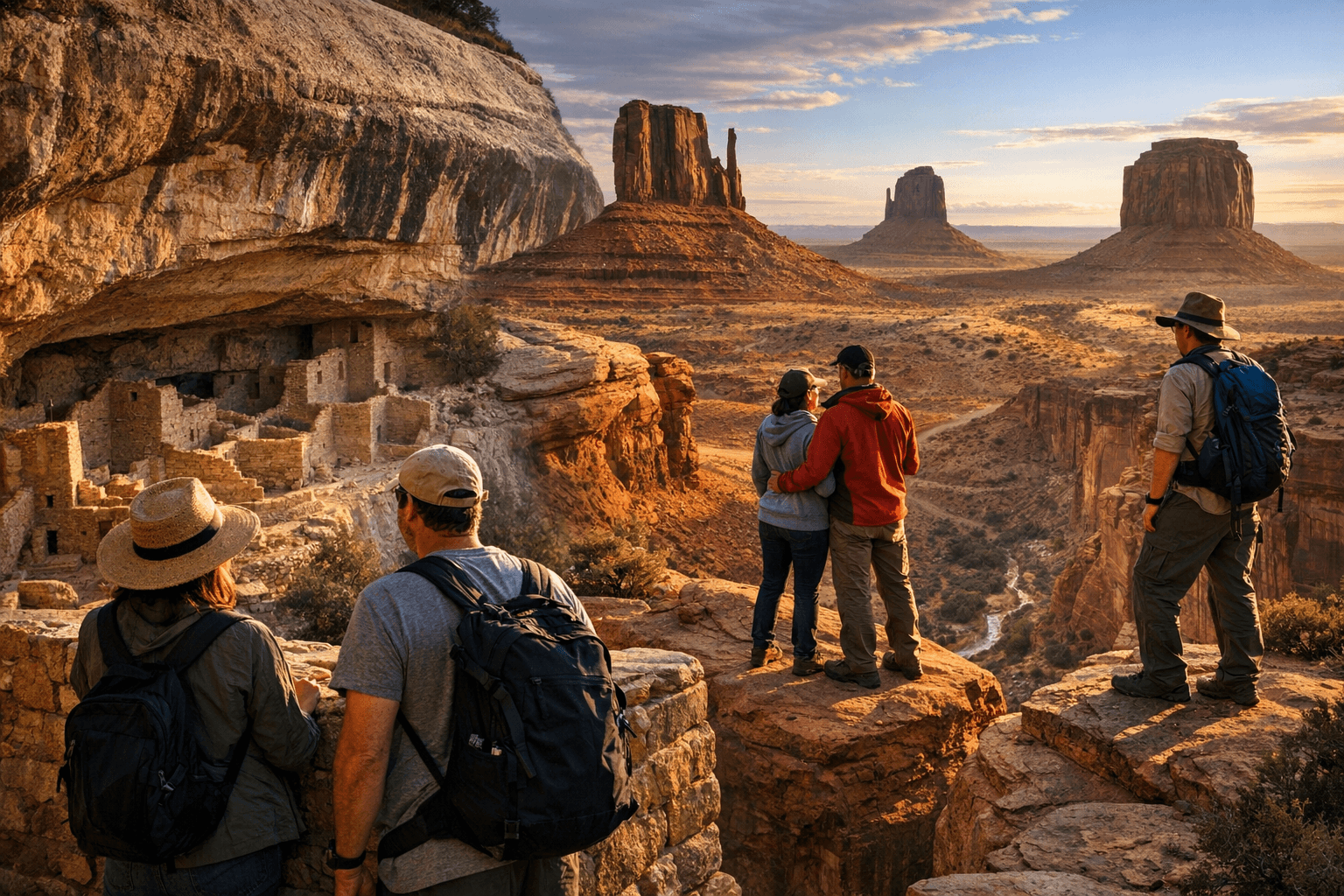
The road that pulls you in
From the moment you leave Albuquerque heading north on US-550, the Southwest stops being a postcard and starts being a place. William and Hui Cha Stanek know that feeling well. Their five-day Four Corners loop itinerary, framed explicitly as a "Native American Heritage" road trip, threads through New Mexico, Colorado, Arizona, and Utah to connect Mesa Verde, Monument Valley, and Canyon de Chelly into a single, manageable arc. For anyone who wants a serious taste of the region without committing to two weeks on the road, this route delivers.
The loop begins and ends in Albuquerque, covering roughly 1,000 miles of high desert, canyon country, and mountain terrain. The Staneks built it around daily anchors rather than a sprint between trailheads: each day has a clear cultural centerpiece, a suggested overnight hub, and room for the kind of improvisational stop that makes a road trip feel like your own.
Day 1: Albuquerque to Durango
The opening drive north sets the tone for the whole trip. The recommended first stop is Aztec Ruins National Monument in the small New Mexico town of Aztec, a well-preserved Ancestral Puebloan great house that most travelers blow past on the way to more famous sites. It earns the detour. From there, the route continues up US-550 into Colorado, arriving in Durango with time to settle in before the longer days ahead. The Staneks suggest the Holiday Inn and Suites Durango Downtown as a comfortable and centrally located base.
Durango serves as the overnight hub for the first two nights, which makes logistical sense: Mesa Verde sits roughly 40 miles to the west, and having a reliable, well-stocked town to return to after a full day in the park keeps fatigue in check.
Day 2: Mesa Verde National Park
Mesa Verde is the cultural anchor of the entire itinerary, and the Staneks treat it that way. The park protects more than 4,700 archaeological sites, including the most celebrated cliff dwellings in North America, structures built and inhabited by the Ancestral Puebloans over 700 years ago.
The recommended stops give you a real cross-section of the park. Cliff Palace is the largest cliff dwelling in Mesa Verde, a sweeping multi-story complex tucked into a sandstone alcove that rewards early arrivals before the midday crowds build. Balcony House is the adventurous option, a ranger-guided tour that includes ladder climbs and narrow tunnel crawls to reach a site most visitors never see up close. Spruce Tree House, one of the best-preserved structures in the park, rounds out the day with easier access and exceptional architectural detail.
Hui Cha Stanek captures the drive in before you even reach the ruins: "The drive to Mesa Verde is beautiful, with the morning light illuminating the red rock formations and the distant mountains. Take your time and enjoy the scenery as you approach one of the most significant archaeological sites in North America."
Day 3: Durango to Monument Valley
Day three is the big geographic pivot. From Durango, the route heads southwest through the Navajo Nation, with Shiprock, a volcanic monolith rising 1,800 feet above the desert plain, marking the crossing into deeper Navajo territory. Shiprock, called Tsé Bitʼaʼí in Diné Bizaad, holds profound religious and cultural significance for the Navajo people and is visible for miles before you reach it.
Monument Valley straddles the Arizona-Utah border within Navajo Nation jurisdiction, and the Staneks are clear about how to engage with it responsibly: Navajo-led guided tours are the way to access the backcountry, reaching formations and areas off the 17-mile Valley Drive that self-guided visitors never reach. The valley's signature formations, the West and East Mittens and Merrick Butte, define one of the most photographed landscapes in the American West, and the light during the golden hour hits differently when you have a local guide explaining the stories behind each formation rather than reading from a placard.
Day 4: Monument Valley to Canyon de Chelly
The route swings east into Arizona toward Canyon de Chelly National Monument, one of the most layered cultural sites in the Southwest. Unlike most national monuments, Canyon de Chelly sits entirely within the Navajo Nation, and Navajo families still live and farm in the canyon bottom, a fact that makes the guided tour requirement more than a formality. It is a working, living landscape.
The North and South Rim Drives offer overlook views of cliff dwellings and petroglyphs built by Ancestral Puebloans between 350 and 1300 A.D., with Spider Rock, a striking 800-foot sandstone spire, accessible from the South Rim. White House Ruin is the only site in the canyon reachable without a Navajo guide, accessible via a 2.5-mile round-trip trail that drops into the canyon floor. For anyone who wants to see the canyon from the bottom up, a paid Navajo guide service opens the full route including the ruins, petroglyphs, and inhabited canyon areas.
A natural add-on before leaving for Albuquerque the next morning is Hubbell Trading Post National Historic Site in Ganado, the oldest continuously operating trading post in the Navajo Nation, active since 1878. The trading post still functions as a working store where visitors can browse authentic Navajo rugs, silver, and crafts, and rangers lead tours of the Hubbell homestead, barn, and collection.
Day 5: Canyon de Chelly to Albuquerque
The return drive east through New Mexico closes the loop and gives the itinerary its sense of proportion: five days covering four states, anchored at three of the Southwest's most significant Indigenous cultural landscapes. The Staneks recommend Hotel Andaluz in downtown Albuquerque as a final overnight option if the drive extends late, a historic property offering modern amenities in the heart of the city.
Planning essentials
A few practical priorities make the difference between a smooth trip and a stressful one:
- Book guided tours at Monument Valley and Canyon de Chelly before you leave home. Navajo-led backcountry tours fill up, and on-site availability varies by season.
- Start early at Mesa Verde. Ranger-guided tours of Cliff Palace and Balcony House require timed tickets, and morning light on the cliff faces is exceptional.
- Fill water and fuel at gateway towns, particularly Cortez and Chinle, before heading into remote sections. Service gaps are real.
- Verify site hours at tribal and federal locations before each day. Hours at Navajo Nation parks do not always align with NPS schedules, and seasonal closures can affect access.
- Pack for desert temperature swings. Canyon country mornings can be cold even in spring and fall, while afternoon heat on canyon floors is intense.
The Staneks' closing reflection captures exactly why the itinerary holds up: "The Four Corners Loop is a journey through a landscape that is as rich in history as it is in beauty... this road trip has been a powerful reminder of the deep connection between the land and its people." Five days is a tight window, but built around Navajo and Pueblo-led experiences rather than overlook-to-overlook box-checking, the loop leaves you with something that outlasts the drive home.
Know something we missed? Have a correction or additional information?
Submit a Tip

