Lake Powell Approaching Dead Pool Status as Reservoir Falls to 27% Full
Lake Powell has fallen to roughly 27% full, pushing reservoir levels toward critical thresholds that could curtail hydropower and reshape recreation and water supplies across the Colorado River basin.

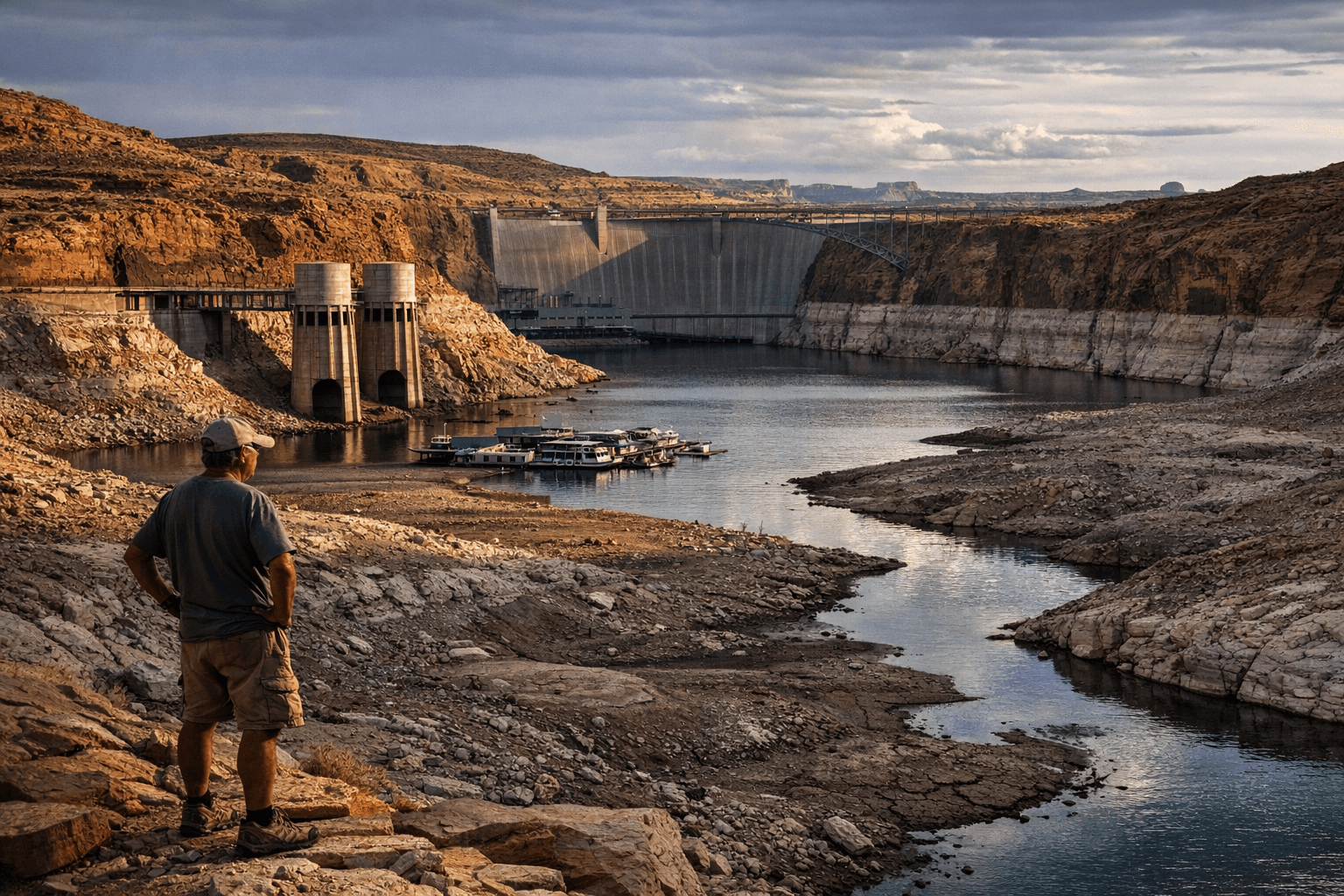
Lake Powell’s water level has dropped to roughly 27% full, a decline that puts the reservoir within reach of operational thresholds that control hydropower, downstream releases and boat access. That level, reported by a regional outlet, comes as federal modeling and expert warnings show increased odds of Powell crossing the next critical elevation markers in coming water years.
The Bureau of Reclamation’s modeling shows large shifts between its April 2025 and August 2025 runs. The August 2025 run put the probability that Lake Powell will fall below 3,525 feet in water year 2026 at 77 percent, compared with 10 percent in the April run. The table also flags the “minimum power pool” threshold as 3,490 feet and the dead pool, where the dam can no longer release water downstream, at 3,370 feet. One summary in broader reporting noted that Lake Powell is “184 feet above the ‘dead pool,’ the level at which a dam can no longer release water downstream.”
Operationally, the distinction matters. A corrected explanation from KUNC clarifies: “Dead pool is 3,370 feet. A water level of 3,490 feet is known as ‘minimum power pool.’ Glen Canyon Dam can release water below minimum power pool through bypass jets until an elevation of 3,370 feet, which is then the top of dead pool and no further water can be released.” Experts also warn that operating hydropower near the minimum power pool risks damage to equipment by allowing air pockets into turbines. NPR partner reporting paraphrases how a true dead pool functions: “Usually, a dam hits a dead pool when the water level sinks just below the pipes and tunnel infrastructure used to retain and release water – so the water just sits there, unable to flow downstream.”
Local and regional impacts are both practical and immediate. Lake Powell stores water for roughly 40 million people across seven states, and low reservoir levels have already forced recreation managers to spend millions to extend boat ramps at Glen Canyon and Lake Mead national recreation areas. NationalParkTraveler recorded surface elevations of 3,557 feet in July and 3,541.23 feet on December 20, while noting full pool is 3,700 feet. Anglers and river runners should also note ecological risk: one report warns a potential “invasion” of smallmouth bass through Grand Canyon National Park that could harm threatened native fish.
The scale of human impact is contested in reporting. One account warned that residents in seven states, Wyoming, Utah, Colorado, New Mexico, Arizona, Nevada and California, could face possible blackouts and water shortages; another list replacing California with Nebraska identifies the seven states that use Glen Canyon hydropower. University of Colorado water law professor Mark Squillace put recent lows in context: “Lake Powell is currently at about 30% of full capacity. That's obviously quite low, but it's been significantly lower than this in 2021 and we didn't hit dead pool at that time.” Squillace added, “It's not likely that we're going to see dead pool at Lake Powell.”
For Four Corners readers who boat, fish, guide trips or depend on regional water and power, the immediate takeaways are practical: expect continued low flows, shorter launch windows and ongoing operational decisions by the Bureau of Reclamation that could alter releases and power generation. Meanwhile, long-range projections and the Colorado River Insights assessment warn that without improved inflows the system could exhaust buffer storage and strain the Interim Guidelines that have governed river sharing. Watch for updated Reclamation projections and reservoir readings over the coming months; the next series of model runs will determine whether the region inches closer to the worst-case thresholds or finds relief in runoff.
This article was produced by Prism’s automated news system from verified source data, official records, and press releases, then run through automated quality and moderation checks before publishing. The system is built and supervised by the people who set the standards it runs under. Read our full AI policy.
Did this article answer your question?