Zion canyoneering guide maps skills, permits, and canyon routes
Zion’s slots look photogenic, but the real test is judgment: route-finding, water, anchors, permits, and an exit plan before you ever clip in.

A canyon can look like a postcard until the rope comes out, the walls tighten, and the next move depends on your judgment as much as your legs. In Zion, canyoneering is not a scenic hike with a little exposure, it is a full skill stack built around route finding, rappelling, problem solving, swimming, and hiking across a wilderness that covers most of the park.
What canyoneering really demands in Zion
Zion National Park frames canyoneering as an activity that combines route finding, rappelling, problem solving, swimming, and hiking, and that definition matters because it strips away the Instagram gloss. The park contains 124,462 acres of designated wilderness, about 84 percent of the park, with another 9,047 acres managed as recommended wilderness and 4,067 acres as potential wilderness. Zion Wilderness was established on March 30, 2009, under the Omnibus Public Land Management Act, and that scale helps explain why self-reliance sits at the center of the sport.
That wilderness footprint also means the park is not a place where you can assume a bailout is around the corner. Zion says there are dozens of canyons to explore, but those canyons are not interchangeable, and the skills you need change fast as soon as water, rope work, or route-finding enter the picture.
Where the learning curve starts
If you want the gentlest introduction, the lower end of the Virgin River Narrows gives you slot-canyon scenery without ropes or special gear. That bottom-up route does not require a permit, which makes it the cleanest place to learn how a narrow canyon feels before you add technical movement.
From there, the skill demand rises quickly. The Subway, in the Left Fork of North Creek, and Orderville Canyon bring in route finding, swimming, and short rappels. Zion’s top-down Subway route is the clearest reminder that the sport is not just about dropping into a slot and hoping for the best: it is 9.5 miles one way, drops 2,400 feet, and is estimated to take 6 to 12 hours. Zion describes it as a technical canyoneering route that requires ropes, harnesses, and cold-water protection even in warm weather.
The top-down Virgin River Narrows through-hike from Chamberlain’s Ranch is another good reality check. At 16 miles, it is a permitted route, and the distance alone shows how quickly a canyon day becomes a logistics day. Zion’s canyons reward people who can move efficiently, but they punish anyone who treats every slot as the same line on a map.
Permits are part of the route, not paperwork after the fact
Zion requires a Wilderness Permit for all technical canyoneering trips, including canyons that need descending gear or ropes. Permits are also required for single-day through-hikes of the Virgin River Narrows and for all trips into the Left Fork of North Creek, better known as The Subway. That permit system is not a formality, it is tied to route control, group limits, and the park’s safety expectations.
Group size rules make the same point. Zion sets a maximum of 12 people for The Left Fork, Orderville, Keyhole, Pine Creek, and the Virgin River Narrows, and a maximum of 6 in all other canyons. The park recommends a minimum group size of 2 for technical canyons, which reflects how much can go wrong when you are alone in a slot with rope work, cold water, or a stuck anchor problem.
The park also makes one distinction especially worth keeping straight: the bottom-up Narrows route from Zion Canyon does not require a permit, but the 16-mile top-down through-hike does. In Zion, the direction you choose can change the whole administrative and technical burden of the trip.
Skills and gear that beginners underestimate
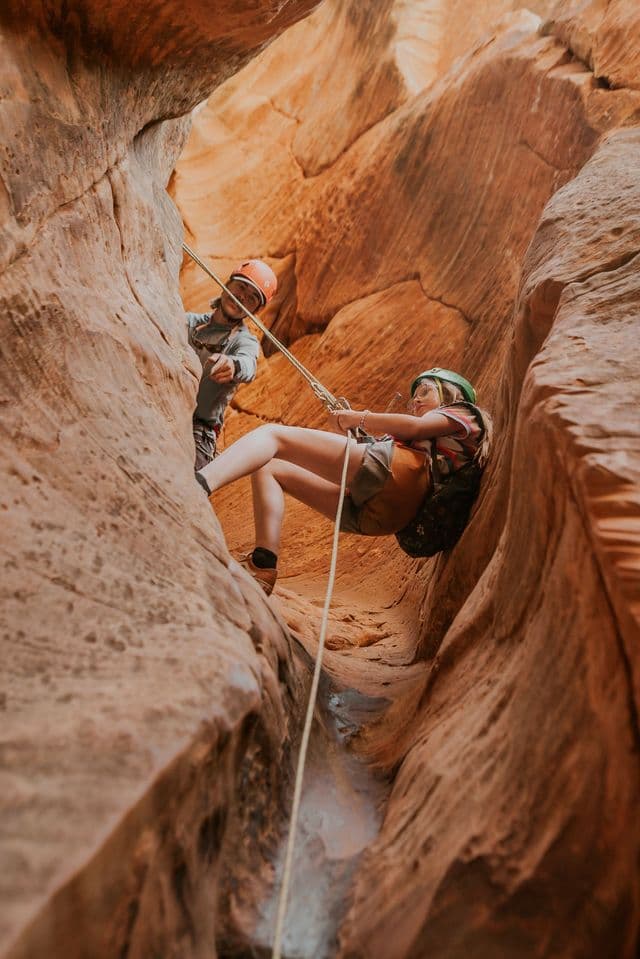
Zion’s guidance is blunt about the basics you need before entering a technical canyon. Every member of the group should know how to belay, ascend, add friction, and evaluate anchors. That is the difference between following a line and managing a rope system when conditions, water, or fatigue make things less predictable than expected.
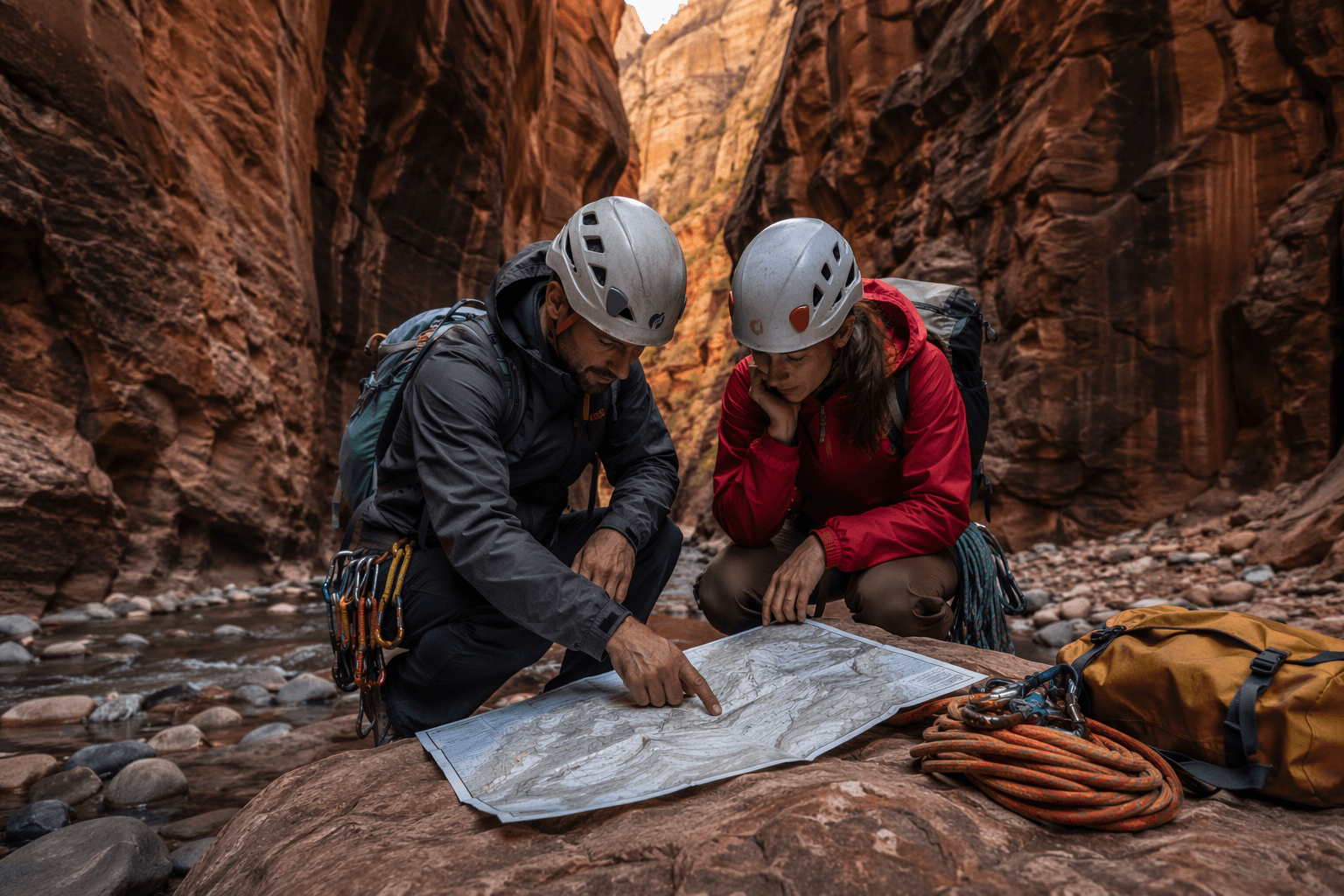
The park also says to bring a map and route description, because once you pull your rope after the first rappel, you are committed to finishing that canyon whether or not it is the one you intended to enter. That single detail captures a lot of the sport’s reality: the canyon does not care about your intention once the line is gone.
Zion recommends a headlamp, first-aid kit, extra food, extra clothing, and one gallon of water per person per day. Those items matter because canyoneering is as much about handling a long, cold, stalled day as it is about making the scenic move everyone wanted to photograph. Unexpected nights out happen, and the park’s own guidance assumes you need to be ready for one.
Weather can turn a slot into a trap
The most unforgiving part of the Four Corners canyoneering mindset is water. Zion warns that flash floods can rise within minutes or even seconds, can be triggered by storms miles away, and can come down a canyon as a wall of water 12 feet high or more. That is why the park tells you not to enter a narrow canyon if bad weather threatens.
This is also where the fantasy gap becomes obvious. A canyon that feels dry and friendly at the mouth can become dangerous fast, and the risk is not abstract. Zion says rescue is not a certainty, and safety is the visitor’s responsibility, which is the right mindset for any route where the terrain itself can control your exit.
What ready looks like
Utah’s tourism materials place canyoneering on a spectrum from non-technical scrambling to advanced climbing and rappelling, and they note that some remote routes often require a guide. That broad range is useful, but it can also be misleading if you only remember the easy end of it. In Zion, the easier entry points still sit inside a larger world of route finding, anchor judgment, cold water, and strict exit planning.
If you are looking at Zion slots for the first time, the real question is not whether you can get into a canyon. It is whether you can manage the canyon after the rope is out, the route is unclear, and weather, water, or a long day make the decision tree much smaller than the photos suggest.
This article was produced by Prism’s automated news system from verified source data, official records, and press releases, then run through automated quality and moderation checks before publishing. The system is built and supervised by the people who set the standards it runs under. Read our full AI policy.
Did this article answer your question?