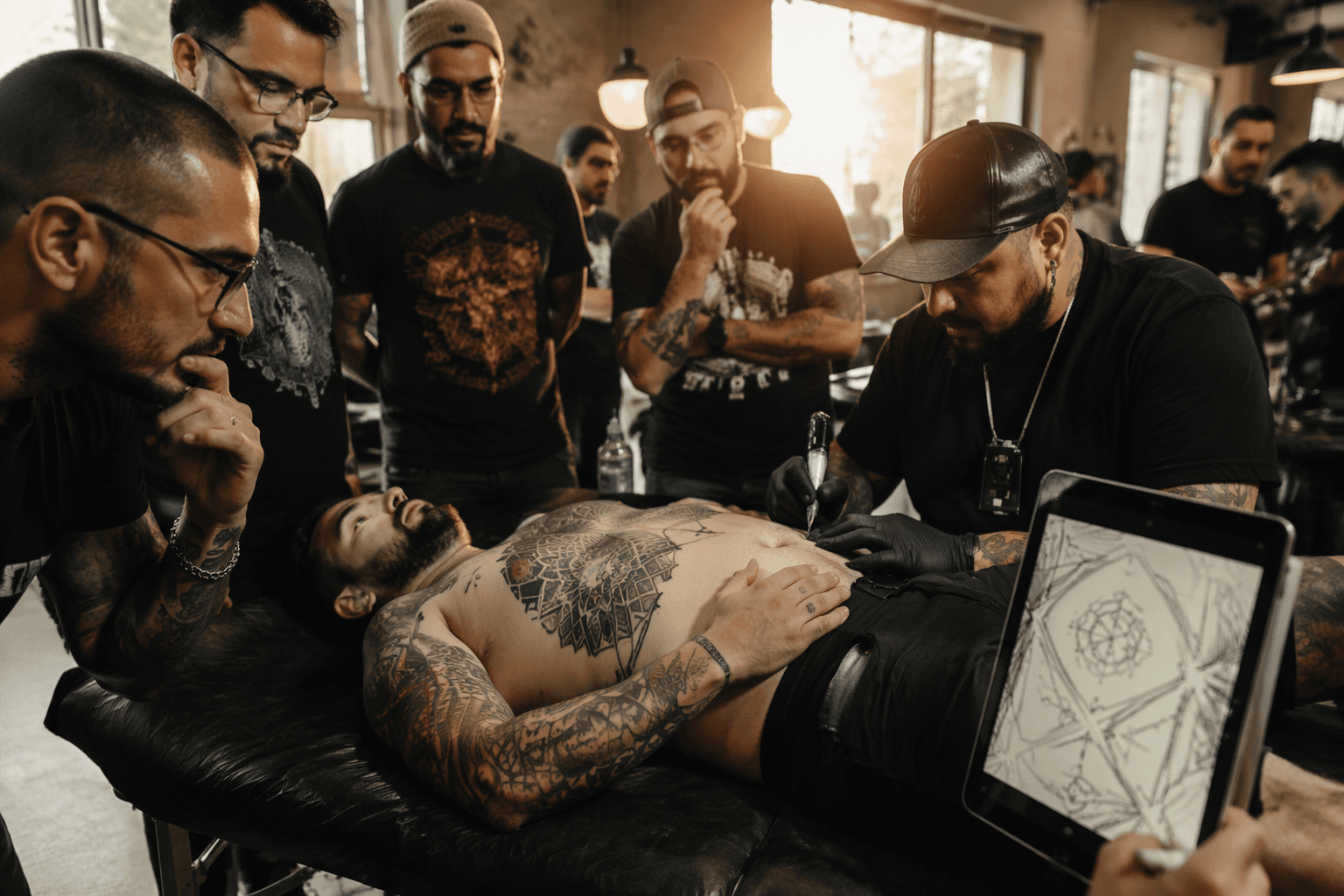
Geometric tattoos blend sacred geometry, symbolism, and personal meaning
Geometric tattoos are moving from simple shapes to meaning-rich systems, where symmetry, sacred geometry, and precision all shape the final brief.

Geometric tattoos now live at the point where symbolism meets technical discipline. The style starts with circles, triangles, squares, and clean line systems, but the real draw is how those forms can hold personal meaning without losing structure. That balance is why geometric work keeps pulling people in: it can read as spiritual, minimal, architectural, or fully custom, depending on how the shapes are built and where they sit on the body.
The core language: shape, symmetry, and meaning
At its most basic, geometric tattooing uses shapes and lines to build intricate, symmetrical designs. Circles often carry ideas of unity, eternity, and wholeness, while triangles can point toward strength, change, or spiritual trinities depending on the cultural context. Squares and other repeated forms add stability and order, which is why the style feels so controlled even when the artwork becomes dense.
That structure is a big part of the appeal. Geometric tattoos do not rely on loose illustration to create impact; they rely on proportion, repetition, and balance. For anyone narrowing ideas into a brief, the first decision is not just what to tattoo, but what kind of visual logic should hold the piece together.
Sacred geometry is still the strongest pull
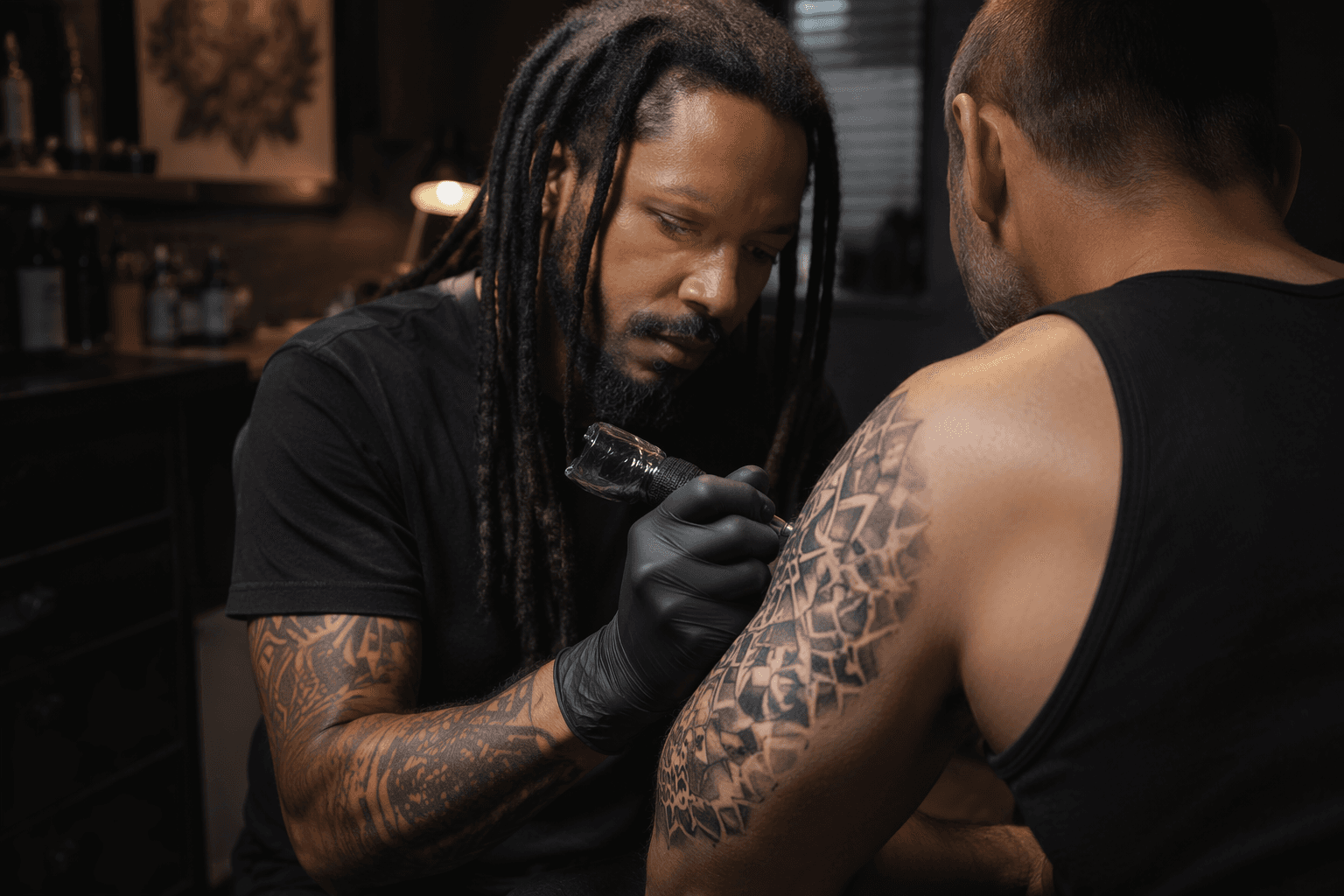
A major branch of the style centers on sacred geometry, especially mandala-inspired designs. Britannica describes a mandala as a symbolic diagram used in Hindu and Buddhist Tantrism for sacred rites and meditation, and as a representation of the universe. It also identifies yantras as linear ritual diagrams in Tantric Hinduism and Vajrayana Buddhism, which helps explain why these motifs keep appearing in geometric tattoo work.
That spiritual layer matters because it changes the meaning of the tattoo beyond decoration. A mandala can suggest interconnectedness, the universe, or personal growth, while a yantra brings in a more ritual-based, diagrammatic feel. If you want a piece that feels meditative and ceremonial rather than purely modern, sacred geometry gives the brief a clear direction.
Minimal geometry and ornamental symmetry are pushing the cleanest look
Not every geometric tattoo needs to be dense or spiritual. Tattoobnb frames the style as customizable, and one of the clearest directions is minimalist geometry: simple forms, careful spacing, and symmetry that stays readable from a distance. This is where the style overlaps with ornamental design, where symmetry itself becomes the statement.
The practical advantage is clarity. Minimal pieces are easier to scale for smaller placements, and they often depend less on heavy shading than on exact line placement and negative space. If you want something subtle but still unmistakably geometric, this is the lane to explore first.
Negative space is part of the design, not just empty skin
One of the most important decisions in this style is how much skin to leave open. Negative-space tattoo design uses the skin itself as part of the composition, creating contrast and depth through the interplay of ink and bare skin. In geometric work, that can completely change the read of the tattoo, especially when the design is built from interlocking lines or repeating shapes.
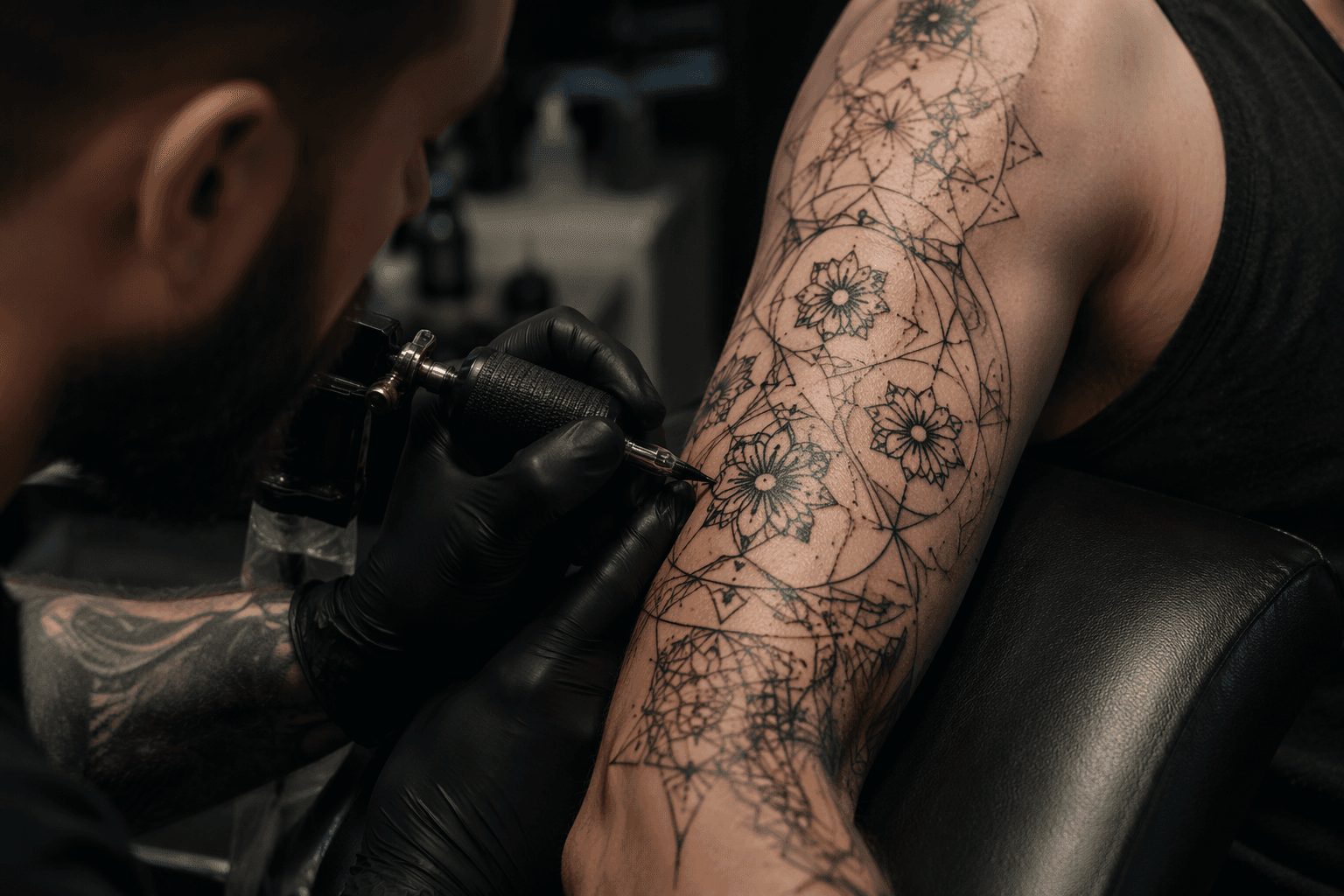
This matters for both aesthetics and longevity. A design with too much visual density can feel crowded, while a thoughtful use of open skin keeps the structure legible. It also changes how the tattoo sits on the body, since the skin becomes part of the architecture rather than just the canvas.
Hybrid motifs are where personal meaning gets layered in
Tattoobnb also highlights geometric designs that weave in animals, celestial symbols, or nature imagery. A geometric wolf inside a hexagon is a strong example of how the style can combine subject symbolism with shape symbolism at the same time. The animal brings its own meaning, while the hexagon adds balance, order, and frame-like containment.
This hybrid approach is often the smartest choice when you want the tattoo to feel personal without losing the precision that makes geometric work distinctive. It also gives the artist more room to design around placement, since the subject and the frame can be adjusted together rather than forced into a single flat idea.
The market is broad enough now that the style no longer reads as niche
The wider cultural context helps explain why geometric tattoos keep expanding. Pew Research Center found in 2023 that 32% of U.S. adults have at least one tattoo, including 22% who have more than one, and it reported that a large majority of Americans say society has become more accepting of tattoos in recent decades. That kind of mainstream acceptance gives more room for styles like geometric work to split into distinct substyles instead of staying underground.
The style also sits inside tattooing’s much older story. Tattooing has been practiced globally for thousands of years, with evidence going back to the Neolithic era. Geometric work may feel current because of its clean modern look, but it is still part of a much older body-art tradition.
What to ask for when you brief an artist
Geometric tattoos reward precision, so the artist choice matters as much as the idea. Tattoos are created by inserting ink into the dermis, and because geometric pieces depend so heavily on clean linework and healing quality, the person doing the work needs confidence with symmetry, spacing, and consistent execution. Many U.S. states do not require artists to provide aftercare instructions, so good aftercare advice should be something you actively ask for, not assume will be handed over.
- Do you want sacred geometry, minimalist symmetry, or a hybrid animal or nature design?
- Should the piece rely on dense patterning or more negative space?
- Is the priority a small, subtle tattoo or a larger architectural composition?
- Does the design need fine-line precision, dotwork texture, or stronger structural lines?
A useful brief usually answers a few practical questions:
The clearest geometric trend is still the same one the style began with: controlled form carrying personal meaning. Whether the choice is a mandala, a yantra, a hexagon-framed animal, or a stripped-down line composition, the best version of the tattoo is the one that keeps the geometry readable while making the symbolism feel specific. That is what gives the style its staying power, and why the cleanest-looking designs often end up saying the most.
This article was produced by Prism’s automated news system from verified source data, official records, and press releases, then run through automated quality and moderation checks before publishing. The system is built and supervised by the people who set the standards it runs under. Read our full AI policy.
Know something we missed? Have a correction or additional information?
Submit a Tip