New Safety Guide Helps Geometric Tattoo Artists Choose Compliant Pigments
Blacks, greys, and opaque whites — the backbone of geometric work — face the biggest reformulation pressure under new EU REACH and FDA standards. Here's what to ask your supplier now.

The inks you loaded last month may not exist in the same form by the end of 2026. That is not a hypothetical: between 2003 and 2024, firms conducted 18 voluntary recalls of tattoo inks in the United States alone, the most recent issued in August 2024, and European regulators have now restricted more than 4,000 substances previously found in commercial tattoo pigments under REACH. For geometric tattooists and blackwork artists, the reformulation pressure lands hardest on exactly the colors you reach for most: carbon-heavy blacks, diluted greys, and the opaque whites used in negative-space designs and highlight dotwork. A new evidence-oriented guide from KinInk, published as a public resource for artists navigating pigment selection in 2026, translates those regulatory shifts into a practical procurement framework.
Why Tattoo Ink Safety Is a Different Category Entirely
Most pigment safety conversations get muddied by a false equivalence with cosmetics. KinInk addresses this directly: "Unlike cosmetics applied to the skin surface, tattoo inks bypass the skin's natural barrier, making ingredient safety and purity critical." The distinction is not semantic. A contaminated foundation washes off; a contaminated tattoo ink is deposited into the dermis and can persist for decades, with research confirming that pigment particles can migrate from the skin to lymph nodes and the liver over time. For artists doing sacred geometry, mandala work, or fine-line dotwork, that permanence cuts both ways: a beautifully pure pigment holds line integrity for life, and an unstable one begins degrading the geometry the moment it settles.
The guide frames pigment selection as both a public-health issue and a durability issue, and for geometric work those two concerns are inseparable. Contaminated or chemically unstable pigments can trigger inflammatory responses that distort the healed surface, accelerate fading in ways that are uneven across a pattern, or cause pigment migration that turns a razor-clean 0.4mm line into a blur within a few years. When your entire design depends on the geometry reading correctly at distance and in detail, those outcomes are not just clinical problems; they erase the work.
The Five Standards That Actually Matter
KinInk's guide distills pigment safety into five core characteristics that artists should treat as non-negotiable when evaluating suppliers.
The first is REACH compliance, the European regulatory framework that now restricts thousands of substances in tattoo ink, including cobalt, nickel, and a broad class of azo dyes that were industry staples for decades. Compliance is not simply a European concern: as EU rules set the de facto global standard for ink manufacturers who want access to the largest regulated markets, REACH-compliant formulations are increasingly the baseline for any serious supplier worldwide.
The second is heavy-metal testing. Research published in late 2025 confirmed that despite REACH regulations coming into force in 2022, heavy-metal contamination in commercial inks remains a documented risk, particularly in brands that have not updated their sourcing. Artists should look for inks with independent laboratory certificates confirming levels below regulatory thresholds.
Third is sterile manufacturing. The FDA's final guidance on insanitary conditions in tattoo ink preparation, issued in October 2024, was a direct response to microbial contamination found in sealed ink bottles across multiple brands. Microbial contamination is not always visible and can survive in inks that appear factory-fresh.
Fourth is transparent ingredient labeling. A supplier who cannot or will not provide a full ingredient list is signaling something about what is in the bottle.
Fifth is documented batch testing. Every production run carries its own contamination risk; a certificate of analysis (COA) from a prior batch does not cover the bottle on your shelf today.
The Black and Grey Problem Geometric Artists Need to Know
Carbon black, the pigment that makes your darkest lines possible, carries a specific and well-documented risk: polycyclic aromatic hydrocarbons, or PAHs, which form as a byproduct of the combustion processes used to produce it. PAHs are classified as potentially carcinogenic, and their concentration in carbon-black-based inks varies significantly by manufacturer. The current benchmark for compliant inks is PAH content below 0.5 parts per million, and brands that have reformulated specifically for REACH compliance publish that test result. If your supplier's black ink documentation does not include a PAH figure, that is a gap worth closing before the next order.
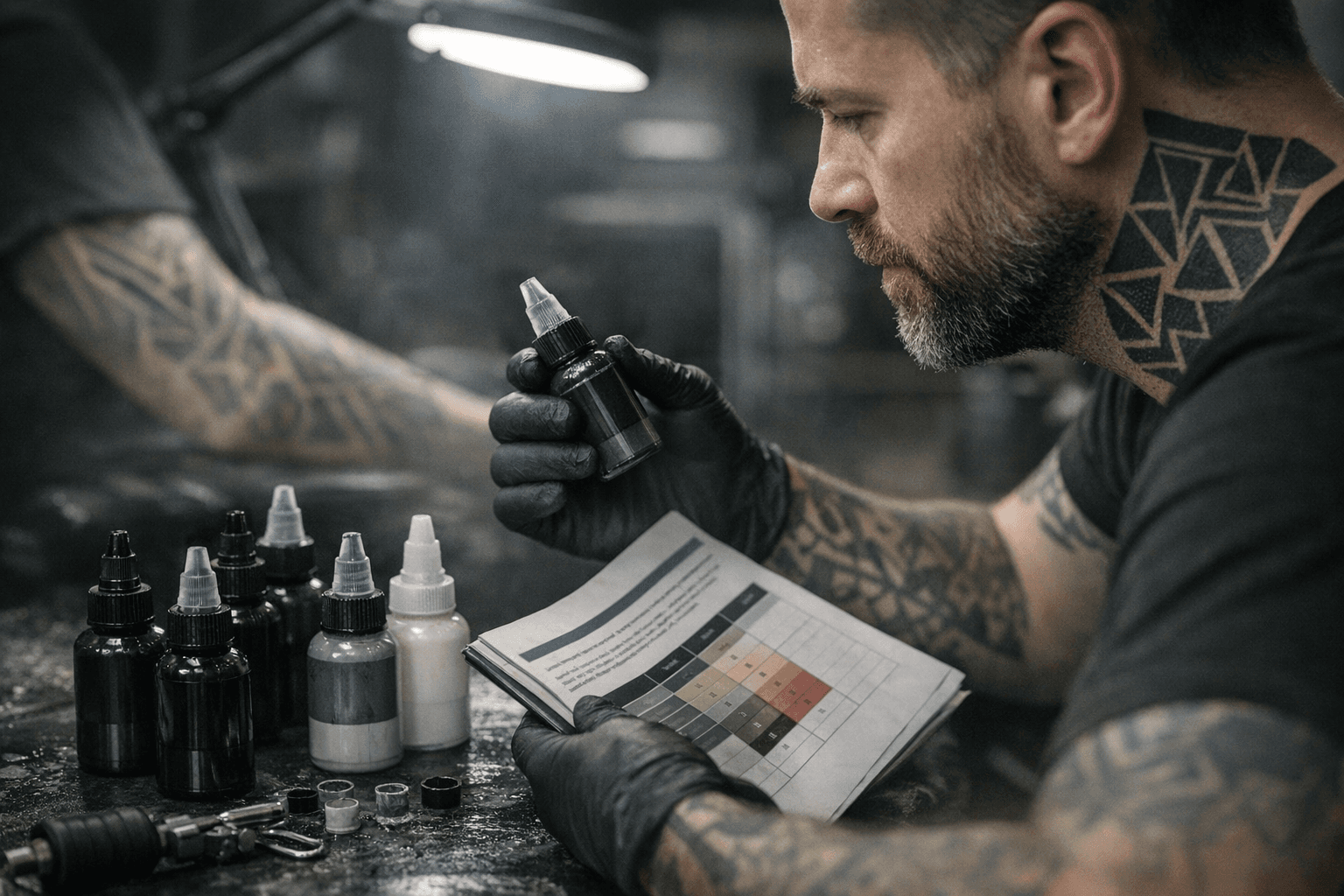
Azo pigments, which appear across the color spectrum but are also foundational to certain grey washes and diluted blacks, present a secondary concern: under certain biological conditions, azo compounds can decompose into aromatic amines, some of which are carcinogenic. REACH restrictions have already removed the highest-risk azo formulations from compliant inks, but legacy stock and unregulated imports continue to circulate. Opaque whites, frequently used in geometric highlight work and watercolor-style negative space, have historically relied on titanium dioxide formulations that are now under renewed scrutiny for particle size and potential immune response.
The Questions to Ask Before the Next Supply Order
The KinInk guide's actionable framework reduces to a straightforward due-diligence checklist for artist procurement. Before purchasing or reordering any ink used in geometric or blackwork pieces, work through these:
- Can the supplier provide a current certificate of analysis for the specific batch you are purchasing, not just a general compliance statement?
- Does the COA include third-party laboratory results for heavy metals, PAHs, and microbial contamination?
- Is the REACH compliance claim backed by documentation, or is it a marketing label without traceability?
- Are sterile manufacturing conditions confirmed in writing, and does that confirmation cover the packaging and filling process as well as the pigment itself?
- Is the full ingredient list available, with carrier liquids and preservatives disclosed alongside the colorant?
What Clients Can Request at the Consultation
As regulatory expectations normalize, clients are increasingly informed and entitled to ask about the inks going into their skin. At the consultation stage, you can proactively offer: the brand and product name of the inks being used, confirmation that the supplier holds REACH-compliant documentation, and a statement about sterile manufacturing. If a client asks to see a batch certificate, that request is reasonable and should be one you can fulfill.
Studios that build this transparency into their standard consent and consultation workflow are ahead of where the industry is moving. Insurers, studio risk policies, and consent form language are already beginning to evolve in markets where regulatory enforcement is active.
Spot the Red Flag: A Quick Reference
Not every compliance problem announces itself. Watch for these warning signs when evaluating a new supplier or reviewing an existing one:
- No batch number on the bottle and no COA available on request
- Vague "REACH compliant" marketing language with no supporting documentation or named laboratory
- Missing or incomplete sterilization information, particularly for water-based pigment suspensions
- Ingredient lists that omit carrier liquids or preservatives
- Repackaged inks with no clear chain of custody back to the original manufacturer
The Longer Game
Standardizing pigment procurement does more than protect the next client sitting in your chair. For geometric tattooists who specialize in work that is meant to read cleanly for a lifetime, pigment purity is the invisible infrastructure of the art. A destabilized black ink does not just create a health risk; it begins softening the edges that define a Metatron's Cube or collapsing the contrast gradient that gives a dotwork mandala its depth. The artists whose work holds up for twenty years are, in part, artists who made better sourcing decisions from the beginning. That connection between supply-chain diligence and long-term aesthetic integrity is what KinInk's 2026 guide is ultimately making legible, at a moment when the regulatory environment is making the cost of ignoring it higher than it has ever been.
This article was produced by Prism’s automated news system from verified source data, official records, and press releases, then run through automated quality and moderation checks before publishing. The system is built and supervised by the people who set the standards it runs under. Read our full AI policy.
Did this article answer your question?