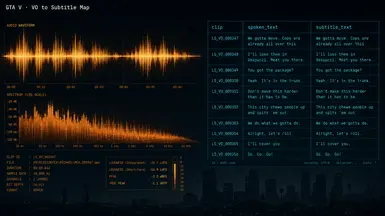
GTA V voice and subtitle map, 156,006 clips cataloged
156,006 clips are now searchable in a voice-to-subtitle map that cuts GTA V dialogue work from guesswork to lookup. Subtitle modders, toolmakers, and researchers can use it right away.
156,006 clips is the kind of number that changes the workflow, not just the headline. The new GTA V voice and subtitle map is not a flashy gameplay mod, but a spreadsheet-first reference built for anyone who needs to search, cross-check, or build tools around Rockstar’s audio and text systems. Instead of forcing you to reverse-engineer dialogue one file at a time, it gives you a structured way to connect spoken lines, subtitle text, and the GXT2 keys that tie them together.
What the map actually gives you
The download comes as two CSV files covering 156,006 English speech clips from GTA V. Each row pairs an AI transcript of the spoken line with the in-game subtitle text from Rockstar’s GXT2 files, plus the GXT2 key that links the two. The page also surfaces useful columns like bank, clip, stream_id, spoken_text, subtitle_text, subtitle_key, source file, and match method, which means the author has already done the tedious normalization work that usually eats up a project before it even starts.
That matters because this is useful in a way a normal mod package is not. There is no runtime change to install and no special tool required just to open the files. You can treat it like a reference library: search a line, find the subtitle entry, confirm the key, and move on with the actual creative work.
Who can use it immediately
Subtitle modders will feel the payoff first. If you are replacing text, building alternate subtitle packs, or checking how Rockstar handled a mission line, the map gives you a fast way to line up spoken audio with the text that appears on screen. Toolmakers can use it as a reference dataset for dialogue browsers, subtitle helpers, or audio indexers that need to know how voice and text are connected inside GTA V.
Machinima creators get a different kind of advantage. When you are scripting a cutscene remake or tracking down the exact line delivery you need for a scene, a searchable database turns a multi-hour file hunt into a few minutes of lookup. GTA researchers, especially anyone studying localization, archive structure, or dialogue organization, finally get a clean way to ask questions like which clip belongs to which subtitle key, how Rockstar grouped the audio, or how the text files relate to the voice assets.
Why this fits the GTA modding workflow
This kind of release slots neatly into the tools the community already uses. OpenIV, one of the main GTA V modding tools, supports opening .gxt2 text files in its text editor, so a structured voice-to-subtitle map gives users something concrete to inspect once they are inside those files. In other words, the map does not replace the usual modding toolkit, it makes the toolkit far more efficient.
The long-running GTAForums discussion around .gxt2 subtitle strings and .awc voice assets shows why this matters. Modders there have spent years trying to understand how subtitle text connects to the game’s audio files, including requests for dialogue scripts and help tracing one asset type to another. This dataset lands right in that gap: it packages the relationship into a searchable form instead of leaving every user to decode it from scratch.
The practical questions it answers
The real value of the map is that it turns slow, annoying questions into quick ones. Instead of asking where a subtitle line came from, you can search the transcript and confirm the GXT2 key. Instead of hunting for a matching voice asset by ear, you can use the source file and match method to narrow the field. Instead of building an audio analysis or subtitle overlay tool around scattered guesses, you can start from a normalized dataset that already links speech, text, and keys.
- subtitle lookups during mod editing
- audio indexing for dialogue libraries
- localization experiments that compare spoken and written lines
- archival work on GTA V’s mission and cutscene dialogue
- building scripts that interact with the RAGE audio system
That makes it useful for:
For people who live in the weeds of GTA asset extraction, that is a big deal. A resource like this saves time not only because it is large, but because it removes the first layer of friction from a lot of different projects.
A small release with a long tail
The map was uploaded to Nexus Mods on June 11, 2026, and it sits in Grand Theft Auto V Legacy Miscellaneous. The page showed zero endorsements when checked, which is normal for something this new, but the size and structure of the dataset make its usefulness obvious long before the community numbers catch up. Nexus also places GTA V Legacy inside a broader catalog with more than 1,000 mods, so this release lands inside an active ecosystem rather than a forgotten corner.
That active ecosystem still matters more than ever because GTA V itself is not a dead archive. Rockstar first announced the game’s release date as September 17, 2013, and the official GTA V pages still frame it as an active product alongside GTA Online and the Enhanced and Legacy versions. More than 12 years later, the fact that players are still mapping voices to subtitles says a lot about how deep the game’s modding and research scene remains.
Why this feels bigger than a database
GTA V modding is often associated with visible chaos: new vehicles, new scripts, new police calls, new ways to break the map. This release is the opposite. It is the invisible infrastructure that makes better mods, cleaner research, and faster experiments possible. A line of dialogue that used to take a long search through audio files now has a path, a key, and a transcript.
That is why this catalog matters. It is not trying to change GTA V on screen. It is changing how people understand the game behind the scenes, and for the creators who work in subtitles, audio, and tooling, that is the kind of update that can quietly reshape the next batch of projects.
This article was produced by Prism’s automated news system from verified source data, official records, and press releases, then run through automated quality and moderation checks before publishing. The system is built and supervised by the people who set the standards it runs under. Read our full AI policy.
Did this article answer your question?