Angus Young says no SG matches his favorite Gibson guitar
Angus Young owns a pile of SGs, but one worn Gibson still beats them all. The real lesson is how neck feel, weight and response can make a single guitar irreplaceable.
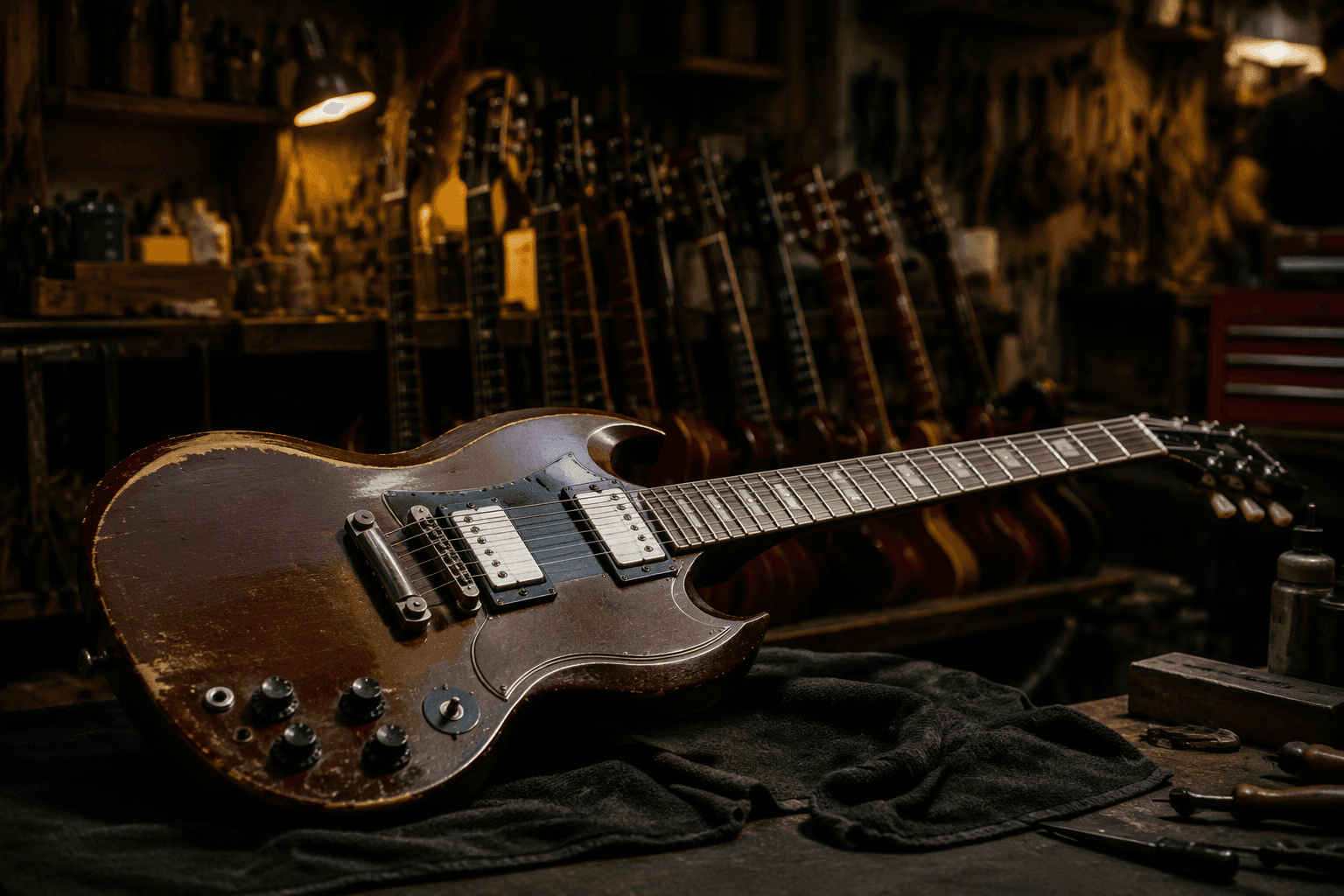
Angus Young owns so many SGs that he has lost count, yet he still singles out one guitar that none of the others can replace. That contradiction is the whole story: a player tied to one of rock’s most recognizable models, still hunting for the exact feel that made the original work. For AC/DC fans, the hook is obvious, but the useful part is even better, because it shows how much a guitar’s neck, balance, weight and response can matter when the instrument has to do the job night after night.
The one SG that still sets the bar
The line that frames the story says everything: “I’ve lost count of how many SGs I have. But none of them match up to that one guitar.” That is not collector talk, it is working-player frustration. A wall of same-model guitars can still leave you chasing one instrument that feels alive under your hands, and that is especially true with an SG, where small differences in carve, setup and wear can change the whole experience.
That is why the search for a replacement matters here. Young is not looking for another decorative piece; he is trying to find a guitar that reacts the same way, sits the same way, and pushes back the same way when he digs in. For a player whose rhythm style depends on attack and physical motion, one SG can become the yardstick for every other SG in the room.
Why the SG fit Angus in the first place
Young’s attachment to the SG was never just about image, even though the guitar became part of the AC/DC silhouette almost immediately. He has said he preferred SGs partly because they were light, which is the kind of practical reason that becomes a lifelong preference once you have done enough shows with a heavy instrument hanging from your shoulder. He has also said the shape suits smaller players better, a detail that gets repeated because it is so plain and so true to how the guitar actually hangs on the body.
The other half of the equation is feel and force. Young has said he tried Fenders but found them too heavy and not as powerful-sounding, which helps explain why the SG stuck. If the guitar is going to drive aggressive rhythm parts, cut through a loud band and still feel fast in the left hand, the SG’s lighter build and compact balance make real sense.
Why one SG can beat a dozen more
The player lesson here is simple: identical specs do not guarantee identical results. Two SGs can share a logo and still diverge in neck carve, balance, finish wear, pickup response and the way they sit against the body. That is the difference between a guitar that just looks right and one that feels like it disappears when you play it.
Young’s case is a clean example of that problem. A newer or cleaner SG can be perfectly well-made and still miss the thing that matters most to the player, whether that is a slightly different neck shape, a more stubborn weight distribution, or pickups that do not react the same way when you hit them hard. The hunt for a replacement is really a hunt for chemistry, and that is why it can be so frustrating even for someone with endless choice.

The archive trail around his SG obsession
This is not a new obsession dressed up as news. A complete interview archived by Jas Obrecht’s Talking Guitar places one Angus Young conversation on October 22, 1983, during AC/DC’s Flick of the Switch tour, which gives the SG story a clear historical anchor. By then, the guitar was already central enough to his playing that the questions kept coming back to why this shape, this weight and this feel worked so well for him.
The paper trail keeps showing the same interest from different angles. Guitar World has an archive piece from 1991 on Young discussing guitar riffs and brown Gibson SGs, and Guitar Player ran a piece focused on Angus Young’s favorite Gibson SG. SoloDallas also posted an update on 2010-09-30 under the title Angus Young’s FIRST Gibson SG, showing that fans and gear hunters have been chasing the same identification game for years.
What the live rig tells you about the guitar itself
Premier Guitar’s AC/DC Rig Rundown, published on 2016-09-13, is useful because it shows how stripped-down the band’s live setup remained. That matters here because when the rig stays lean, the guitar becomes the main event, not a piece buried under layers of processing or switching. With Angus and Stevie Young in a pared-back environment, the instrument’s own feel and response carry more of the load.
That is exactly why the favorite SG keeps mattering. In a stripped-down AC/DC context, you do not get to hide a guitar that feels wrong, fights back, or sits awkwardly on the strap. The right one has to give you the attack, the balance and the physical confidence to play the part without thinking about the tool.
What the story really teaches players
Angus Young’s SG obsession is useful because it strips the gear talk down to the part that actually matters. A famous name can own endless versions of the same model and still keep one guitar on top, because the best one is not always the cleanest, newest or most expensive. It is the one with the neck, weight and response that make you play differently the second you plug in.
That is the real takeaway from the hunt for his favorite Gibson SG: once a guitar locks in with a player, every other copy has to prove it can do more than look the part. For Angus Young, that benchmark has stayed stubbornly specific, and that is why one SG still defines the sound better than the rest of the collection ever could.
This article was produced by Prism’s automated news system from verified source data, official records, and press releases, then run through automated quality and moderation checks before publishing. The system is built and supervised by the people who set the standards it runs under. Read our full AI policy.
Did this article answer your question?