AHA Confirms 2026 National Homebrew Competition Dates, Finals Head to Asheville
First-round judging is already underway at nine regional sites, with NHC finals heading to Asheville June 17-18 for the competition's 47th year.
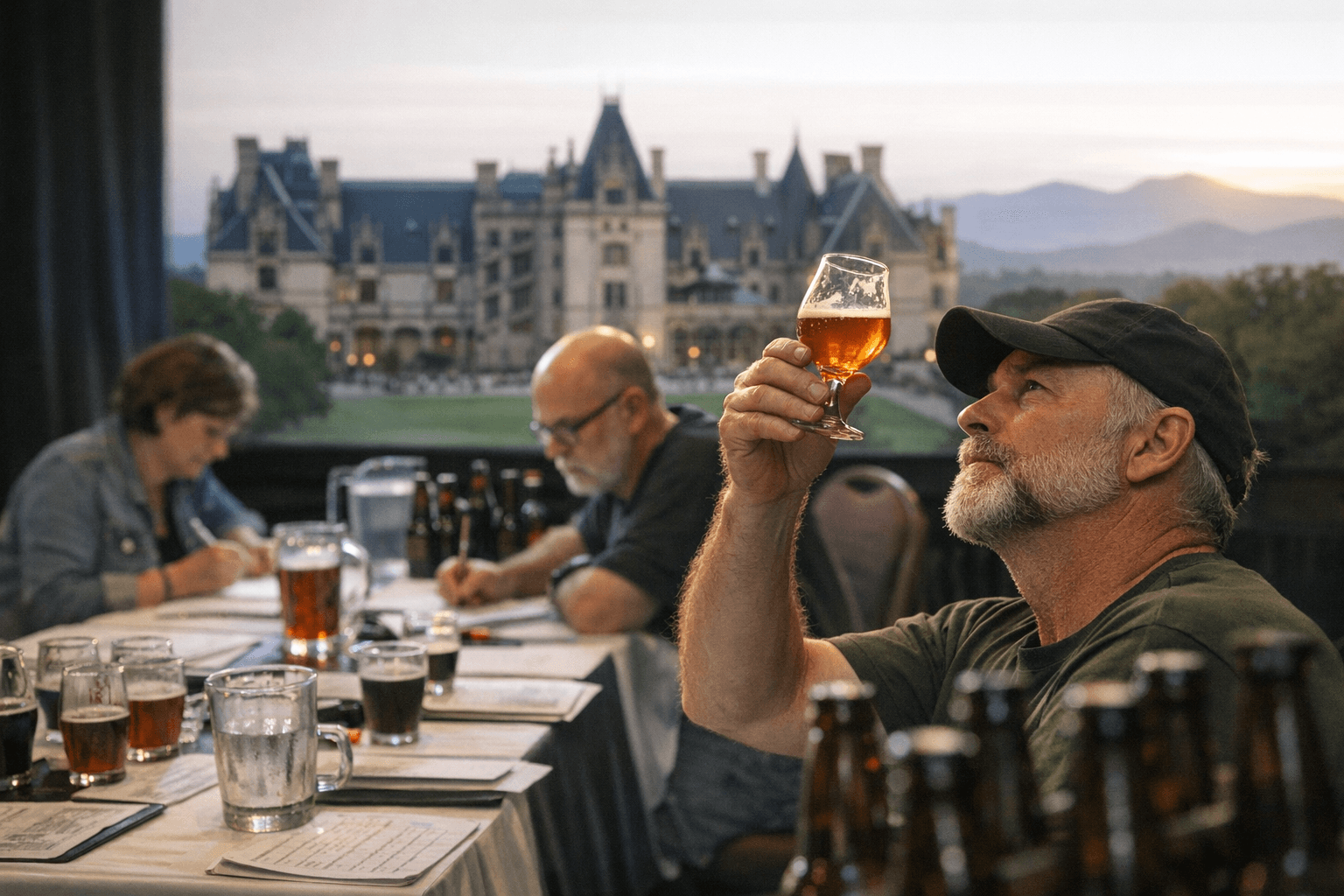
First-round judging for the 2026 National Homebrew Competition is already running across nine U.S. sites, with the American Homebrewers Association having confirmed a full schedule that places the Final Round and Awards Ceremony in Asheville, North Carolina, for the competition's 47th year.
Chicago opened first-round panels April 7, with judging running through April 11. Longmont follows April 10 through 12, and San Francisco closes the regional bracket April 11 through 12. Receiving windows at most sites wrapped in March and early April, meaning the bottle-shipping phase is effectively over. Advancement to Asheville now depends on judges working through entries at each of the nine sites, all of which are capped at 750 entries per location. With nine sites running at capacity, the first round accounts for up to 6,750 entries nationwide, an expansion from seven sites in 2025 and the program's most geographically distributed edition in recent memory.
Final Round judging runs June 17 and 18 in Asheville, followed by HomebrewCon on June 19 and 20 at the Harrah's Cherokee Center in downtown Asheville. The NHC Awards Ceremony and Knock-Out Party land June 20 at The Renaissance, marking the first fully independent HomebrewCon since the AHA separated from the Brewers Association in July 2025. Conference tickets are priced at $334.95, and the AHA has signaled that availability is limited.
For entries already in transit or at receiving tables, the packaging fundamentals carry full DQ weight. Federal law requires each bottle or can to carry a "HOMEMADE PRODUCT FOR COMPETITION" label, and the outside shipping box must display "Attn: 2026 NHC" clearly. No identifying marks go on the bottle itself; judges pull entries blind, and anything traceable to a specific brewer gets flagged before it reaches the panel. Standard brown or green bottles in the 10-to-14-ounce range with crown caps are required for most beer categories, fill levels must land within half an inch of standard, and carbonation should match the declared style. AHA membership must be current through judging, entry fees confirmed paid, bottle count correct per category, and the style category must align with the 2025 BJCP guidelines under which all entries are evaluated. Entries registered in the wrong category face the same outcome as mislabeled bottles: no advancement and limited useful feedback.
The style selection decision compounds the logistics. High-ABV entries, imperial stouts, barleywines, and Belgian quads travel reliably and hold their character under multi-day shipping. Dry-hopped IPAs and delicate German lagers oxidize or shift significantly under heat and transit stress, and they also carry higher judging variance across regional panels where freshness is impossible to standardize. Mixed-fermentation styles and malty entries tend to score more consistently across sites. For anyone already planning for 2027, the sharper move is choosing the shipping site first, then building the recipe around what will arrive intact.
The NHC has evaluated more than 170,000 entries since 34 homebrewers competed in Boulder in 1979. Finalists in Asheville this June will join that history, and for a handful, a medal in Asheville has historically been the opening line of a commercial brewing conversation.
This article was produced by Prism’s automated news system from verified source data, official records, and press releases, then run through automated quality and moderation checks before publishing. The system is built and supervised by the people who set the standards it runs under. Read our full AI policy.
Did this article answer your question?