Community-centered breweries find traction as craft beer market softens
The breweries still gaining ground are winning close to home, not by chasing every shelf. In a softer market, taprooms and neighborhood loyalty are doing more heavy lifting.
The market has gotten harder to outrun
The breweries still finding traction are not the ones trying to be everywhere at once. They are the ones building a stronger reason for people to come back to the same room, the same neighborhood, the same beer list.
That matters because the numbers tell a blunt story. U.S. craft brewers produced 23.1 million barrels in 2024, down 3.9% from 2023. Craft’s volume share slipped to 13.3%, even as retail dollar value was estimated at $28.8 billion. The Brewers Association also counted 9,796 operating U.S. craft breweries in 2024, with 430 openings and 529 closures, the first year since 2005 that closures outpaced openings nationwide.
There is still motion in the market, but it is slower, tighter, and less forgiving. The association reported 9,358 active craft breweries as of June 2024, up slightly from 9,339 in June 2023, while 54% of surveyed breweries said they grew in the first half of 2024 compared with a year earlier. At the same time, craft brewing employment rose to 197,112, a reminder that this business is increasingly shaped by hospitality, taprooms, and brewpubs as much as by package volume.
What the breweries finding traction keep doing
The strongest pattern in the analysis is also the most practical one: community-centered breweries are getting more attention because they are easier to defend. Direct relationships with drinkers, a recognizable local identity, and a sense of place still matter when the shelf is crowded and the on-premise market is crowded too.
That is a real shift from the old distribution-first mindset, where growth often meant pushing farther outward. The breweries that are moving now are usually doing the opposite. They are leaning into neighborhood loyalty, event programming, and spaces people actually want to spend time in, which creates a feedback loop that is harder to replicate from afar.
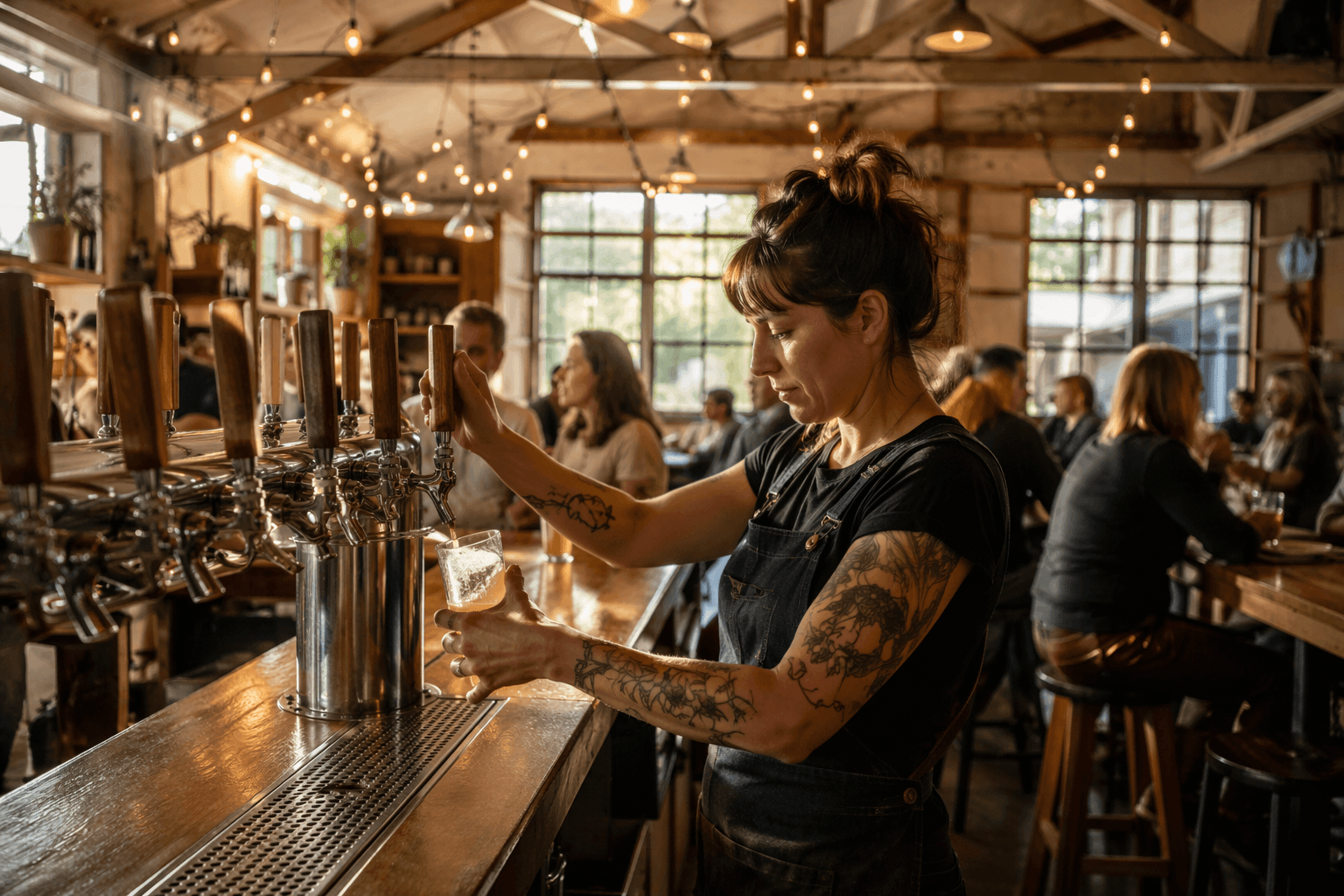
That logic fits the broader labor picture as well. The Brewers Association has tied rising craft employment to hospitality-forward models like taprooms and brewpubs, and that connection matters because it explains where the value is moving. A brewery that creates reasons to visit, stay, and return is not just selling beer, it is building a local habit.
Why the checklist feels persuasive, and where it still needs proof
The appeal of the sponsored analysis is that it does not pretend there is one magic formula. It looks across brewery conversations, market data, style trends, ingredient demand, and time spent in taprooms across North America, then points to recurring behaviors rather than a single cure-all. That is the right instinct in a market where broad growth is no longer automatic.
Still, it is worth pressure-testing the claims. A pattern showing up in conversations is not the same thing as a repeatable business model. Community focus, for example, is clearly actionable for small breweries because it can be built with modest capital and a tight operating footprint. But it still has to be backed by good beer, disciplined staffing, and an experience worth repeating. Without those pieces, “local” becomes a slogan instead of an advantage.
The same caution applies to the supplier-side optimism around premiumization, craft beer, alcohol-free beer, and premium whisky. Soufflet Malt, which describes itself as the world’s leading maltster and says it serves both large global breweries and artisan craft brewers, has a broad view of demand. That wide lens is useful. It does not automatically prove which individual brewery concepts will work in a softer market.
What actually translates for small breweries
For small breweries, the lesson is not to copy scale. It is to make the business easier for regulars to understand and easier for them to revisit. The breweries with momentum are usually doing a few things well rather than many things halfway.
- They know what their taproom stands for, and they make that obvious fast.
- They create reasons to return, from events to fresh releases to a room that feels connected to the neighborhood.
- They avoid treating every market like a growth opportunity if they do not have the operational depth to support it.
- They pay attention to the crowded shelf and crowded draft list, then lean harder into the face-to-face part of the business.
For serious homebrewers, that same logic is useful in a smaller form. The most resilient homebrew projects are often the ones built around a clear identity, a tight feedback loop, and a realistic sense of what the people around you actually want to drink. In a market where consumer attention is fragmented, clarity beats ambition that has no follow-through.
The real win is becoming a habit
The industry is not rewarding bigness the way it once did. It is rewarding breweries that feel rooted, recognizable, and worth returning to, especially when the broader market is softer and the easy growth has already been picked over.
That is why the most convincing signal in the analysis is also the simplest one: the breweries still moving ahead are acting less like distant brands and more like part of the local routine. In a year when closures finally outpaced openings, that is not a slogan. It is the difference between being noticed once and becoming the place people keep coming back to.
This article was produced by Prism’s automated news system from verified source data, official records, and press releases, then run through automated quality and moderation checks before publishing. The system is built and supervised by the people who set the standards it runs under. Read our full AI policy.
Did this article answer your question?