Festival Season Checklist: Brew, Package, and Network Like a Pro
Sixty-plus breweries just poured at Lagerville and Wormtown is back in Worcester; the festival pipeline is wide open for homebrewers ready to show up with a plan.
The window between now and late June is the most crowded stretch of the craft beer calendar, and every reopening, festival, and competition final is a door you can walk through. Lagerville drew more than 60 breweries to Figueroa Mountain Brewing in Buellton this weekend. Wormtown Brewery relaunched its Worcester, Massachusetts taproom with a larger footprint after a year-plus closure, bringing its "Be Hoppy" IPA back to a community that's been waiting. The Barcelona Beer Festival hosted 30,000-plus attendees and poured from 600-plus craft beers across 100-plus breweries at Fira Barcelona's Montjuic hall. The American Homebrewers Association's 2026 National Homebrew Competition sends its final round to Asheville, North Carolina on June 17-18. These aren't events to watch from afar. They are your entry points.
Brew Something Worth Pouring
A festival-ready small batch starts with a commitment to a single, clear style story, not a showcase of every technique you've learned. Think "session Kölsch with local lemon peel" rather than a kitchen-sink adjunct build. Festivals reward clarity: a pourer who can explain a beer in one sentence gets more return visits than one describing seventeen ingredients. For a 10-to-20-litre batch at this scale, water chemistry and fermentation temperature control matter disproportionately. Small-volume mashes amplify every pH deviation and every degree of temperature drift during fermentation, so measure both rather than estimating.
Yeast health is the variable most homebrewers underinvest in for short runs. Build a starter or properly rehydrate dry yeast: underpitched or stressed yeast produces off-flavors that a small batch has nowhere to hide. For festival IPAs specifically, late hopping combined with thiol-enhancing practices, explored in depth through BeerSmith's coverage of yeast and hop biotransformation, maximizes aroma without loading in harsh bitterness that compounds across a long pour session. The goal is a beer that tastes as good in the final sample glass of the session as it did in the first.
Package Like It Has to Travel
If short-run canning isn't viable at your scale, crowler fills are the professional alternative. They preserve hop character, look clean on an event table, and give you flexibility on fill date without committing to a full canning run. Whatever format you use, investigate local labeling requirements before you arrive anywhere near a festival or pop-up. Even informal events can carry liability exposure, and ABV labeling rules vary by jurisdiction. A quick call to your state's alcohol control board, or a conversation with a brewer who's already navigated it, takes 20 minutes and can prevent a costly surprise.
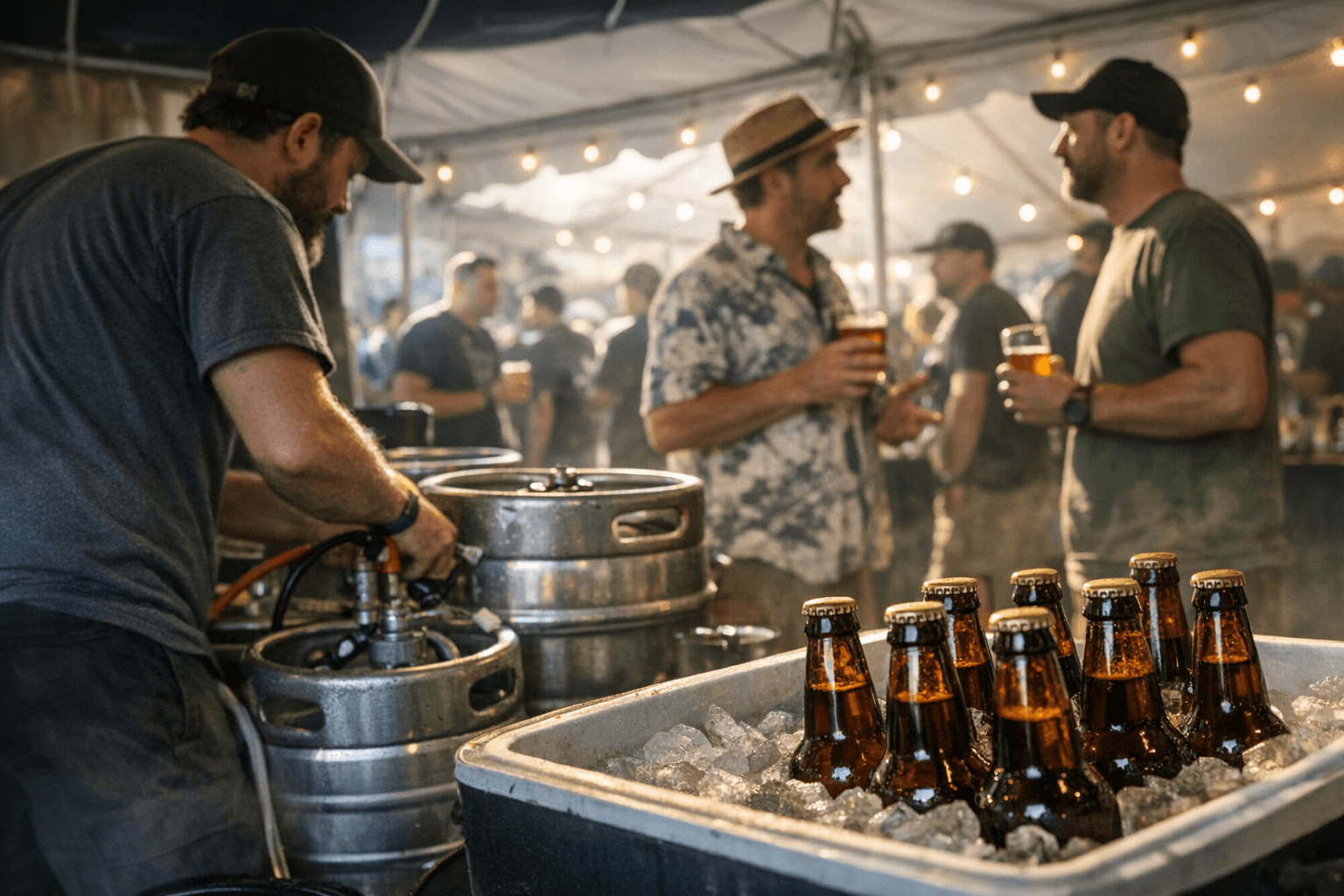
The temperature chain is the part of packaging logistics that homebrewers most often skip and then regret. Hoppy beers begin losing volatile aroma compounds the moment they leave refrigeration. From fill to festival table, keep them cold: simple insulated coolers and iced totes are sufficient and make a measurable sensory difference by the end of a four-hour pour session.
Sell the Story Before the Sip
No matter how technically sound your beer is, the conversion from "sample" to "I need to find this person again" happens through storytelling. Prepare one line: the ingredient origin, the recipe inspiration, the local tie-in. Bring printed business cards and a QR code linking to your recipe notes or an email list signup. Include a printed ingredient list at the table for allergen transparency. These details signal professionalism to the brewers, buyers, and collaborators also working the event, not just to casual attendees.
Collaboration as a Growth Strategy
Cross-traffic partnerships with local food trucks, charities, or small independent brewers extend your reach beyond the homebrewer identity. A food pairing collaboration for a festival weekend, even an informal one, puts you in front of an audience that wouldn't have sought out your table independently. If demand from a successful festival appearance exceeds what a small-batch setup can support, contract brewing for a limited run is a legitimate next step, provided you retain your recipe IP and maintain quality oversight at every stage. The recipe is the asset; the production arrangement is just logistics.
Your 30-Day Action Plan
The fastest way to move from passive observer to active participant is to work backward from a specific deadline rather than waiting for a perfect moment.
Days 1-7: Research and reach out
Identify two or three local festivals or taproom events in the next 60 days. Email the organizer directly: introduce yourself as a homebrewer, ask about pouring opportunities, volunteer slots, or steward positions for any accompanying competition. For the AHA's National Homebrew Competition, which runs first-round judging across nine sites nationally before the June 17-18 Asheville final, steward and judge roles are filled through the AHA forum and site coordinators. Post there this week. For festivals on the scale of the Great American Beer Festival, new pouring volunteers require a referral from a current volunteer; start building that relationship now rather than in October.
Days 8-14: Brew and document
Lock in your style target and brew your festival batch. Log every variable: mash pH, fermentation temperature curve, pitch rate, and dry-hop timing. This documentation becomes your talking point at the table and your quality baseline if you scale into contract production.
Days 15-21: Package and prepare your table kit
Fill crowlers or cans, label them correctly, and build your full table setup: a printed ingredient list, a QR code card linking to your recipe or mailing list signup, and a two-sentence pitch you've said out loud to another person before the event.
Days 22-30: Cold-chain test and confirm logistics
Do a full dry run. Pack your cooler as you would for the actual event, hold it at ambient temperature for four hours, then evaluate the beer. If aroma has degraded noticeably, adjust your insulation before the event. Confirm your pour or volunteer slot, verify any required insurance or licensing paperwork, and plan to arrive early enough to introduce yourself to the organizers before the crowd fills the space.
The homebrewers who convert festival energy into lasting momentum are not the ones with the most technically accomplished beer. They are the ones who showed up prepared, told a clear story, and made it easy for the right person to find them again.
This article was produced by Prism’s automated news system from verified source data, official records, and press releases, then run through automated quality and moderation checks before publishing. The system is built and supervised by the people who set the standards it runs under. Read our full AI policy.
Did this article answer your question?