Scientist Brews Experimental Vaccine Beer Using Engineered Yeast at Home
NCI virologist Chris Buck brewed a Lithuanian farmhouse ale with cancer-linked virus antigens at home, drank two pints daily for four days, and reported antibody responses.
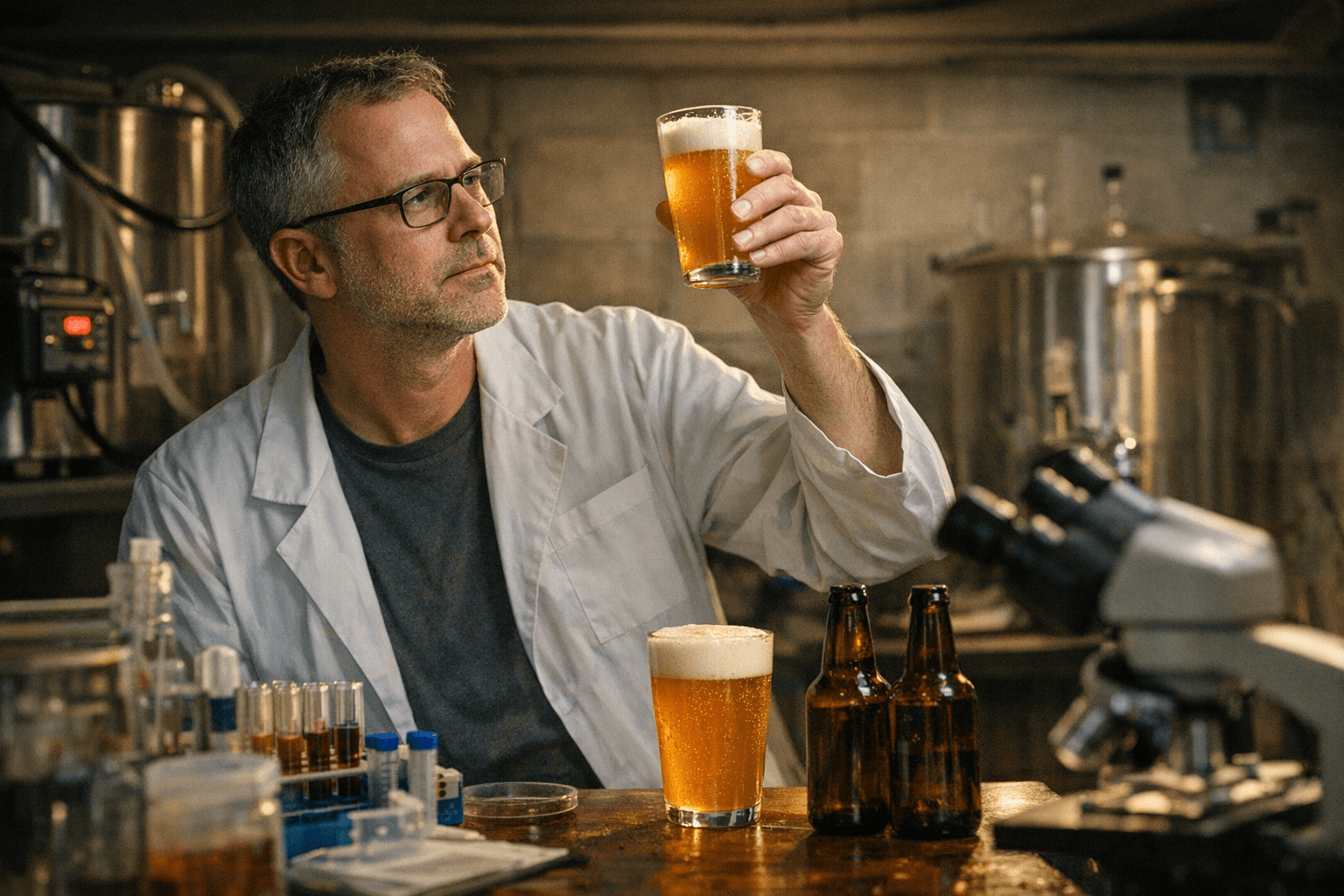
Chris Buck had homebrewed beer off and on for 30 years before it occurred to him that his kitchen setup and his virology lab might be pointing at the same experiment. When research showed that feeding lab mice engineered brewer's yeast could induce protective antibody responses against the virus he studies, Buck's reaction was immediate: "Well, I can definitely do that at home."
So he did. Buck, a virologist at the National Cancer Institute in Bethesda, Maryland, engineered a strain of Saccharomyces cerevisiae to express proteins from BK polyomavirus and used that yeast to ferment what he later described as a Lithuanian-style farmhouse ale. He drank about two pints a day for four days, then monitored his blood in the months that followed. The results, posted to the research repository Zenodo in December and not yet peer-reviewed, suggest his antibody levels rose against BK polyomavirus subtypes II and IV, with subtype IV as the primary target of the experimental brew.
BK polyomavirus is not an obscure target. The virus infects most people in childhood, typically without symptoms, but reactivates dangerously in transplant recipients on immunosuppressants, causing kidney damage, bladder inflammation, and serious complications. Buck has discovered four of the 13 polyomaviruses known to infect humans, and his NCI laboratory is collaborating with the biotech company Biological E on a conventional injectable vaccine for polyomaviruses, a program still some distance from clinical trials. The beer experiment was never meant to wait for that timeline. "If I were waiting for a transplant I would get it immediately," Buck told The Times.
The delivery mechanism is the point. Buck engineered the yeast so that live cells protect viral proteins from stomach acid long enough to reach the intestines, where immune cells encounter the antigens and can mount a response. His brother co-authored one of the two Zenodo reports, which together describe both the beer-making process and the broader concept of edible vaccines. "It's a radically simplified approach to making vaccines," Buck said.
The institutional path was less smooth than the fermentation. A research ethics committee at the National Institutes of Health told Buck he could not experiment on himself by drinking the beer. According to reporting by Futurism, two separate NIH panels, one research and one ethics, came out against the self-experimentation. Buck proceeded anyway, conducting the project through Gusteau Research Corporation, a one-man shell company he established to allow private experimentation outside his official NCI capacity. Some reporting separately characterizes the vehicle as a nonprofit he founded; the exact organizational structure has not been publicly reconciled.
Buck, his brother, and a small number of others consumed the beer and reported no adverse effects. He has posted the full homebrewing recipe publicly on Zenodo and argues the ingredients carry no novel risk: the yeast components meet the FDA definition of "generally regarded as safe," and he notes that polyomaviruses themselves are shed in urine and aerosolized with every toilet flush, meaning most people already encounter them daily without knowing it.
The self-reported antibody data has not been independently verified, and the Zenodo posts have not undergone peer review. Some researchers, while supportive of ingestible vaccine research as a concept, have expressed concern that the unsanctioned approach could fuel anti-vaccine misinformation. Buck is not persuaded that waiting is the right call: "This is the most important work of my whole career. It's important enough to risk my career over."
For people who don't drink, he is already experimenting with alternate formats, including dried yeast chips and yeast capsules, and hopes to enlist commercial yeast manufacturers to scale production beyond what a home kitchen can handle. The beer itself, for what it's worth, got high marks on its own terms. "It was one of the best homebrews I ever made," Buck said.
This article was produced by Prism’s automated news system from verified source data, official records, and press releases, then run through automated quality and moderation checks before publishing. The system is built and supervised by the people who set the standards it runs under. Read our full AI policy.
Did this article answer your question?