Top All-Grain Brewing Systems Ranked by Budget, Batch Size, and Automation
All-grain ingredient savings can pay back a $229 electric kettle in under 12 months; here's exactly which system earns that upgrade for your batch size and automation goals.
Here's the split that matters before you spend a dollar: can you brew excellent beer with a bag and a stockpot? Yes. Does that answer change as soon as you want brewery-style repeatability, 10-gallon batches, or step-mash capability? Completely. The upgrade from extract to all-grain saves roughly $8-10 per 5-gallon batch in ingredient costs alone, since raw base grain runs 30-40% cheaper than equivalent malt extract per batch. Brew twice a month and a $229 electric kettle system pays for itself in under 12 months. That payback window stretches to roughly four years on a $999 Bluetooth-connected all-in-one. Knowing your number before you shop changes which product makes sense.
The upgrade path runs in a clear line: stovetop extract, then BIAB in any kettle, then electric all-in-one with integrated element and PID, then pump-assisted two-vessel, then three-vessel HERMS or RIMS. Every step costs more upfront, saves active time per brew day, and tightens process control. The three benchmarks worth measuring before you buy: time per brew day (electric all-in-ones cut active monitoring by 30-45 minutes versus manual propane), mash efficiency (recirculating systems consistently hit 75-80% versus 65-70% for static BIAB), and annual ingredient spend (raw grain costs roughly 30-40% less per batch than malt extract). Here are the 10 systems, ranked from minimum-viable to full pro-sumer build.
1. Entry-level BIAB bag-and-kettle setup (under $100)
A nylon mesh bag dropped into any kettle you already own is the cheapest legitimate all-grain path. There is no PID, no false bottom, no recirculation, but the beer is genuinely all-grain and the method scales to any grain bill. This is the proof-of-concept phase: brew two or three batches before you commit to hardware.
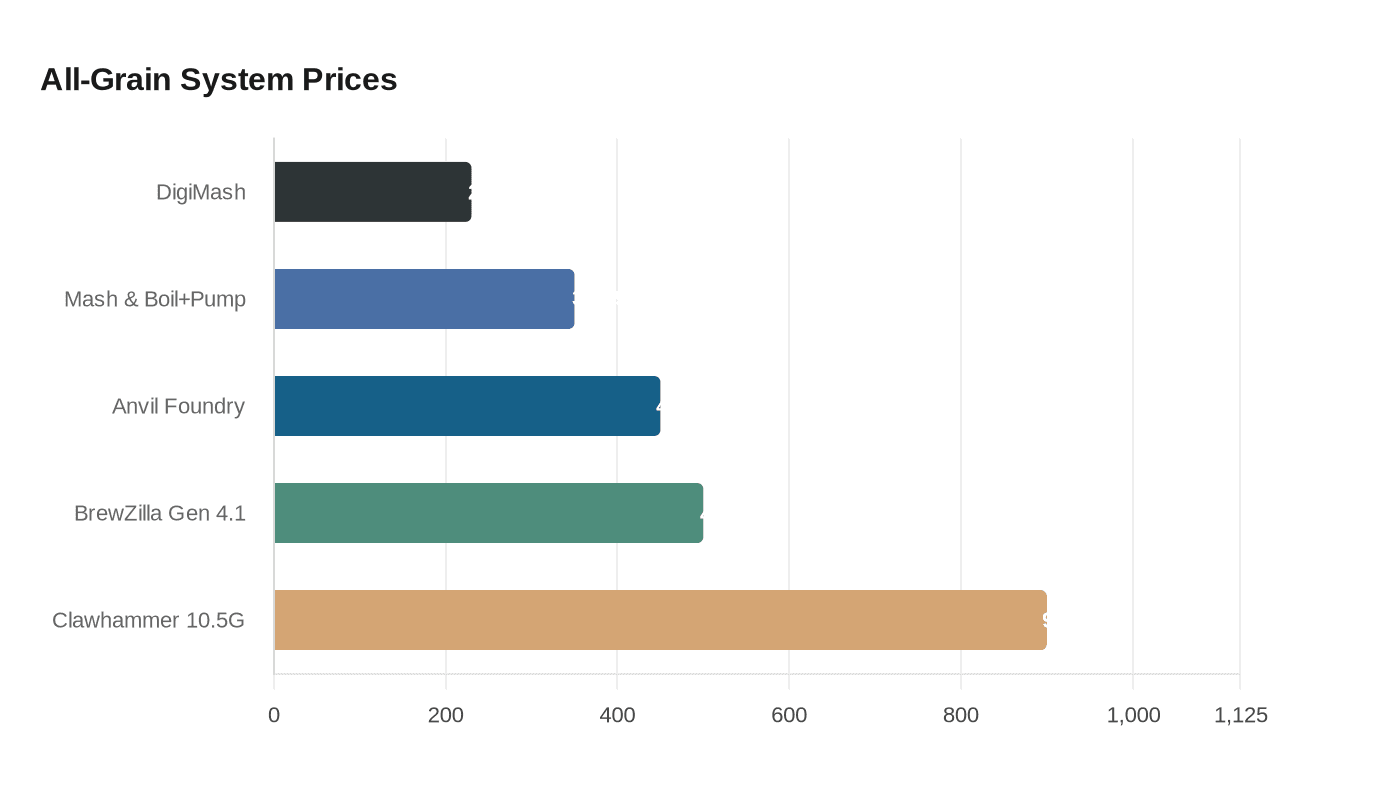
2. DigiMash All-Grain Electric Brewing System ($229.99)
The DigiMash pairs a 9-gallon DigiBoil electric kettle with a stainless mashing accessory pack and holds its position as the most affordable electric all-grain option on the market. The false bottom is noted to pass fine grain particles, which many brewers address by adding a nylon bag inside the grain basket. At $229.99 for a complete electric rig, the tradeoff is easy to accept.
3. Brewer's Edge Mash & Boil Series 2 with Pump ($349.99)
The Mash & Boil's double-wall stainless construction conserves heat well enough to achieve a rolling boil on 110 volts and 1,600 watts, making it a genuine kitchen-friendly option. The pump-equipped version at $349.99 handles grain bills up to 16 lbs., covering most standard 5-gallon recipes without breaking a sweat. The adjustable thermostat and internal sparging basket handle mash and boil in a single vessel, which keeps cleanup simple.
4. BrewZilla Gen 4.1 35L (~$499.99)
The BrewZilla Gen 4.1 moves beyond simple temperature maintenance with a sophisticated digital control panel that supports pre-programmed mash schedules, turning step mashes from an active task into a set-and-forget process. At $499.99 from retailers like MoreBeer, this is the most feature-dense system under $500 on most shortlists. The Gen 4.1 also accepts a distillation lid and AlcoEngine condenser for dual-use, making it one of the most versatile purchases in this price range.
5. Anvil Foundry (~$450 base / ~$550 with pump)
The Anvil Foundry's standout feature is switchable power: it runs on standard 110V household current or 240V for significantly faster heat-up times, which matters on larger grain bills where wait time compounds. The pump is a $100 add-on rather than integrated, giving you the option to use a pump you already own. Temperature precision in the Foundry is consistently rated tighter than competitors at this price, though its base construction is not 304 stainless.
6. Clawhammer Supply 10.5 Gallon Electric All-in-One (~$900)
Built from 304 stainless steel and running on 120V standard power, the Clawhammer Supply 10.5-gallon system is one of the largest food-grade single-vessel electric rigs available before you cross the $1,000 mark. The modular design with replaceable parts reduces long-term maintenance cost, and the semi-automated digital controller handles both the mash and the boil. For brewers pushing true 10-gallon batches without a 240V circuit, this is the top single-vessel contender.
7. Grainfather G30 Connect (~$999 MAP)
The Grainfather is a feature-laden, all-in-one brewing system constructed from 304 stainless steel. The GrainFather G30 Connect runs on standard 110-120V household power and has a 1,600-watt heating element, with a tempered glass lid and a ton of advanced features without the price tag of some of the more advanced all-in-one electric brewing systems available. The Connect includes Bluetooth capability so you can control the unit from your phone, with programmable step mashing temps and delayed heating so you can fill your Grainfather with water the night before and wake up to water at strike temperature. The included counter-flow chiller pushes total accessory value well above any competitor at this price point.
8. Pump-assisted two-vessel recirculating system ($600-$1,500)
Moving from a single vessel to two means separating the mash tun from the boil kettle and adding at least one pump for wort recirculation and transfer. A functional two-vessel setup with a fabricated mash tun, a March or Chugger pump, and a basic PID controller can be assembled in the $600-$1,200 range depending on vessel size and materials. This is where lautering consistency improves meaningfully: vorlauf runs cleaner, first runnings are clearer, and you gain the ability to run a RIMS tube for step mashing outside any single manufacturer's ecosystem.
9. Two-vessel HERMS setup: Blichmann BrewEasy and equivalents ($1,500-$2,500)
The Blichmann BrewEasy is the canonical example of a polished two-vessel heat exchange recirculating mash system: a kettle and mash tun stack with a recirculating heat-exchange circuit that delivers brewery-grade mash temperature control without the footprint of a three-vessel rig. A two-vessel HERMS configuration offers precise and efficient control of mash temperature through continuous recirculation of the wort. At $1,500-$2,500 depending on kettle size, mash efficiency stabilizes in the 78-82% range, and the compact two-vessel footprint fits most garage setups without permanent plumbing.
10. Three-vessel HERMS/RIMS electric rig ($2,000-$5,000+)
Spike Brewing builds turnkey brewing systems available in 10- to 50-gallon kettle sizes, with stainless steel kettles, a 50-amp PID-controlled brewing panel, a HERMS coil, heating elements, pumps, valves, pickup tubes, mash screens, food-grade tubing, and quick-connect fittings. A determined DIY builder can put together a 120V three-vessel HERMS rig for closer to $1,500-$2,000 by sourcing a Blichmann HERMS coil, DC solar pump, and wort pump separately, as documented by builders on Homebrew Talk. The cost factor is unavoidable: this is the pinnacle of homebrew equipment and it is priced accordingly, and portability is essentially gone once the system is set up. The payback case on ingredient savings alone is thin at this tier; the real return is 10-gallon-plus batch consistency and the ability to brew commercially scalable recipes at home, batch after batch, without variables.
The most common regret in homebrewing upgrades is not buying too cheaply, it is buying for the brewer you hope to become rather than the one you actually are right now. A BrewZilla at $499 brewing 24 batches a year beats a three-vessel rig sitting idle in a garage every time.
This article was produced by Prism’s automated news system from verified source data, official records, and press releases, then run through automated quality and moderation checks before publishing. The system is built and supervised by the people who set the standards it runs under. Read our full AI policy.
Did this article answer your question?