What hop creep is, and why dry-hopped beer keeps changing
Dry hopping can keep beer fermenting after it’s packaged, shifting gravity, carbonation and diacetyl while raising the risk of gushers or bottle bombs.
A dry-hopped beer can keep fermenting after the tank looks finished. Hop creep keeps changing beer after packaging, nudging gravity, alcohol, carbonation and flavor stability in ways that matter most when the beer is already in a bottle or keg.
What hop creep is
Hop creep happens when enzymes carried on hops break long-chain, unfermentable dextrins into sugars that yeast can still eat. Three things have to line up for it to happen: there has to be unfermentable extract in the beer, live yeast has to be in suspension, and hops have to be added to fermenting or fermented beer.
That makes hop creep a process problem, not just a hop-aroma story. A beer can taste finished, pass a quick gravity check, and still keep changing after dry hopping because the yeast is still working on sugars that were not available before the hop addition. The effect can continue once beer warms in package, which is why the risk does not end when a tank is chilled or a keg is filled.
Why packaging is where the danger shows up
The biggest concern is not just a little extra attenuation. Hop creep can push beer out of specification in alcohol, diacetyl, and CO2, and once that happens after packaging, the result can be over-pressurization. That is when dry-hopped beer stops being a stable finished product and starts becoming a package-safety problem, with the real-world risk of gushers, broken glass, or a keg venting harder than expected.
A package can rupture at the distributor, at the retailer, or in a customer’s possession, and the brewer is responsible for preventing that over-pressurization.
Where hop creep enters the workflow
Hop creep usually enters after the beer is already on the path to packaging. Dry hopping can happen during fermentation, after fermentation, or in bright beer, and the wrong combination of yeast, extract and hop addition can keep attenuation moving when the brewer expects it to be done. If gravity keeps drifting down after packaging, carbonation climbs, alcohol shifts, and diacetyl can appear or reappear in the finished beer.
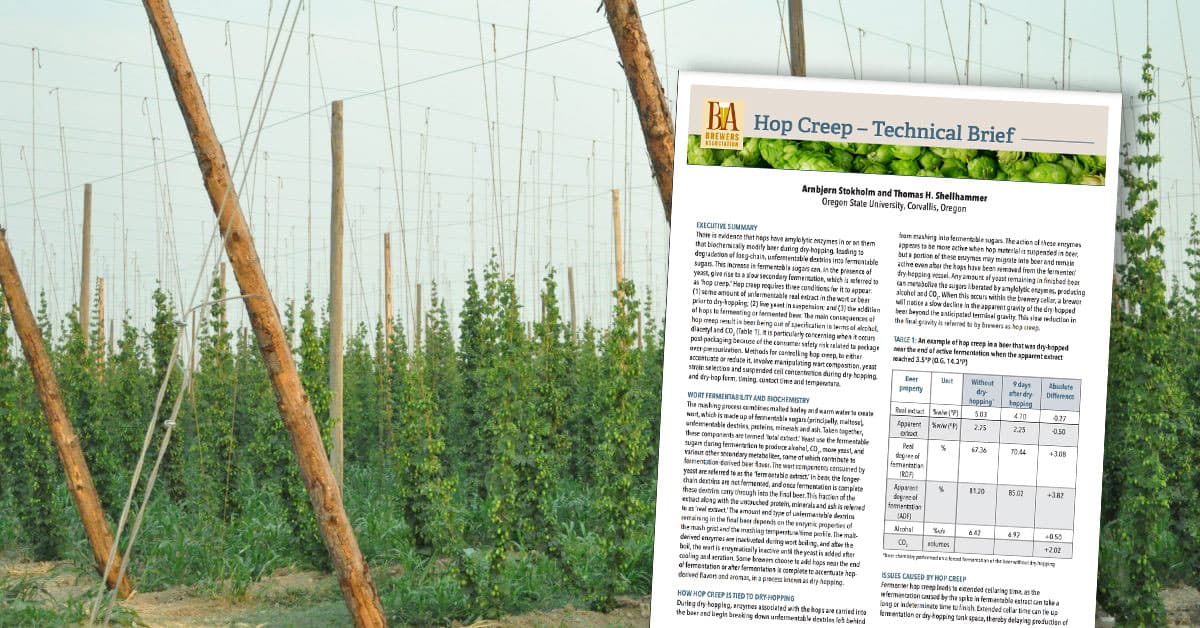
In a 2018 Oregon State University and BJCP presentation, Shellhammer showed the numbers. In one example, real extract fell from 5.0 °P to 4.7 °P, apparent extract dropped from 2.8 °P to 2.3 °P, alcohol rose from 6.4% to 6.9% v/v, and CO2 increased by 2.0 volumes. That is the kind of drift that turns a clean packaging run into a shelf-life and pressure problem.
Shellhammer has recalled that in a 2015 Craft Brewers Conference Q&A, someone asked about diacetyl from dry hopping, a sign that brewers were already seeing the symptom before the mechanism was fully mapped out.
The scientists who helped pin it down
Thomas H. Shellhammer, the Nor’Wester Professor of Fermentation Science and Professor of Food Science at Oregon State University, has been one of the central names in that work. His lab studies hop oil chemistry, dry-hopping, hop-yeast interactions, and thiol biotransformation, which puts the chemistry of aroma and the biology of fermentation in the same frame.

Hop creep sits exactly at that intersection. It is not only about how many oils come off a pellet or how much aroma lands in the glass. It is also about what else the hop brings into contact with yeast and residual extract, and what that combination does to the beer after you think fermentation is over.
How to keep hop creep from turning into a packaging problem
Hop creep management can start with wort composition, yeast strain selection, suspended cell concentration, hop form, timing, contact time, and temperature. Those are the dials that determine whether the beer finishes cleanly or keeps moving after dry hopping.
A few controls matter immediately in the cellar:
- Leave enough space in the fermenter. Brewers Association packaging guidance says fermenters are typically designed with 25% to 35% free headspace and should not be filled beyond 65% to 75% full, depending on manufacturer design.
- Build a dry-hopping SOP and train to it. Hazards can be reduced through a two-step hazard assessment process and a safe dry-hopping standard operating procedure.
- Watch the physical hazards, not just the beer. Dry hopping carries physical hazards including hop volcanoes, asphyxiating CO2, ladder hazards, and tank failure from a clogged PRV.
- Give the tank time before opening the dry-hop port. Pressure and gas release are part of the process, and rushing that step can turn a routine addition into a safety event.
- Verify stability before packaging, then keep watching it. If gravity is still drifting, the beer is not done, no matter how ready it looks.
The hop form itself can matter too. Replacing T90 pellets with more concentrated T45 or cryo-hop pellets may reduce hop creep because the enzymes appear to be associated more with the hop’s green matter. That does not eliminate the risk, but it gives brewers another lever when they want aroma without as much unintended refermentation.
Why this is still an active brewing issue
Hop creep keeps showing up because modern hop-forward beer asks for a lot from dry hopping: more aroma, more freshness, more saturation, and often less time between tank and tap. Allagash Brewing Company has publicly described building a model for its Sixteen Counties brand to predict over-attenuation in package due to hop creep.
This article was produced by Prism’s automated news system from verified source data, official records, and press releases, then run through automated quality and moderation checks before publishing. The system is built and supervised by the people who set the standards it runs under. Read our full AI policy.
Did this article answer your question?