AKC Offers Five Tips to Help Owners Train Hyperactive Dogs
The AKC's updated five-tip guide cuts through the "hyper dog" frustration with practical exercise prescriptions and CGC training tools that can produce visible results in as little as two weeks.
Living with a dog that can't seem to power down is one of the most common frustrations in the community, and the American Kennel Club has just refreshed its go-to resource on the subject. The AKC updated its primer "Is Your Dog Too 'Hyper?' 5 Tips to Train Hyperactive Dogs" on March 12, 2026, summarizing the common causes of perceived hyperactivity, highlighting the owner mistakes that make it worse, and laying out clear, tested interventions for getting things back on track.
Before diving into solutions, it helps to know what genuine hyperactivity actually looks like. Holistapet identifies six signs worth watching for:
- Frenetic activity
- Impulsive behavior, such as the inability to turn off play when the ball goes away
- Inability to relax completely, even when the environment is quiet and familiar
- Being overly reactive to regular stimuli, such as food, noises, or people
- An inability to focus on any task and a concise attention span
- Physiological symptoms like elevated heart rate and heavy breathing, even when not active
On the clinical side, Holistapet notes that "Hyperkinesis is the canine form of human ADHD!" but immediately qualifies the point: it's more likely that your dog is hyperactive due to an energetic personality or possibly anxiety. That distinction matters because the fix for a high-drive Border Collie running circles in the living room is different from the fix for a dog with a genuine anxiety disorder. When physiological symptoms appear consistently at rest, a vet or certified behaviorist is the right next call.
Tip 1: Meet Your Dog's Exercise Needs First
Every other intervention in the AKC primer builds on this foundation, and for good reason. The AKC is explicit that for active breeds, a leash walk simply may not do the trick. The organization recommends playing fetch or other games in a fenced yard or dog park where the dog can actually run, and suggests owners consider tug toys, puzzle toys, or an automatic ball launcher to keep energy expenditure high even when you can't be fully hands-on.
For those who want specific numbers to aim for, Holistapet provides them: "A long walk in the morning, anywhere from 30 to 60 minutes, and then a shorter one in the evening, 15 to 30 minutes, is the minimum time for most healthy dog's mental exercise, regardless of breed." When schedules don't cooperate, there's a workable fallback: "In a pinch, breaking aerobic activity into multiple short bursts throughout the day will also work."
The proof is in the results. In the book "AKC STAR Puppy: A Positive Behavioral Approach to Puppy Training," CGC Evaluator Karen Vance describes assigning her students to bring an exercise plan for their dogs to class. When she reviewed the plan for a German Shepherd Dog who was jittery and couldn't focus, "a light bulb went off." She worked with the owners to modify the exercise plan, and "within two weeks, the puppy was acting like a different dog." Two weeks. That's the kind of turnaround that comes from actually matching activity level to the dog's needs rather than guessing.
Tip 2: Build Structure and Predictability
Exercise alone gets you a tired dog; structure gets you a calm one. Holistapet frames it this way: "A source of stress can be not knowing what to expect. Create routine and predictability by building some basic structure in your dog's daily activities and, even more importantly, in how you interact with your dog."
One of the most practical techniques for building that predictability is deceptively simple: "A commonly used technique to help you with this is asking your dog to perform a simple task before being given any resource." Sit before the food bowl goes down. Wait before the leash goes on. Down before the ball gets thrown. These micro-moments of structured interaction accumulate into a dog that understands there's a predictable order to the world, which directly reduces the frantic, reactive edge that makes hyperactive dogs so exhausting to live with.
Tip 3: Teach and Use Practical CGC Skills
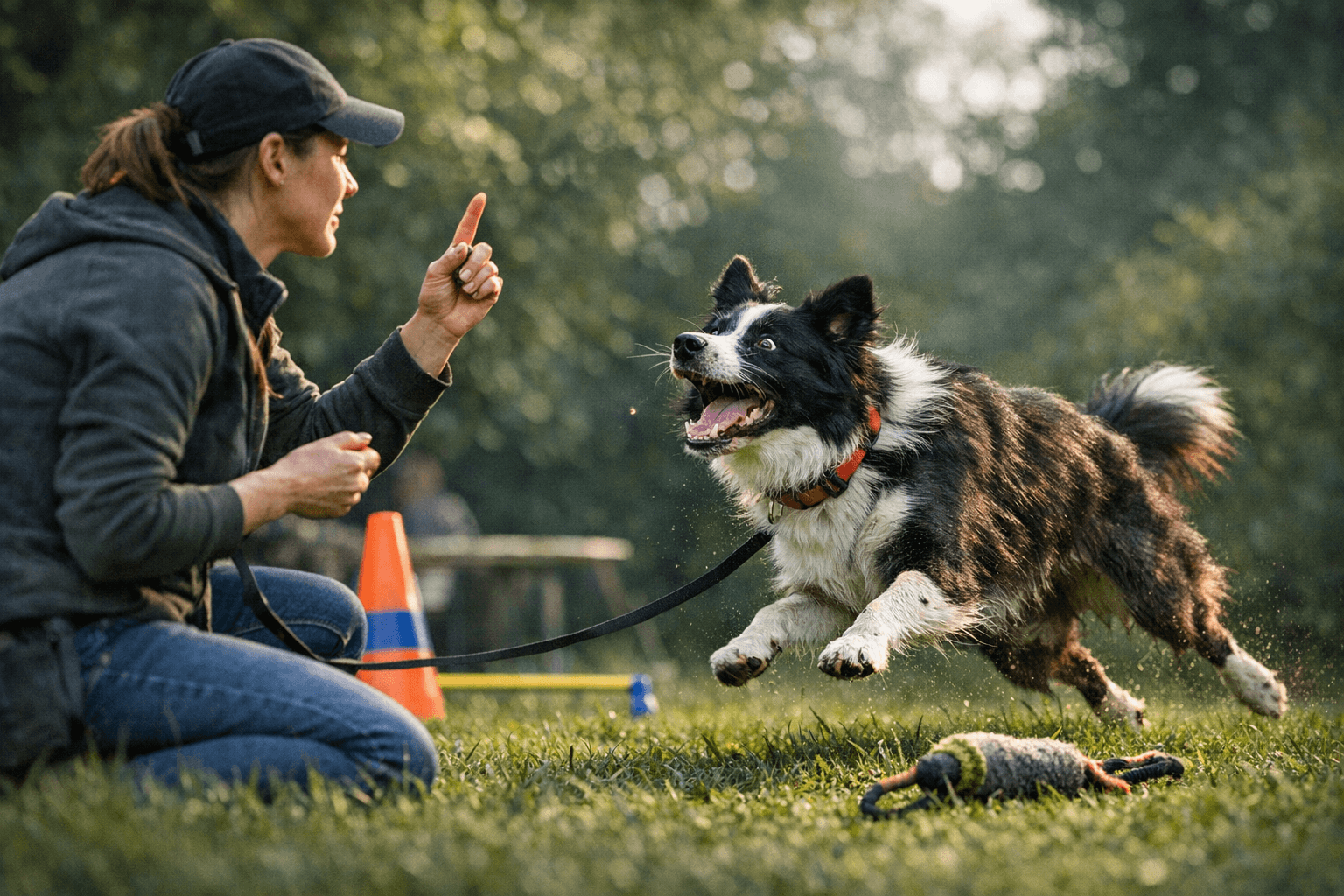
Once the exercise deficit is addressed, the AKC points owners toward the Canine Good Citizen toolkit for day-to-day management. The guidance is direct: "Once you've met the exercise needs of an active dog, you can use functional CGC skills, such as sit, down and stay to manage your dog." The example the AKC gives is one every dog owner with a bouncy dog will recognize: "When company comes and the dog can't 'settle,' a down-stay is often just what is needed to help the dog become calm."
The CGC framework isn't complicated, but it's reliable. Sit, down, and stay are not tricks; they are behavioral anchors that interrupt the arousal spiral before it escalates. Investing time in these skills during calm moments means they're available as tools during the chaotic ones.
Tip 4: Add Enrichment and Consider Daycare
Physical exercise and obedience training cover a lot of ground, but enrichment fills in the gaps, particularly for dogs whose owners work long hours. The AKC specifically acknowledges this reality: if you're away from home during the daytime for long periods, doggy daycare may be a suitable option. For dogs wired for high activity, eight hours of boredom is practically a recipe for the zoomy, frantic behavior that greets owners at the door each evening.
At home, the AKC recommends puzzle toys and tug toys alongside the automatic ball launcher already mentioned. These tools keep the brain engaged and provide an outlet for physical drive even during downtime. Mental stimulation and physical stimulation aren't interchangeable, but used together they dramatically reduce the surplus energy that spills out as hyperactive behavior.
Tip 5: Integrate the STAR Philosophy
The AKC's S.T.A.R. Puppy program ties the individual tips together into a coherent framework. In the STAR program, the acronym stands for Socialization, Training, Activity, and Responsibility, and AKC instructors actively discuss daily exercise plans with owners during STAR classes, making activity a structured part of the curriculum rather than an afterthought.
Holistapet endorses the same framework, noting that "this entire STAR philosophy can be helpful when dealing with a hyper dog. Granted, it won't singlehandedly solve the problem, but if adequately integrated with the five tips above, you may end up with a calm, collected, and relaxed dog." The STAR lens is useful precisely because it positions training and activity not as isolated fixes but as components of responsible ownership, which is the fourth letter in the acronym.
For dogs showing the more persistent physiological signs from the checklist above, such as elevated heart rate and heavy breathing at rest, professional evaluation should come before any training program. But for the vast majority of high-energy dogs who are simply under-exercised, under-stimulated, and operating without predictable structure, the combination of these five approaches gives owners a concrete, progressive plan. As Holistapet puts it: "Don't give up hope; there is help for almost any hyperactive dog.
Know something we missed? Have a correction or additional information?
Submit a Tip