Best Dog Agility Equipment of 2026: Top Picks for Every Skill Level
The right agility gear can transform a hyperenergetic dog into a focused, confident competitor — here are the 10 essential pieces of equipment, ranked from first obstacle to full course.
The AKC logged over 1.2 million competition entries in sanctioned agility events in 2023 alone — and with that community still growing fast, the gear conversation has never been louder. Whether your dog is a Border Collie who dismantles the couch out of boredom or a rescue mix you're bringing into the sport for the first time, the equipment you train on shapes everything: speed, confidence, safety, and that invisible thread of communication between handler and dog. In agility, a dog and handler complete an obstacle course as accurately as possible and in as short a time as they can. It's a highly athletic event that requires training, teamwork, and concentration.
Here's the complete breakdown of the 10 pieces of equipment every agility team should know, ranked from the best starting points for newcomers to the most advanced tools for competition-ready teams.
1. Agility Tunnel
A dog tunnel is one of the most exciting and versatile obstacles in agility training. It teaches dogs to move quickly, commit to an entry, and focus on the handler's commands. A dog runs at full speed to the entrance of the tunnel, approaching from any angle, runs through it, and then exits quickly — and it's a good starting point because it's one of the easiest obstacles to master. For competition-caliber tunnels, look for heavy-duty PVC-coated vinyl that is weatherproof and flame resistant, 24-inch regulation openings that match AKC competition requirements, and steel spiral reinforcement that keeps the tunnel round and stable even during high-speed runs.
2. Adjustable Bar Jump
Jumps are one of the most basic yet crucial pieces of dog agility equipment. They help teach coordination, body awareness, and timing, and they make up the majority of obstacles on most competition courses. A bar jump, which consists of a horizontal bar the dog must leap over, is great for beginners — start with the bar placed low and gradually raise it as your dog's confidence and ability improve. Competition-grade jumps run from $150 to $400.
3. Weave Poles
Most handlers will say that agility weave poles are the trickiest obstacle to teach. They require the dog to move in a precise zig-zag pattern — start with just a few poles set wide apart and gradually bring them closer together as your dog learns. Most agility enthusiasts who compete even on a local level have weave poles at home to train. Expect to invest accordingly: competition-quality weave poles run around $500, give or take.
4. Pause Table
Not every obstacle is about speed — pause tables teach patience, impulse control, and listening skills. Your dog learns to jump up, sit, or lie down on the table before continuing the course. The pause table is used less than in the past, but it still requires dedicated training to ensure correct performance. For backyard training, the Max 200 pause table with rubberized top and PVC base runs around $350.
5. Tire Jump
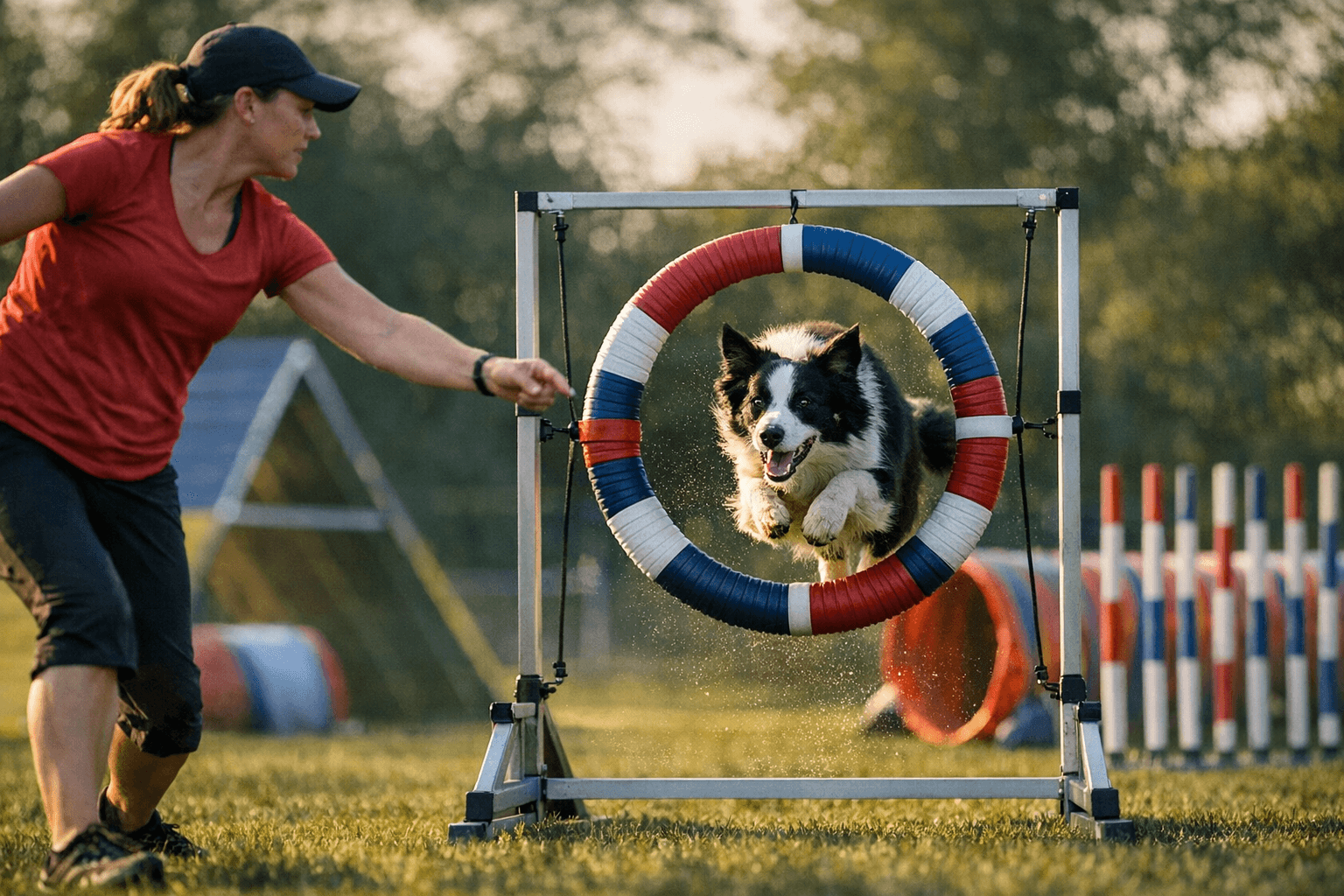
Tire jumps are a fun variation found on just about every competition course. They involve your dog jumping through a suspended tire, and it's important to make sure the tire is lightweight and adjustable for beginners so it can be lowered or raised to suit your dog's skill level. The tire jump is also a meaningful test of focus: unlike a bar jump, it requires the dog to thread a precise target rather than clear a horizontal plane, which adds a new cognitive challenge at the intermediate level.
6. Seesaw (Teeter)
The teeter, also known as the seesaw, is the only dynamic contact obstacle in agility. Dogs handle dynamic obstacles differently than static ones due to the need for increased coordination and postural control. The teeter-totter and the weave poles are typically the most challenging obstacles to teach — many dogs are wary of the seesaw's movement. For competition setups, look for designs that address board whip: engineered rigid aluminum plank construction eliminates board flex and whip, while speed-limiting cushioning cylinders on the base reduce rebound.
7. A-Frame
The A-frame is one of the signature contact obstacles in agility, alongside tunnels, dogwalks, seesaws, and weave poles. The dog climbs up one side and descends the other, touching a painted "contact zone" at the bottom — a rule enforced in all major venues. When considering purchasing equipment to train on, it's important to factor in the equipment standards for each organization you might compete in — for example, requirements for the length of the boards for the A-frame can vary among agility organizations.
8. Dogwalk
The dogwalk consists of a center section 48 inches off the ground with two ramps, and the obstacle is long (three sections, each 12 feet) and quite narrow (about 12 inches wide) for how fast dogs run across it. The dogwalk is a critical contact obstacle that builds confidence at elevation and demands precise footwork from a running dog. Many high-quality pieces are made with furniture-grade PVC, which is UV resistant and weatherproof, while metal components are often aluminum, chosen because it does not rust or overheat in the sun.
9. Agility Starter Kit (Multi-Piece Set)
If you're not sure where to start, an agility kit is the easiest way to bring obstacle course fun to your yard. A well-built starter kit contains an adjustable jump, weave poles, a tire jump, tunnel, and pause box; the gear is sturdy, easy to assemble, and comes with a large carrying bag — and the price is most likely lower than what you would pay for each piece individually. For a step up in that category, the Better Sporting Dogs 7-piece set is a community favorite: it contains two standard adjustable jumps, a tire jump, six fixed-base weave poles, a standard tunnel with four sandbags, a chute tunnel with two sandbags, and a pause box.
10. Training Accessories (Wobble Boards, Stride Regulators, and Tunnel Bags)
Whether you need a few pieces of equipment for your backyard or you're outfitting multiple competition rings, the agility world also relies on accessories like weave pole wires, wobble boards, training planks, and stride regulators. Stabilization systems including sandbags, stake-down belts, and tunnel tamers keep tunnels securely in place — a detail that matters far more than most beginners expect when a high-drive dog hits a tunnel at full speed. These accessories are often overlooked at purchase but become essential as training intensity increases.
The sharpest insight for anyone building a home course: when you train with quality equipment, you protect your dog's joints, paws, and muscles while still building speed and accuracy — and equipment built to competition standards makes it easier to transition from backyard practice to trial courses. Start with a tunnel and a bar jump, get your dog loving the game, and build from there. The course grows with the dog.
This article was produced by Prism’s automated news system from verified source data, official records, and press releases, then run through automated quality and moderation checks before publishing. The system is built and supervised by the people who set the standards it runs under. Read our full AI policy.
Did this article answer your question?