Edmonton science exhibit lets families experience the world like dogs
Edmonton’s new dog exhibit lets families test speed, scent and instincts, while showing why sniffing is a dog’s superpower.
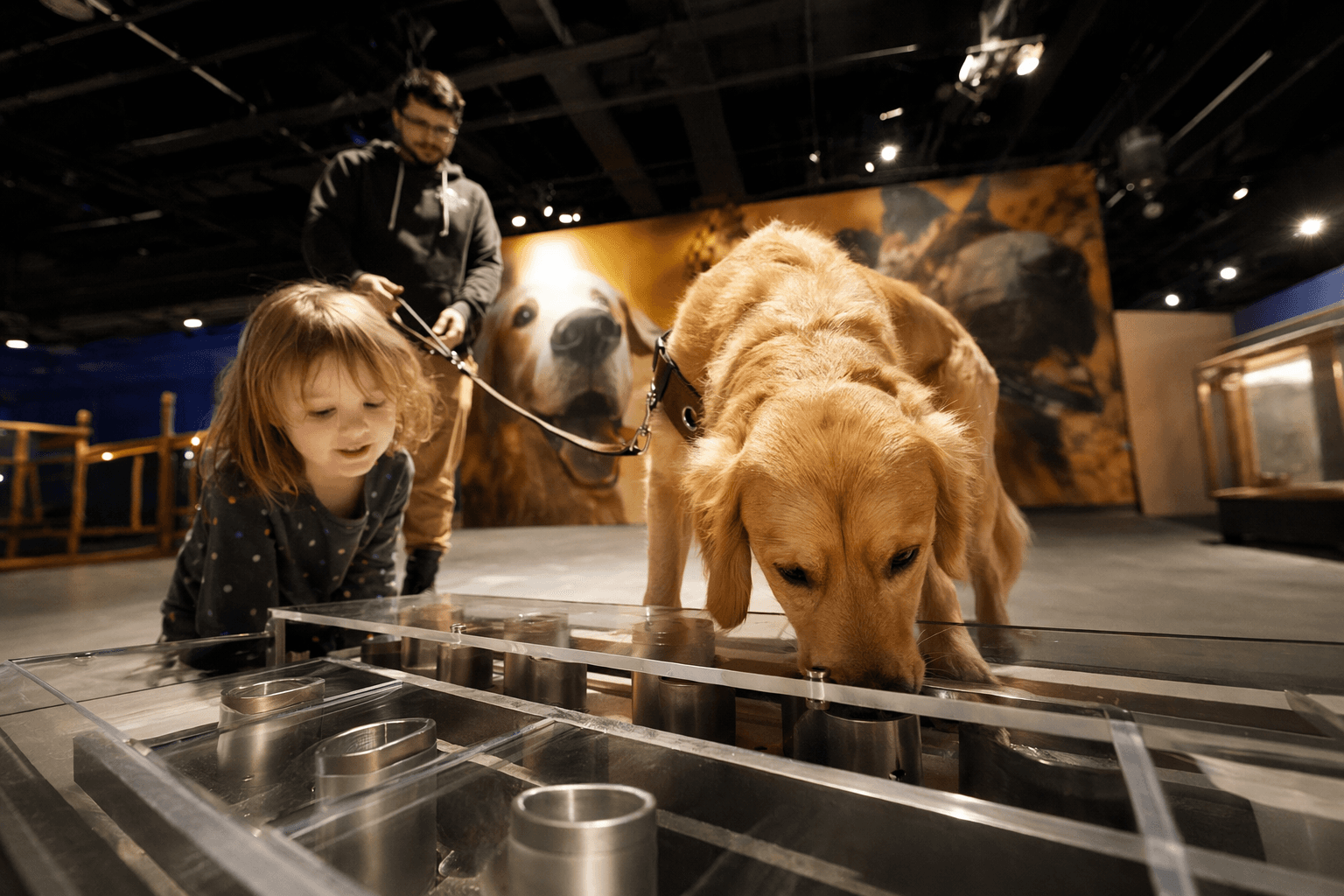
At TELUS World of Science Edmonton, dogs are not just on display, they are the lesson. Dogs! A Science Tail opened May 2 and turns canine behavior into a hands-on outing where families can sniff, sprint and see the world from a dog’s point of view, with admission included and annual members admitted free. The science center says pets have to stay home, but the exhibit brings enough canine chaos to fill a day anyway.
The most useful part for active-dog people is how plainly the exhibit explains what dogs are built to do. One station lets visitors build a dog, another asks them to test top speed against different breeds, and a trivia game called Jeopawdy adds some competition. Secret buttons hidden around the space release odors, turning smell into a scavenger hunt and showing how far human guesses are from actual canine perception. That matters at home, too: a dog’s nose is not a side feature, it is the main event, and scientific reviews say canine olfaction is vastly more specialized than ours, with many more odor receptors than humans have.
The exhibit also puts some common “bad manners” in a different light. It tackles why dogs sniff butts and crotches, why some circle before pooping and why some dogs seem to favor one nostril when checking out an unfamiliar scent. For owners, the takeaway is simple: sniffing is work, information gathering and social communication. A dog that insists on reading every patch of grass on a walk is not being defiant. It is doing the canine version of scanning a room before a conversation.
That instinct has deep roots. The science center’s explanation lines up with natural-history accounts that say dogs likely began living near human camps because they could scavenge food there, with calmer animals tolerated and gradually shaped by human choice. A review article places that domestication process over roughly 15,000 to 30,000 years. The result is the dog beside your leash today, built by thousands of years of selection for cooperation, alertness and work alongside people.
The exhibit also does not gloss over the costs of breeding for looks. It points to bulldogs and other brachycephalic breeds, including English bulldogs, French bulldogs, pugs, Boston terriers and Pekingese, whose shortened muzzles can contribute to breathing problems. For families with active dogs, that is a blunt reminder that not every body can handle the same workload. The exhibit’s run through September 7 offers a summer window to see how canine biology shapes training, play and recovery, and why understanding a dog’s senses is often the fastest route to better behavior.
This article was produced by Prism’s automated news system from verified source data, official records, and press releases, then run through automated quality and moderation checks before publishing. The system is built and supervised by the people who set the standards it runs under. Read our full AI policy.
Did this article answer your question?