Military working dogs Howoard and Baily retire after decade of service
Howoard and Baily logged 10 years at Joint Base Andrews, including explosive sweeps, presidential transports and eight national special security events, before a base theater sendoff.
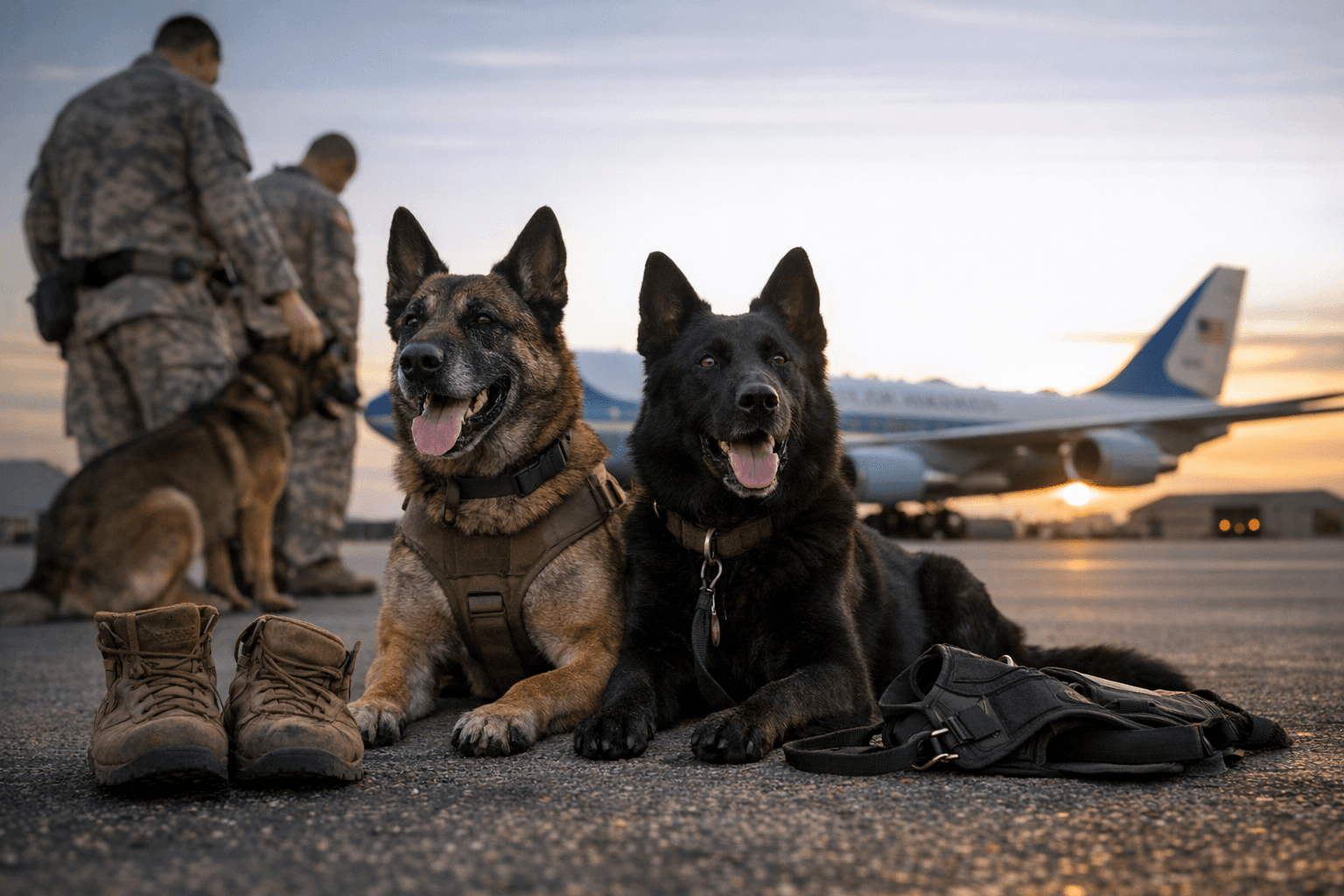
Howoard and Baily ended a combined 10 years of service at Joint Base Andrews with a retirement ceremony in the base theater on April 15, where members of the 316th Security Forces Support Squadron marked the close of two canine careers built on stamina, repetition and split-second reliability.
Baily spent three years on duty and turned that time into hard numbers that read like a security ledger. He helped secure eight national special security events and completed 60 transports for President Donald Trump, work that placed him in the middle of some of the most sensitive movement and protection missions at the Maryland base. For that service, the Air Force awarded Baily the Air and Space Commendation Medal. The ceremony also had a personal ending: Baily was adopted by his handler, Senior Airman Daylynn Robinson, after meritorious service.
Howoard’s record showed the same kind of operational grind. With Staff Sgt. Ryan Willson as his handler, he completed 1,200 hours of explosive detection and 2,500 vehicle searches during his time at Andrews. Those are the kinds of deployments that expose a working dog to constant repetition, noise, confined spaces and long stretches of vigilance, the daily test that separates a sport-ready dog from a dog trusted around presidential movement and base security. At Andrews, that level of work was not ceremonial. It was part of the security system.
The retirement also connected to a much longer base history. Joint Base Andrews says its first sentry dogs arrived in 1961, which means military working dogs have been part of the installation’s security mission for decades. The Department of the Air Force’s military working dog program trains dogs for patrol, drug detection, explosive detection and specialized mission functions, with the 341st Training Squadron at Joint Base San Antonio-Lackland serving as a major training hub for that pipeline.
The dogs’ next chapter is also shaped by policy, not luck. The DoD Military Working Dog Adoption Program gives priority to former handlers, and Congress enacted Robby’s Law on Nov. 6, 2000, to help retired military working dogs move into adoption. A Department of the Air Force guidance memorandum dated April 15, 2026, also updated program guidance on welfare and adoption, underscoring that these dogs are managed under formal rules from start to finish. For Baily and Howoard, retirement was not an exit from importance. It was the official handoff from mission life to whatever comes after the gate.
This article was produced by Prism’s automated news system from verified source data, official records, and press releases, then run through automated quality and moderation checks before publishing. The system is built and supervised by the people who set the standards it runs under. Read our full AI policy.
Did this article answer your question?