Seattle parks debate off-leash dogs, balancing freedom and safety
Seattle’s leash fight is really a space fight: with just 14 off-leash areas, active dogs keep bumping into the city’s tightest park rules.

The real issue is not whether dogs should run. It is where Seattle has left them room to do it.
For owners of hyperenergetic dogs, the Seattle parks debate comes down to a simple mismatch: the city has a formal off-leash system, but it is still small enough that dogs and people keep colliding in the same contested spaces. That is why the argument never stays abstract for long. It shows up on ballfields, at trailheads, near beaches, and in the daily frustration of trying to give a working, sporting, or just plain restless dog enough exercise without breaking the rules.
How Seattle built its off-leash system
Seattle’s off-leash-area program did not start as a sprawling network. It began in 1997 with an 18-month pilot project at seven sites in parks and one site on Seattle Public Utilities property, and the city’s first off-leash area was built that same year. From there, the system grew into a permanent part of park planning, not just a side project.
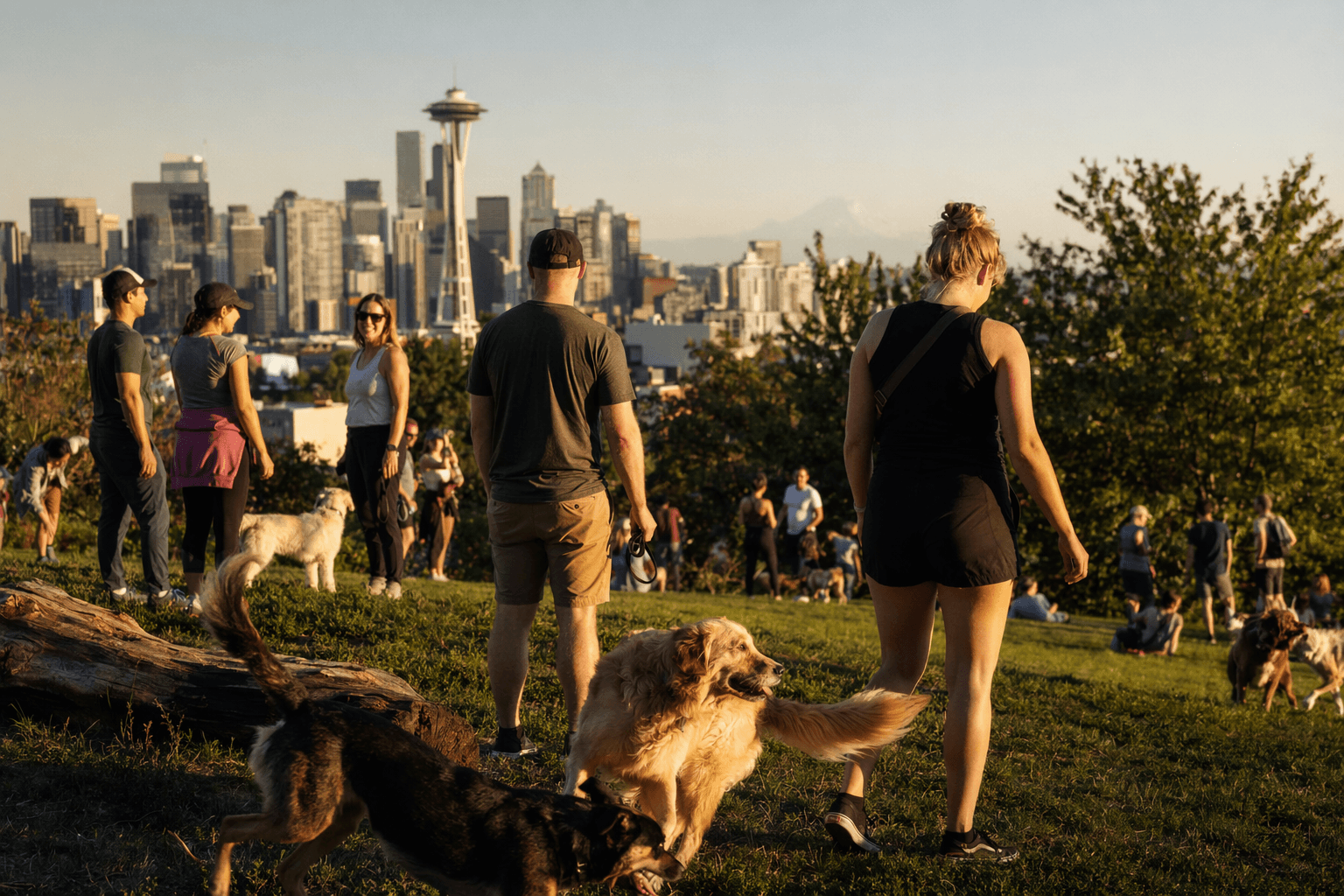
Today, Seattle Parks says the city has 14 designated off-leash areas in parks. A 2024 parks document put the system’s footprint at roughly 26 acres citywide, while a 2024 advisory committee presentation described 15 fenced off-leash areas totaling roughly 28 acres. However you count it, the basic reality is the same: Seattle is trying to serve a big dog-owning population with a very limited amount of dedicated ground.
What the rules actually demand
Seattle’s rules are stricter than many dog owners would like, and they are clear on paper. Dogs must be leashed in parks unless they are inside a designated off-leash area. They are not allowed at any time on organized athletic fields, beaches, or children’s play areas.
That matters because the city is not treating off-leash access as a casual perk. It is treating it as a controlled exception. Seattle also tells residents to report recurring off-leash incidents to Parks and Animal Control, which is a reminder that enforcement is part of the policy, not an afterthought. In practice, the leash debate is never just about manners. It is about whether the city has enough designated space to make the rules realistic for people with high-drive dogs.
Why the conflict keeps coming back
Seattle has already seen what happens when official off-leash space does not match demand. In a 2016 response to the City Council, Seattle Parks said about 26 percent of Seattle dog owners admitted to exercising dogs illegally in non-off-leash areas. Those places included ballfields, tennis courts, play areas, turf areas, shorelines, beaches, and trails.
That number is the whole story in one statistic. If you own a dog that needs more than a neighborhood loop, and your nearest legal off-leash option is crowded, far away, or simply not built for the kind of exercise your dog needs, the temptation to cut corners rises fast. That is where the debate gets sticky for everyone else using the same public land.
The city’s latest answer: find more land, build more parks
Seattle’s most recent expansion effort shows the city knows the current system is not enough. The 2023 Off-Leash Area Expansion Study reviewed 32 Seattle Parks and Recreation-owned sites to identify future locations, and the Board of Parks and Recreation Commissioners approved the study on March 28, 2024.
Two sites were selected for new off-leash areas: West Seattle Stadium and Othello Park. Seattle Parks says the 2023-2029 Park District funding cycle covers construction of those two new areas and design work for a third, although additional construction money is still needed for that third site.
That funding detail matters. It shows the city is not just debating leash rules in the abstract. It is actively trying to add capacity, but the money and land are still not lining up fast enough to solve the daily pressure on existing parks.
What makes a site viable
Seattle’s siting criteria explain why off-leash areas are so hard to add in a dense city. The expansion study says potential sites need to avoid conflicts with existing park uses, historic sites, environmentally critical areas, and areas with significant trees. The study also says new areas should be at least 50 feet from other property lines and ideally accessible by transit or parking.
That is a narrow lane. It means some parks that look perfect on a map can fall apart once you account for neighborhood use, ecology, historic protections, or simple geometry. The city is not just looking for empty grass. It is looking for land that can take dog traffic without breaking something else people already value.
Why some parks stay contested
The expansion study shows how quickly public feedback can shut down a site that seems available on paper. Some reviewed locations were not recommended at all because of community feedback and existing uses, including Discovery Park, Lincoln Park, Powell Barnett Park, and others named in the planning process.
That pattern is familiar to anyone who has watched dog access debates long enough. The parks that are most attractive for off-leash use are often the very ones other users most want protected, especially when they are scenic, heavily used, or important for other park functions. Seattle’s problem is not a lack of opinion. It is a lack of surplus land.
The public process is bigger than a dog-owner complaint cycle
Seattle Parks has framed the issue as a stewardship problem as much as a dog issue. Its strategic plan says community support is key to success, and the department has created a formal process for community groups and other stakeholders to propose new off-leash areas. In 2024, more than 4,700 people participated in the expansion-study outreach through an online survey, in-person engagement, and public comment.
That level of participation is a useful signal. This is not a niche fight between dog owners and everyone else. It is a citywide park-management question with serious constituencies on multiple sides, including people walking reactive dogs, families using play areas, runners on trails, and owners trying to give active dogs a healthy outlet without turning every outing into a gamble.
What this means if you live with a high-energy dog
Seattle’s system tells you exactly how to navigate the city if your dog needs real exercise: use the designated off-leash areas, stay out of athletic fields, beaches, and play areas, and do not treat gray areas as if they were open invitations. The city has 14 official off-leash areas in parks, and even the broader planning documents only put the system at roughly 26 to 28 acres.
That is a small footprint for a city where many dogs need more than a stroll around the block. Until Seattle adds more legal acreage, the same pressure will keep resurfacing in the same places, and the off-leash debate will remain less about ideology than about whether the city has made enough room for the dogs it already has.
This article was produced by Prism’s automated news system from verified source data, official records, and press releases, then run through automated quality and moderation checks before publishing. The system is built and supervised by the people who set the standards it runs under. Read our full AI policy.
Did this article answer your question?