Smart Collars Combine GPS, Fitness Tracking, and Health Insights for Active Dogs
When a bolt-prone dog hits full stride, the gap between a 2-second and 60-second GPS refresh is the gap between found and lost - and 2026 collars have finally closed it.

Skye, a compact Klee Kai with the kind of relentless engine that makes harness clips feel like suggestions, spent weeks field-testing the SATELLAI collar across trail sessions and backyard sprints. She did not need a dramatic escape to prove what every owner of a high-drive dog already knows: speed is the variable that smart collars have always struggled to match. The 2026 generation finally answers that challenge directly. GPS refresh rates that once lagged at one update per minute on budget devices now hit 2 to 3 seconds on the fastest hardware, a 20- to 30-fold improvement in positional frequency that is not cosmetic when a dog is doing 20 mph through a gap in a fence.
The 2026 Leap: Faster Refresh, Longer Battery, Smarter Alerts
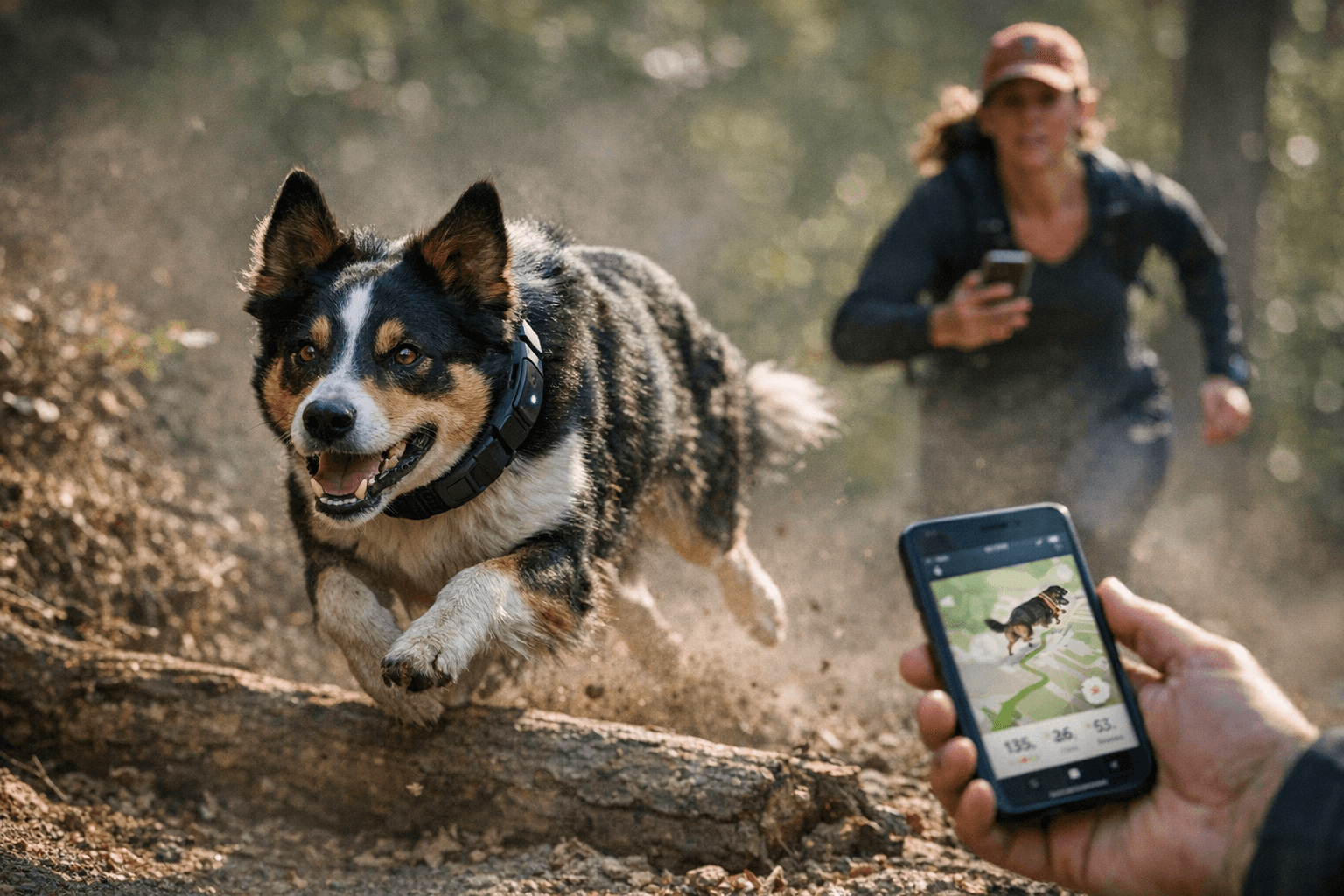
Three upgrades define this year's hardware above everything else. The first is location frequency. In a documented escape simulation, a dog running approximately 25 meters ahead on a trail returned nearly continuous positional updates on Tractive's LIVE Tracking mode, with minimal delay between actual position and app display. Compared to devices that update every 30 to 60 seconds, that live-tracking difference translates directly to how far a running dog travels before an owner gets an accurate fix. For German Shorthaired Pointers, Vizslas, Brittanys, and any breed engineered to cover ground at full speed, older refresh rates effectively made real-time tracking a fiction.
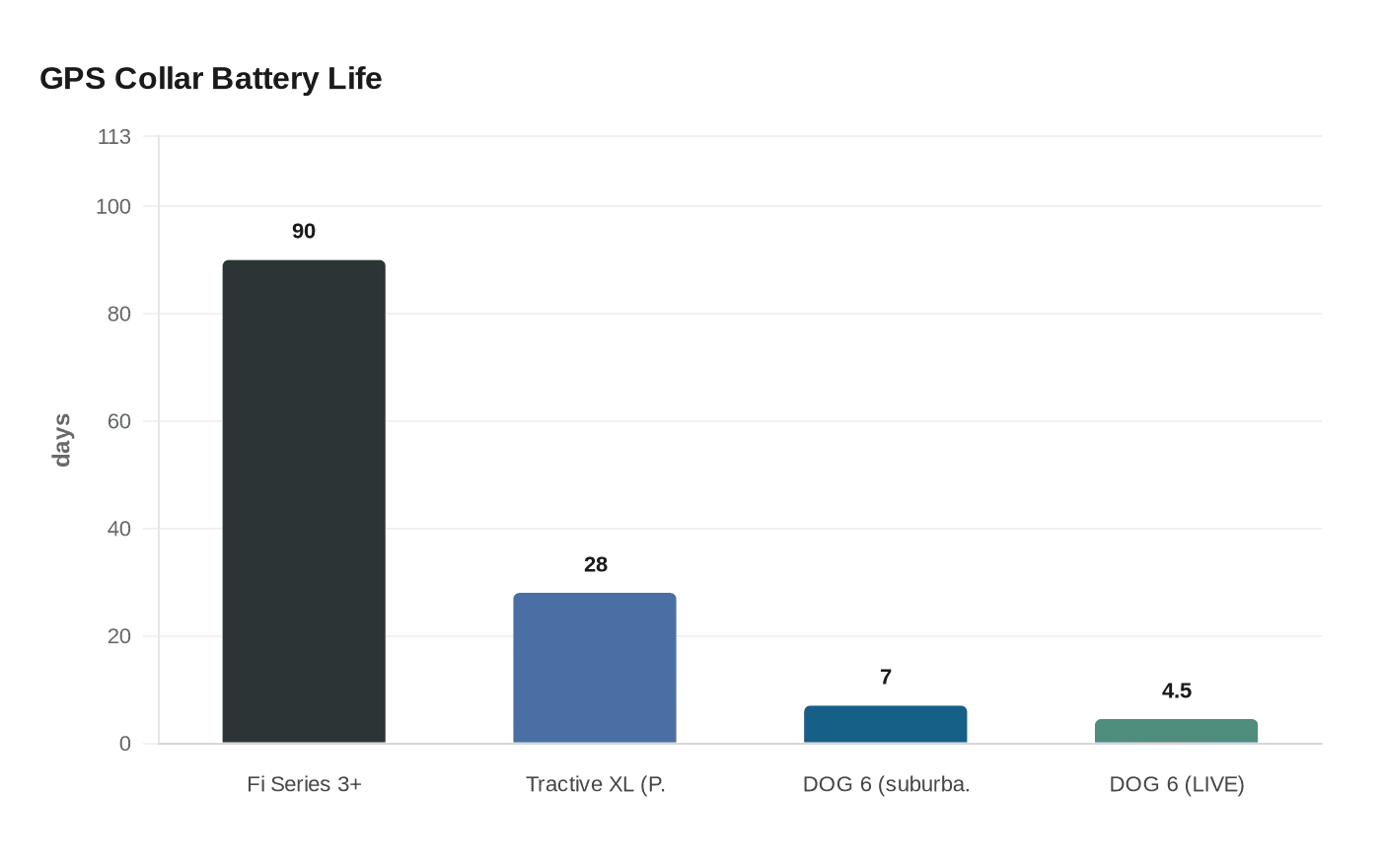
The second upgrade is battery endurance. The Fi Series 3+ now claims up to three months per charge - a figure that looks like a spec-sheet boast until you consider that a dead collar provides exactly zero data on the day a dog slips a gate. The Tractive DOG 6 runs 6 to 8 days in structured suburban use, dropping to 4 to 5 days with frequent LIVE sessions, while the Tractive XL pushes closer to four weeks in Power Saving Zone configurations for larger breeds. Longer battery windows reduce the single most common failure mode in GPS collar ownership: the device that was on the charger.
The third is AI-driven health alerting. Several 2026 collars now aggregate resting heart rate, respiratory patterns, sleep quality, and heart rate variability into trend-based weekly summaries, flagging meaningful deviations rather than surfacing raw biometric data for owners to decode alone. The shift from raw-data readout to interpreted insight makes health monitoring usable for the first time outside a veterinary context.
Time-to-Find: Collars Ranked by High-Motion Performance
The most useful metric for a bolt-prone dog is not range, waterproofing rating, or app design. It is how quickly a moving dog's location appears after the moment of escape, and how well that position holds across real-world terrain.
Tractive DOG 6 leads on live refresh speed. At $49.99 with subscriptions from $5 per month (two-year ownership cost: $169), it delivers 2- to 3-second LIVE updates across AT&T, Verizon, and T-Mobile LTE nationwide. Heart and respiratory rate monitoring and bark detection are standard. The trade-off is battery: frequent LIVE tracking pushes real-world battery life to 4 to 5 days, requiring a consistent charging routine to ensure the collar is active during an escape.
Fi Series 3+ targets owners who need both reliability and endurance. At $149 plus $99 per year, it offers 2x improved GPS performance over its predecessor on LTE-M connectivity, escape alerts, Lost Dog Mode, Apple Watch integration, and shareable Smart Vet Records built for veterinary review. Live tracking connection times run slightly slower than Tractive's LIVE mode, but the three-month battery means the collar is overwhelmingly more likely to be charged and functional when an escape happens.
SpotOn GPS Fence covers scale. Named the Official GPS Collar of the American Kennel Club in 2026, SpotOn's True Location technology draws customizable virtual fences up to 1,000 acres, the only realistic option for owners running dogs on large rural properties, hunting land, or field sport venues. The investment is $1,295 upfront with a two-year total cost around $1,533. For anyone who was already pricing traditional fence installation, that math shifts considerably.
Halo Collar 4/5 collapses two problems into one device. At $799, it combines GPS tracking with a virtual fence that delivers training feedback through the collar itself, replacing both a tracker and a containment system. For owners whose primary goal is boundary compliance rather than post-escape recovery, Halo is the only collar that addresses both simultaneously.
SATELLAI brings hardware precision for technically demanding environments. Its 5-GNSS dual-frequency dual-antenna design with a dedicated antenna chamber is built to maintain signal reception where single-band GPS collars struggle: dense tree canopy, canyon walls, and compressed urban canyons. It runs lighter than both SpotOn and Halo, a practical advantage for smaller high-drive breeds who notice extra hardware mass and adjust their movement accordingly.
Whistle Switch Smart Collar handles continuous daily wear. With 24/7 location updates, configurable safe-zone boundaries, escape alerts, step tracking, and health monitoring, it suits dogs moving between handlers in day care, multi-person households, or cooperative training programs where real-time access needs to be shared rather than centralized.
Where GPS Degrades and What to Do About It
Every collar on this list depends on cellular or satellite infrastructure that terrain actively disrupts. Dense pine canopy can drift virtual fence boundaries. Canyon walls reduce cellular signal. Budget devices refreshing once per minute become functionally useless during a fast escape in poor signal conditions. Owners training or competing with dogs in remote backcountry should treat a cellular-only collar as a partial solution and consider dual-mode options that pair GPS with radio-frequency communication for environments where cell networks thin out.
Biometric Monitoring: What the Data Can and Cannot Do
The Tractive DOG 6, Fi Series 3+, SATELLAI, and Whistle Switch all surface resting heart rate, respiratory rate, and sleep quality in some form. Collars that aggregate these into AI-generated weekly summaries can catch early health changes - subtle declines in mobility or recovery that might otherwise look like a tough training session rather than the beginning of something worth investigating. QR-code-accessible digital medical records and owner contact details are increasingly standard, making stray identification faster for anyone who finds a lost dog. The critical boundary: collar biometrics support veterinary conversations; they do not replace physical examinations. Any trend that looks abnormal in an app is a prompt to call, not a self-diagnosis.
Match the Collar to the Dog
- Best for runners, hunting breeds, and field sport athletes: SpotOn GPS Fence for rural acreage-scale fencing (AKC's official pick), or SATELLAI for GPS precision in dense terrain.
- Best for fence-jumpers and escape artists: Fi Series 3+ for the three-month battery that keeps it alive through repeated escape attempts, or Halo Collar for virtual boundary training built into the hardware.
- Best for day care and multi-handler households: Whistle Switch for 24/7 access shared across a contact list with integrated health tracking.
- Best budget entry point with the fastest live tracking: Tractive DOG 6 at $49.99, with 2- to 3-second LIVE updates and a two-year ownership cost of $169.
The Feature Most Owners Overpay For
Premium GPS accuracy upgrades. Several collar brands offer higher-accuracy subscription tiers at significantly increased monthly cost, and the upgrade is largely irrelevant for the suburban or semi-rural scenarios where most dogs actually escape. A dog who bolts from a backyard in a subdivision does not need sub-meter precision to be recovered; she needs an alert within 10 seconds and a moving pin on a map. The Tractive DOG 6's 2- to 3-second live refresh at $5 per month outperforms a $30-per-month premium accuracy plan on a slower device in virtually every urban escape scenario. Save the high-accuracy hardware budget for genuine rural properties, acreage-scale field trials, or off-leash hunting situations where that precision earns its price - the other 95 percent of escape events are won by speed and battery, not centimeter-level positioning.
This article was produced by Prism’s automated news system from verified source data, official records, and press releases, then run through automated quality and moderation checks before publishing. The system is built and supervised by the people who set the standards it runs under. Read our full AI policy.
Know something we missed? Have a correction or additional information?
Submit a Tip