Step-by-Step Recall Training Guide Helps Dogs Master Off-Leash Returns
Reliable recall is the single skill that keeps a high-drive dog alive off-leash; a new vet-reviewed 14-day program builds it from scratch with real progression gates.
Every high-drive dog owner has felt that particular drop in the stomach: the moment your dog catches a scent, spots a cyclist, or locks onto a squirrel at 40 yards and everything you thought you'd trained evaporates in an instant. For Border Collies, Malinois, Vizslas, and the full spectrum of dogs who live at full throttle, recall is not just another skill to polish. It is the single behavior that determines whether your dog gets to experience the freedom of off-leash life at all. A veterinarian-reviewed step-by-step guide from Pet & Life, updated at the end of March 2026, structures this critical skill as a progressive training program, and it maps almost perfectly onto a 7-to-14-day framework that high-drive handlers can run with precision.
The stakes are not abstract. Having a reliable recall is especially important if you are planning to allow your dog off-leash outside of a fenced yard or inside a dog park, and it is critically important in an emergency where you absolutely need your dog to come to you so they can be safely secured. For the hyper end of the dog world, where a bolt into traffic is a real scenario rather than a hypothetical one, that framing is not dramatic. It is accurate.
Days 1-2: Build the Cue Indoors Before You Build Distance
The first gate in the program is deliberately unglamorous: your kitchen, your hallway, a quiet corner of the yard. Begin with short-distance calls in a low-distraction environment, and use treats or favorite toys to immediately reward your dog for responding. The word "immediately" is doing real work here. High-drive dogs form associations fast, and delay between the return and the reward bleeds the cue of its power. Use a clicker or a consistent verbal marker at the exact moment all four paws arrive at your feet, then follow with the highest-value reinforcer your dog will work for, whether that is a piece of real meat, a tug toy, or a chase game.
Keep sessions short and frequent. Multiple short reps across the day beat one long session every time, because the goal at this stage is pure repetition volume, not duration. You are burning a neural groove.
Days 3-5: Long Line and Distance
Once the cue has a strong indoor foundation, the long line becomes your most important piece of equipment. A long training leash (15-30 feet) ensures you still have control while increasing difficulty, and it also prevents the most damaging thing that can happen at this stage: a self-rewarded escape. Every time a dog successfully chases a deer or a car, they receive a massive neurochemical rush, making the behavior likely to happen again. The long line ensures your dog cannot rehearse the wrong outcome while you are still building the right one.
Practical long-line handling matters more than most guides acknowledge. Keep a soft curve in the line rather than constant tension, step on it to prevent a bolt rather than yanking it, and practice rotating your body to manage slack before you add a distracted dog to the equation. Ten minutes of line-handling practice without the dog pays off enormously in the field.
The Two Places High-Drive Recall Breaks Down
There are two failure points that reliably collapse recall in high-drive dogs, and both deserve their own focused training blocks within this program.
The first is motion. Cyclists, joggers, other dogs at full run, even a thrown ball at distance; these are not just distractions for prey-driven dogs. They are triggers that activate a neurological sequence that predates domestication. Recognizing which part of the predatory sequence activates your dog allows you to select the most rewarding training games, but more practically, it tells you exactly which stimulus class needs the most proofing reps. During Days 5 through 10, introduce controlled motion gradually: a family member jogging past at 20 feet, then 10 feet, then directly toward the dog. Practice the recall cue at the exact moment your dog's head turns. Reward explosively when it works. Proofing a dog to a recall cue, or getting the dog to respond in all situations, is where training gets trickier, and motion is the category that most consistently exposes the gap between "knows the cue" and "will use it when it counts."
The second failure point is the collar grab, and it is wildly underaddressed. Grab your dog's collar before you give the reward every single time during training. A recall is no good if you can't catch your dog. For high-drive dogs in particular, the moment a hand reaches for their collar can trigger an evasive spin or a keep-away game, especially if the grab has historically meant the end of fun. Fix this by making the collar grab a conditioned pleasure: reach for the collar, mark it, treat it, release the dog back to play. Repeat until your dog leans into the touch. Do this in isolation before you stack it onto the full recall behavior.
Days 6-10: Proofing and the Progression Gate
Consistent training methods can lead to a 90% success rate in recall even amid distractions. Start with basic recall commands in a distraction-free environment, then climb the distraction ladder one rung at a time. The progression gate is simple: your dog must achieve five fast, clean recalls in a row at the current distraction level before you raise the difficulty. No exceptions. Attempting to rush this gate is the single most common reason recall falls apart at the park six weeks later.
Games accelerate learning at this stage more than most handlers expect. The recall race, in which two handlers take turns calling the dog back and forth between them at increasing distances, builds speed and arousal into the return behavior rather than treating it as a neutral compliance. Hide and seek, where the handler disappears and then calls the cue, triggers a dog's searching instinct and makes the return feel like a win rather than a surrender. Both games create the kind of strong motivational association with returning to the handler that pure repetition drilling cannot fully replicate.
Days 11-14: Off-Leash Transition
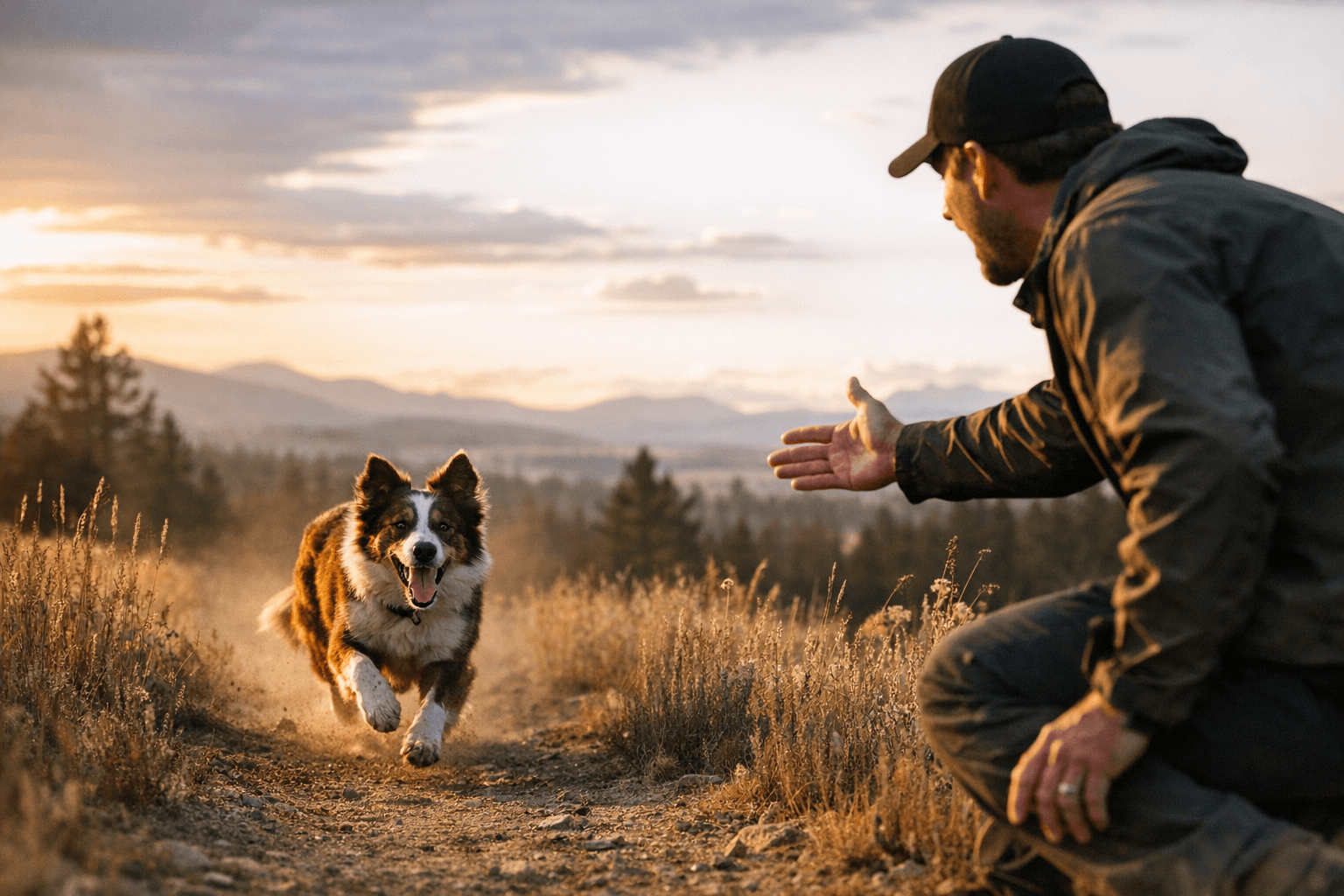
The final phase only opens once the progression gates are passed: fast collar-grab recalls at 30-plus feet with motion distractions present, five-for-five, twice in a row. Let your dog play off-leash only in safely secured areas, and practice your recall within that safe perimeter. A fully fenced field or a secured dog sports facility is the right venue for first off-leash reps, not a public park with open egress.
At this stage, switch from a fixed reinforcement schedule to a variable one. Reward every recall during the initial learning phase, but unpredictable, high-value jackpots are what maintain behavior long-term under real-world pressure.
When Recall Collapses at the Park
Even well-built recall fails under specific conditions. Here is what to troubleshoot when it happens:
- Dog won't disengage from another dog or a moving object: You have not yet proofed that specific trigger class. Return to the long line and run 20 reps at the distance where your dog can still hear you and choose correctly, then rebuild gradually.
- Dog comes back slowly or stops halfway: The reinforcement value has dropped. Rotate your high-value rewards, add a collar grab jackpot, or use a short chase game on arrival to restore the motivational charge.
- Dog recalls perfectly until the gate opens: The collar grab is predicting the end of fun. Rebuild the collar grab as a conditioned positive independently of the session ending.
- Recall works at home, nowhere else: The cue was not generalized across environments. Rebuild the cue in three new low-distraction locations before adding difficulty.
Safety, Fitness, and When to Call a Professional
Before adding high-intensity recall games that involve sprinting and abrupt stops, check physical readiness. Hip and elbow health, cardiovascular fitness, and growth plate status in puppies all matter here. Fast returns with sharp stops are athletically demanding, and a young dog whose joints are not fully formed needs modified versions of these games until clearance from a veterinarian.
The Pet & Life guide is direct about when to escalate: persistent recall failure despite structured work, or red flags like extreme impulse collapse around wildlife, livestock, or traffic, are reasons to bring in a certified professional rather than simply adding more reps. A trainer who specializes in high-drive dogs will identify whether the breakdown is motivational, environmental, or a deeper impulse-control gap that requires its own dedicated work before recall training can succeed.
One non-negotiable throughout: never use punitive corrections on failed recalls. For high-drive dogs especially, a single punishment on a return poisons the cue and can take weeks to undo. The dog that gets corrected for coming back slowly will eventually stop coming back at all.
The 14-day framework is not a guarantee of perfection. It is a structured path from zero to a recall that works under real pressure, and for fast dogs in a world full of things worth chasing, that is the difference between a dog that gets to run free and one that never gets the chance.
Know something we missed? Have a correction or additional information?
Submit a Tip