Cold plunge group turns sunrise swims into a youth social ritual
A dawn plunge at Merewether has become a weekly social anchor, where cold water is the excuse and coffee, conversation and belonging are the real draw.
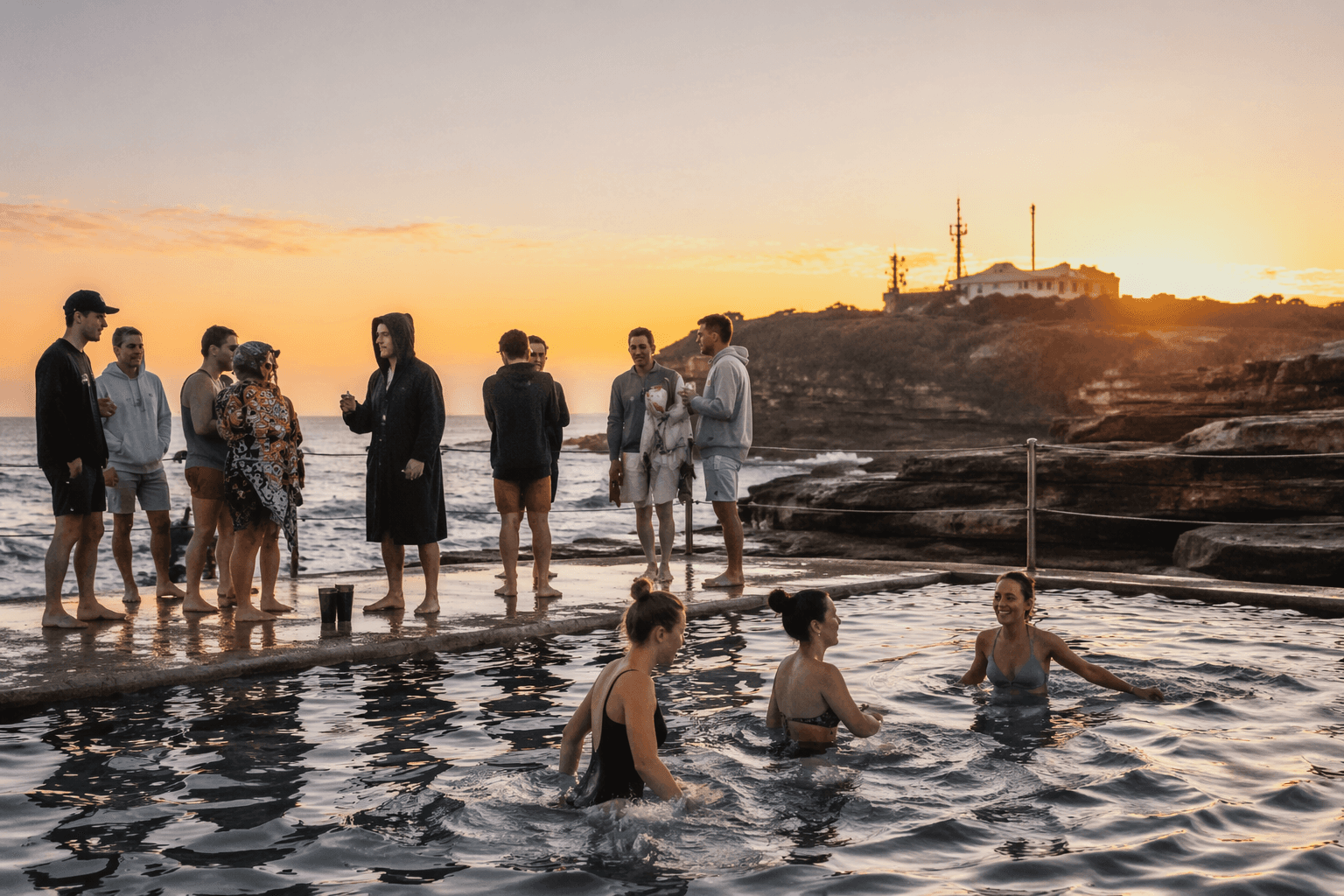
By about 6 a.m. at Merewether Ocean Baths, with June air around 10 degrees Celsius, dozens of young people are still showing up before sunrise for a plunge that starts as a jolt and ends in conversation over coffee. For 24-year-old Sam Colbert, who has been coming to Moist Mondays since November 2025, missing the session makes the whole week feel off.
A ritual that starts with a few mates
Moist Mondays began as a small group of mates and has since spread from Newcastle to Sydney and the Gold Coast. The structure is deliberately loose: it feels less like a coached fitness class and more like an open invite to turn up, get in, and stay around afterward. Week after week, the same pre-sunrise meet-up turns a one-off cold shock into something people plan their mornings around.
For Colbert, the plunge is the marker that the week has properly begun. That kind of attachment does not come from novelty alone. It comes from the predictability of seeing the same faces, the same shoreline, and the same post-swim drift toward coffee.
Why the chat after the swim matters most
Zali Saxby, who helps run the sessions, puts the emphasis where the group lives best: not in the cold water itself, but in the talk that follows. The swim creates a shared task, and the conversation after it makes the task social. The low-pressure setup gives young people a reason to meet without the awkwardness of a formal event or the pressure of a defined hangout.
Cold plunge groups can scale quickly. They ask very little of people beyond a willingness to show up, tolerate a few minutes of discomfort, and linger. The formula is simple and repeatable, and it does not depend on expensive gear or a luxury setting.
- The cost barrier is low compared with most wellness habits.
- The discomfort is shared, which makes the first hello easier.
- The schedule is fixed, which builds accountability.
- The conversation afterward turns strangers into regulars.
Once people know they can arrive, plunge, warm up, and stay for coffee, the ritual becomes easier to return to than to invent from scratch.
Loneliness gives the ritual its urgency
The social value of Moist Mondays is clearer against the loneliness numbers around young Australians. A 2025 study found more than 40 per cent of Australians aged 15 to 25 reported being lonely, with one in seven saying they had been lonely for at least a year. The University of Sydney’s August 2025 report sharpens that further, putting the loneliness rate at 43 per cent for Australians aged 15 to 25 and finding that one in seven had experienced persistent loneliness lasting at least two years.
Ben Smith, a University of Sydney public-health professor who works with Ending Loneliness Together, frames that loneliness as a public-health issue rather than a private mood. The plunge group is building a routine people can actually join, one morning at a time, in a place where conversation happens almost by accident. The plunge gives people a reason to arrive; the repetition gives them a reason to return.
Cold exposure as social infrastructure
Cold exposure is being used as social infrastructure. The activity is distinctive enough to pull people in, but ordinary enough to be copied elsewhere without much friction. That combination helps explain why a small crew can become a network across multiple cities.
The idea is not new. In 2021, Wim Hof-style workshops treated ice baths as only one part of a broader wellbeing practice built around breathing, silence and community support.
The World Health Organization has pushed the issue even further into public-health territory. Its Commission on Social Connection was established in November 2023, and its June 30, 2025 report found that 1 in 6 people worldwide is affected by loneliness. The same report linked loneliness to an estimated 100 deaths every hour, or more than 871,000 deaths a year.
What the cold can and cannot claim
In May 2025, the evidence for benefits such as mood boosts, better sleep, immune support and anti-inflammatory effects was still limited and conflicting in the general population. The studies reviewed found no evidence of mood improvement, although there was some evidence of lower stress shortly after immersion.
This article was produced by Prism’s automated news system from verified source data, official records, and press releases, then run through automated quality and moderation checks before publishing. The system is built and supervised by the people who set the standards it runs under. Read our full AI policy.
Did this article answer your question?