How professional reviewers test cold-plunge tubs (a reproducible methodology for expert rankings)
Most "best cold-plunge" lists hide more than they reveal — here's the exact scoring rubric expert reviewers use, and the questions that expose every shortcut.
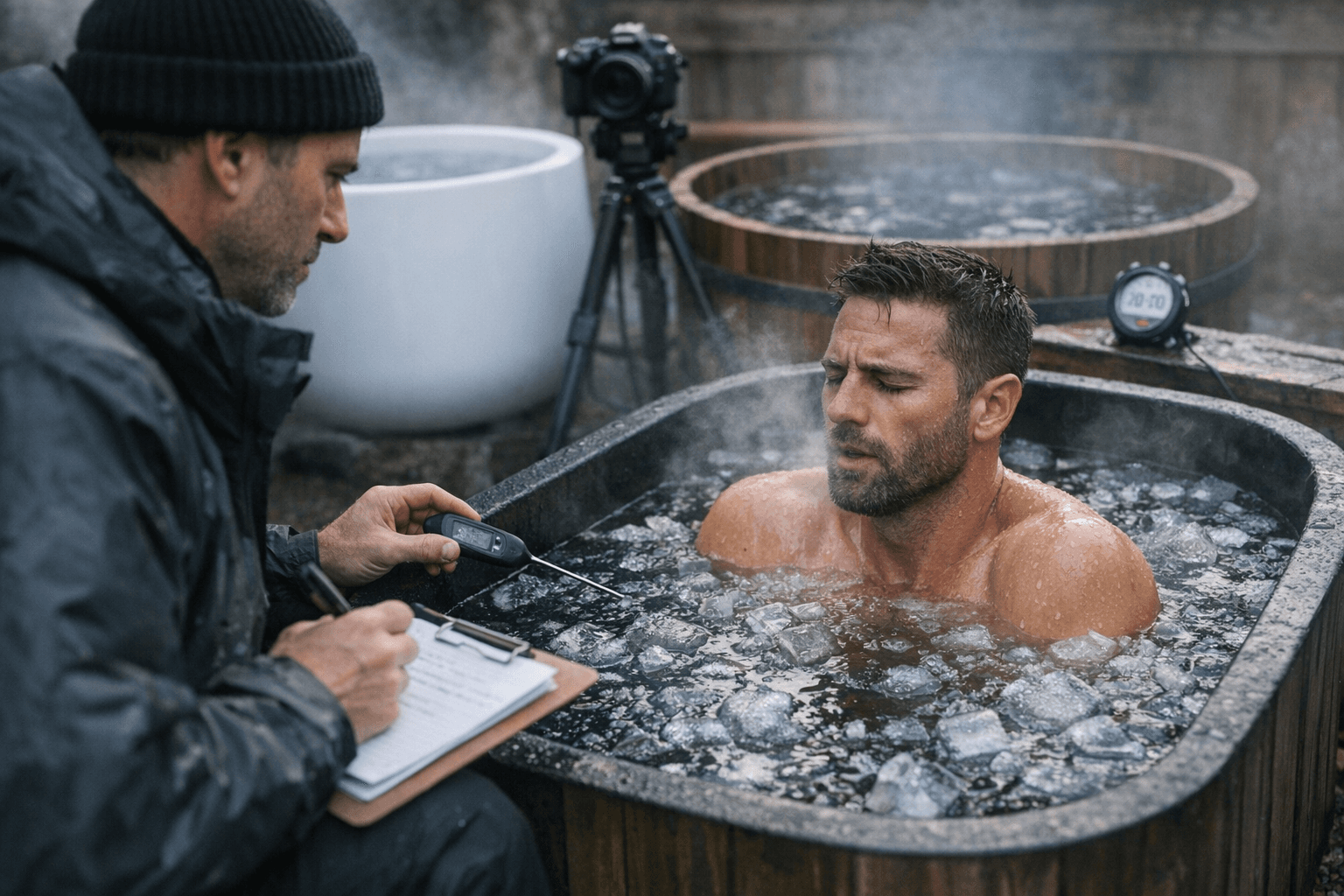
A calibrated waterproof probe clipped to the rim of a chest-style chiller, a stopwatch, a watt meter plugged into the wall socket, and a notebook. That is the unglamorous core of a credible cold-plunge review. No sponsored unboxing, no single-session verdict, just a multi-week testing cycle that surfaces the numbers a manufacturer's spec sheet will never volunteer. Understanding what that process looks like, step by step, is how you read any "best of" list with clear eyes.
Why methodology is the only thing that matters
The cold-plunge market has exploded, and the review ecosystem around it has grown just as fast, much of it financially entangled with the products it covers. Sites that test 40-plus units over a six-month protocol exist alongside pages that list affiliate links after a single overnight soak. The gap between those two approaches is enormous. A rigorous tester measures temperature uniformity at multiple depths, logs watt-hours across full chilling cycles, and exercises the warranty claims process as a deliberate test. A thin review trusts the brand's stated temperature range and calls it done. The rubric below is the standard the former uses, and the lens through which every ranking deserves to be read.
Temperature performance and range
The first thing a serious reviewer does is ignore the advertised minimum temperature and measure the unit's actual performance under load. The best systems on the market reach setpoints between 37°F and 39°F; more powerful commercial-grade chillers can push to 32°F, while budget units often plateau in the high 40s°F even in a cool room.
What matters more than the floor temperature is stability under repeated use. Testers measure water temperature with calibrated probes placed at multiple depths and lateral positions inside the tub. This reveals hot pockets near the surface or at the far end from the inlet, which a single-point thermometer would miss entirely. The probe readings are logged before entry, immediately after exit, and again at 10-minute intervals to capture recovery time. Digital thermostats that hold ±1°F accuracy across the full setpoint range represent the current performance standard.
A useful secondary metric: rate of cooling. A well-engineered chiller drops water temperature at roughly 3 to 5°F per hour under typical ambient conditions, then cycles on and off to hold the setpoint rather than overcooling and wasting energy. Units that cannot maintain their setpoint during a 90°F ambient summer day outdoors are a meaningful data point for anyone planning an outdoor installation.
Insulation and energy efficiency
Temperature performance is inseparable from energy cost, and this is where many reviews go silent. A reliable test involves logging watt-hours with a dedicated energy meter over a 24-to-72-hour idle period with no entries, then again over a week of simulated daily use. The idle test reveals thermal insulation quality: a well-insulated tub loses very little heat to the environment, meaning the chiller runs fewer cycles and the electricity bill stays manageable. A unit run continuously through a Texas summer has been documented costing approximately $26 per month in additional energy draw, a figure that changes dramatically for poorly insulated competitors in the same climate.
For indoor buyers, standby power consumption is a factor in long-term ownership cost that almost never appears on a product page. For outdoor installations, reviewers should confirm the chiller's rated cooling capacity in BTUs or watts at ambient temperatures up to at least 90°F, because a chiller that meets its spec at 65°F ambient may struggle or fail entirely during summer.
Sanitation and water quality
A cold-plunge tub holds still, body-temperature-adjacent water that multiple people enter without showering. Sanitation is not a minor feature. Credible reviewers assess three things: filtration micron rating, disinfection chemistry, and circulation dead zones.
Filtration systems in quality units cycle the entire water volume roughly every 15 minutes, passing it through particulate filters before exposing it to ozone or UV disinfection. Ozone generators are rated by output, with capable systems producing between 200 and 500 milligrams per hour; anything below that range struggles to keep up with daily use. UV systems are evaluated by lamp wattage and replacement cycle. Units that rely on chlorine alone require more hands-on chemical management, with test-strip checks and manual dosing adding to the maintenance burden.
Dead-zone flow analysis, where reviewers use dye tracers to visualize circulation patterns, reveals corners or foot wells where water sits stagnant even when the pump is running. This is a manufacturing quality signal that no spec sheet will disclose.
Construction and ergonomics
Material choice defines both longevity and the daily experience of getting in and out of a cold tub. Acrylic shells are common at mid-range price points and resist most chemical disinfectants. High-density polyethylene (HDPE) is lightweight and impact-resistant, making it a popular choice for portable and barrel-style designs. Stainless steel, particularly 316-grade marine stainless, offers the best corrosion resistance and is favored in premium units, though it transfers cold more aggressively to anyone who leans against the walls.
Ergonomic evaluation covers entry/exit ease (step height, grab bars, slip resistance), interior seating geometry relative to a range of body sizes, and the physical footprint of the unit in a real room. A reclined tub that runs 5.5 feet long and weighs 345 pounds empty creates very different installation requirements than a vertical barrel design with a 36-by-30-inch base. Reviewers document interior dimensions explicitly, because a tester who is 6'4" will report a cramped experience in units that a 5'8" user finds spacious, and that specificity matters.
Noise and vibration
Chiller noise is measured in dB(A) during active cooling cycles. The practical range across currently available systems runs from approximately 45 dB, roughly equivalent to a quiet room, up to 60 dB, closer to a normal conversation. Units at the lower end of that range are meaningfully more livable for indoor installations or shared living situations. Reviewers should note that noise ratings vary with ambient temperature: a chiller working hard in warm weather runs louder and longer than the same unit in a cool basement.
Feature ergonomics and smart controls
App connectivity, programmable scheduling, guided breathwork lighting, and contrast-therapy heating modes have become standard talking points in marketing. Reviewing them objectively means testing whether the app works reliably across iOS and Android, whether scheduled pre-cooling actually reaches temperature before the user arrives, and whether heating functions bring water up to useful contrast-therapy temperatures without the same unit taking hours to return to cold setpoint afterward. Accessory compatibility, including covers, steps, and in-water lighting, gets documented as part of the total ownership picture.
Safety and electrical grounding
Every unit with a chiller plugs into mains power and sits in a water-filled environment. GFCI protection on the circuit is a non-negotiable baseline, and reviewers verify that the unit ships with appropriate electrical ingress protection ratings labeled on the chassis. Grounding strategy, bonding between water and chassis, is assessed against the manufacturer's documentation. Vendors who provide clear customer screening checklists covering medical contraindications and electrical installation requirements demonstrate a higher level of safety rigor, and that documentation quality is itself a scoring input.
Real-world durability
Short reviews do not catch long-tail reliability problems. Accelerated soak tests run pumps and chillers through compressed multi-week use cycles to surface gasket wear, corrosion points at fittings, and signs of pump bearing degradation. Credible reviews that test for three months or longer are in a genuinely different category of reliability prediction than ones concluded after two weeks.
Warranty and field service
A warranty is only as useful as the process for exercising it. Serious reviewers submit actual warranty claims, or at minimum contact support through multiple channels, to rate responsiveness, parts availability, and documentation clarity. A two-year warranty with a three-week replacement part lead time and an unanswered support line is functionally worse than a one-year warranty backed by same-week shipping and a knowledgeable service team.
Price-to-performance scoring and use-case mapping
Raw scores become useful when weighted by use case. An athlete logging daily immersions needs maximum temperature performance, chiller durability under load, and efficient filtration above all else. A wellness user rotating in occasional contrast-therapy sessions weights noise levels, app quality, and footprint more heavily. A single composite score that collapses these into one number without use-case disclosure tells you almost nothing actionable.
Questions to ask before you buy
Use this short script against any ranking or review you encounter:
- What probe calibration method was used, and at how many measurement points?
- Was energy draw measured with an independent watt meter, or estimated from the spec sheet?
- How many weeks did the testing period run, and how many entries per week were logged?
- Was the warranty claims process actually tested, or just described?
- Does the reviewer disclose affiliate or sponsored relationships with the brands ranked?
- Is the scoring weighted differently for performance use versus casual wellness use, and does that weighting match your own?
A review that can answer all six questions with specifics is one worth trusting. One that cannot answer most of them is editorial curation dressed up as testing, and the cold-plunge market has plenty of both.
This article was produced by Prism’s automated news system from verified source data, official records, and press releases, then run through automated quality and moderation checks before publishing. The system is built and supervised by the people who set the standards it runs under. Read our full AI policy.
Did this article answer your question?