Five months of cold plunges gave one writer better focus
Five months of cold plunges did not remake life overnight. It built a steadier morning, sharper focus, and a ritual worth keeping.
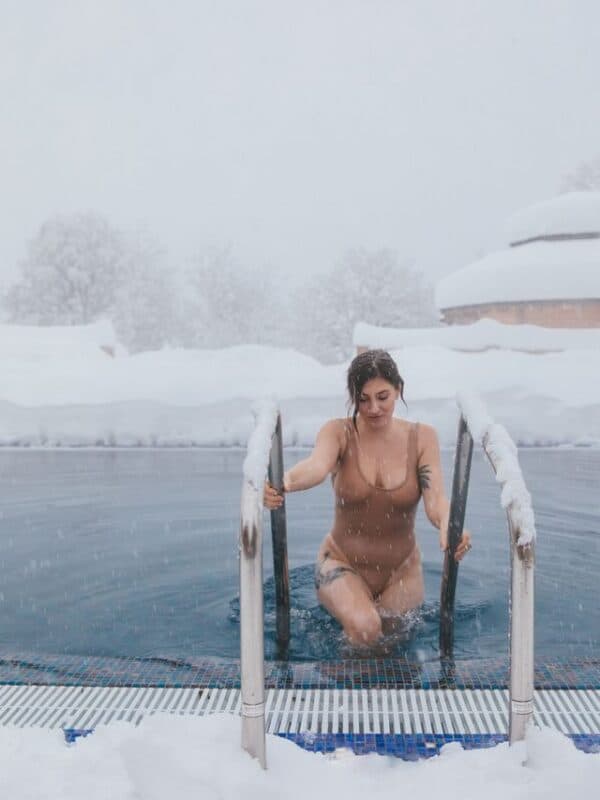
Becca Blond did not come to cold plunges looking for a heroic transformation. She wanted relief from sluggish mornings, low energy, inflammation, and the brain fog that made early work feel heavier than it should. Five months into a Nordic-style routine of sauna sessions and cold plunges three times a week at her Denver gym, usually in the morning, the change she describes is less cinematic than durable: better focus, less bloating, some weight loss, and a stronger mental lift that arrives around the 3.5-minute mark in the plunge.
What actually changed after five months
The most striking part of Blond’s account is how ordinary the payoff sounds once the novelty wears off. There is no single miraculous before-and-after moment here, just a set of small improvements that made the routine stick. She says the practice helped her mornings feel more manageable, and that, as someone with ADHD, it became a productivity tool and “the one thing I don't want to skip.”
That detail matters because it separates the ice-bath fantasy from the ice-bath habit. A dramatic wellness experiment promises reinvention. A sustainable routine usually delivers something quieter: a dependable reset, a better start to the workday, and enough positive reinforcement to keep showing up three mornings a week.
The physiology behind the contrast-therapy loop
The appeal is not just psychological. Heat from the sauna dilates blood vessels and increases circulation, while cold exposure constricts vessels and triggers a sharp stress response before the body rebounds. Put together, the sequence acts like a vascular workout, with the body moving from expansion to contraction and back again.
That is why contrast therapy has long been used around circulation, recovery, and resilience. The experience can feel dramatic in the moment, but the mechanism is familiar: a controlled stressor, followed by recovery. For people who keep returning to the practice, the value often lies in the ritual as much as in the physiology.
What the research can and cannot promise
The strongest case for cold-water immersion remains modest and time-sensitive rather than sweeping. A January 29, 2025 systematic review and meta-analysis in PLOS One pooled 11 studies with 3,177 participants and found a significant reduction in stress 12 hours after cold-water immersion. It also found improvements in sleep quality and quality of life.
Just as important, the same review found no consistent improvement in mood and no consistent evidence of immune benefits. It also found an acute inflammatory response immediately after exposure, which is a reminder that the body does not experience cold water as a spa treatment first and a stressor second. In other words, the benefits are real enough to matter for some people, but not broad or uniform enough to sell as a universal cure.
Harvard Health’s summary of the review put the practical versions of the protocol in plain view: most of the studies used water between 45 and 59 degrees Fahrenheit, with exposure times from 30 seconds to 15 minutes. That range is a useful reality check for anyone assuming there is one magical temperature or one perfect plunge length. The research suggests a spectrum, not a single formula.
The benefits that may be real, and the ones that may be novelty
Blond’s story sits right on the line between measurable effect and lifestyle momentum. Better focus, calmer mornings, and a lower sense of bloating are believable outcomes for a person who adopted a repeatable routine, got out of the house in the morning, and paired the plunge with sauna use. Some of that may come from the cold itself, some from the structure, and some from the simple fact of committing to a practice that demands attention.
That is where novelty effects deserve a closer look. A new routine can improve mood and alertness because it is new, because it is physically activating, and because it creates a clear start to the day. The fact that Blond found the biggest mental lift at about 3.5 minutes in suggests a personal threshold, not a universal benchmark. For an ice-bath hobbyist, the lesson is not to copy her exact timing, but to notice whether a repeatable routine is doing the real work.
How to borrow the useful parts without adopting the whole identity
The easiest takeaway from Blond’s experience is not “become a cold-plunge person.” It is to separate the habit from the aesthetic. You do not need a full Nordic-wellness identity to borrow the useful pieces: a fixed morning slot, a consistent contrast between heat and cold, and a short enough session that it fits into real life.
A practical version of the routine looks like this:
- Keep the session regular, not heroic. Blond’s rhythm was three times a week, usually in the morning.
- Pair the cold with something you already trust, like sauna time, instead of chasing intensity for its own sake.
- Pay attention to what changes after a few weeks, not after a single dramatic plunge.
- Treat focus, sleep, and morning energy as the real scoreboard, not social-media spectacle.
That kind of approach fits the way many people actually stick with ice baths. Consistency tends to beat extremity, especially when the goal is to make the practice part of a life rather than a one-off challenge.
The safety line matters as much as the feel-good story
The cardiovascular side of cold exposure is why caution belongs in the conversation from the start. Harvard Health advises that people with heart disease, heart-rhythm problems, high blood pressure, diabetes, or poor circulation should check with a doctor before trying cold-water immersion. Harvard also quoted a sports cardiologist warning that post-exercise cold therapy may hurt gains in muscle power and strength.
That warning cuts against a common assumption in recovery culture: that more cold must always be better after training. The body does not only need to be shocked back into place. In some contexts, especially right after exercise, cold exposure may interfere with the very adaptations people are trying to build.
Why the trend keeps spreading anyway
Mayo Clinic has described cold-plunge and sauna routines as increasingly mainstream, with home sauna tents and ice baths becoming more popular. Wim Hof remains one of the big names associated with that shift, but the broader appeal is bigger than any one figure. Cold exposure now sits at the intersection of recovery, self-discipline, and daily reset culture.
Harvard T.H. Chan School of Public Health adds an important counterweight: the evidence for mental-health benefits is mixed, and the risks include cold shock and heart arrhythmia. Even so, about half a million people swim regularly in England’s lakes, rivers, and sea, including in winter, which says something about how deeply cold-water ritual has taken hold outside elite sport. The practice endures because it offers something many wellness trends do not: a clear physical experience, repeated on purpose, that some people find genuinely stabilizing.
Blond’s five-month routine lands in that space between experiment and habit. It is not proof that cold plunges solve everything, and it is not just a novelty either. It is a reminder that the real power of the plunge may be in what happens after the shock passes, when the morning feels a little clearer and the routine has earned its place back on the schedule.
This article was produced by Prism’s automated news system from verified source data, official records, and press releases, then run through automated quality and moderation checks before publishing. The system is built and supervised by the people who set the standards it runs under. Read our full AI policy.
Did this article answer your question?