Hudson Valley's Grassroots Sauna Movement Makes Cold Plunges Affordable and Communal
Grassroots co-ops across the Hudson Valley are undercutting boutique wellness pricing with sliding-scale sauna and cold plunge sessions run on volunteer labor and community trust.

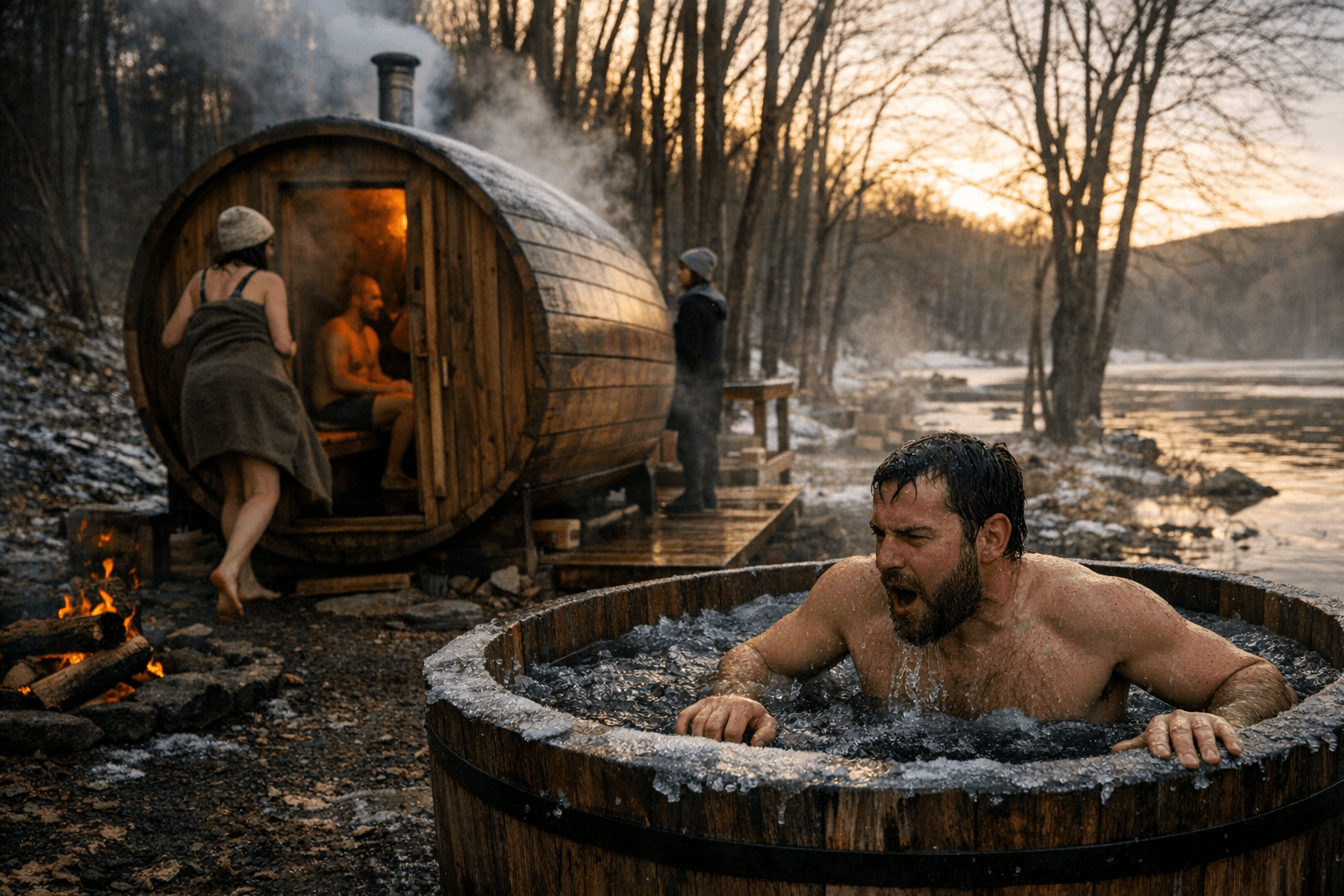
The wood-fired heat hits you the moment you pull open the door. Inside, a handful of neighbors sit in companionable silence, watching a timer count down. Twenty minutes later, everyone files out toward the cold plunge, a shared tank of water sitting somewhere in the low 50s°F, and nobody paid more than $20 to be here, if they paid at all.
That is the Hudson Valley's people's sauna, and according to Chronogram's recent deep-dive into the regional movement, it is spreading.
The Price That Breaks the Boutique Model
Here is the number that defines this whole story. A boutique NYC thermal bathing club like Lore in NoHo charges $200 per month for unlimited access or $89 per week for its Finnish sauna and cold plunge combination. Drop-in rates at comparable metro-area venues run $40 to $60 a session. The grassroots Hudson Valley model sits at the opposite end of that spectrum, operating on sliding-scale pricing, donation tiers, or outright mutual aid funds designed to keep sessions within reach regardless of income.
The Community Sweat Fund at a Hudson, NY spa makes the logic explicit: it uses mutual aid contributions specifically to bring affordable sauna visits to everybody in the Hudson community. That is not a model that appears in any VC pitch deck, which is precisely the point. The boutique experience and the people's sauna are delivering roughly the same physiological protocol, and one of them costs a fraction of the other.
What a Session Actually Looks Like
The structure is simple and deliberately unhurried. Sessions typically run 60 to 90 minutes and cycle through communal time in a wood-fired or electric sauna, a cold plunge, and social time afterward. Chronogram describes the experience as gently structured around timers and hydration breaks, with outdoor seating to decompress between rounds. That rhythm, sauna in, plunge, breathe, repeat, is the same contrast therapy protocol that urban wellness clubs package as a premium amenity. Here it unfolds in a repurposed rural outbuilding, staffed by volunteers, with an easy social atmosphere that pays-by-the-slot scheduling simply cannot manufacture.
How the Governance Actually Works
The cooperative model is what makes this financially viable rather than merely idealistic. Most Hudson Valley operations rely on small membership pools rather than open-ended public enrollment, volunteer labor in place of paid staff, barter or donation-based pricing, and scheduling built around committed regulars. Some use a sliding scale so that higher-paying participants effectively subsidize access for lower-income neighbors, building a mutual-aid logic directly into the pricing structure.
A comparable model in Minneapolis, the 612 Sauna Cooperative, illustrates how explicit this governance can get. Its cooperative code requires members to vote, volunteer, and stay current on dues, on the premise that the organization is "only healthy when all Members are consistently and entirely engaged." Hudson Valley organizers bring the same mutual-accountability logic to a more rural, more loosely organized context, pairing it with peer-led safety briefings, basic cardiovascular screening, and gradual cold-exposure coaching built on organizer experience rather than clinical protocol.
The Third-Place Argument
Chronogram connects the movement to a broader cultural appetite among younger Hudson Valley residents for non-alcoholic, experience-based social infrastructure. The people's sauna functions as a genuine third place: not home, not work, not a bar. It is somewhere to show up regularly, sweat with neighbors, and leave feeling better, without a hangover or a $15 cocktail on the tab.
This framing explains why the model is sticky beyond the initial novelty. Physiology helps, the cardiovascular and recovery benefits of contrast therapy are well-documented, but what keeps people returning is ritual and community, not the science alone. Chronogram's reporting is direct on this: sociality, not just physiological recovery, drives sustained engagement. The cold plunge is the draw; the conversation on the bench afterward is the reason to come back next week.
Adaptive Reuse and Local Craft
Much of what makes the Hudson Valley fertile ground for this movement is the physical landscape itself. Rural properties with outbuildings, barns, and land to spare make sauna installation feasible in ways that an urban lot simply does not allow. Operators are building their own wood-fired structures using local craft approaches, lowering startup costs and producing saunas that feel rooted in place rather than imported wholesale from a Scandinavian wellness catalog.
Chronogram positions this as part of a broader regional pattern of adaptive reuse: former agricultural and industrial spaces reimagined as community wellness infrastructure, driven partly by the urban-to-rural population flows of the past several years. The cultural capital that arrived with transplants from New York City is being channeled into something genuinely communal rather than something that just replicates boutique urban amenities in a pastoral setting. For regional tourism, that distinction matters: low-tech, authentic thermal experiences are becoming a draw in their own right, embedded in local identity rather than franchised from a wellness brand.
Where It Breaks: The Scaling Problem
The grassroots model works well at small scale and starts straining under exactly the pressures that have always challenged cooperative enterprises. Demand spikes first. When word spreads and waitlists grow, the session-based scheduling model becomes a bottleneck. You can only fit so many people into a 90-minute communal sauna without degrading the intimacy that made it worth attending.
Then come the institutional pressures:
- Insurance: Liability coverage for facilities involving cold-water immersion, heat exposure, and participants with varying cardiovascular profiles is neither cheap nor straightforward. Most small cooperatives are underinsured relative to their actual exposure.
- Permits: Local permitting for sauna structures and water features varies by municipality across New York State. Many grassroots operations exist in a gray zone that functions until a jurisdiction decides to clarify its code.
- Water and energy costs: A wood-fired sauna is relatively cheap to run, but maintaining a cold plunge through a Hudson Valley winter, heating enough water to keep a communal plunge clean and properly chilled, requires real infrastructure and real utility bills that scale linearly with session frequency while volunteer bandwidth does not.
The public health questions are equally real. Peer-led cardiovascular screening works when the community is small and organizers know their participants personally. As membership grows, that informal knowledge becomes unreliable and the liability exposure grows with it. Standardized screening protocols require either professional oversight or documented informed consent, both of which push the operational complexity toward something resembling the commercial model the movement is deliberately avoiding.
The Durability Question
What Chronogram's reporting ultimately suggests is that the people's sauna model is most durable when it actively resists scaling beyond its natural community size. The operations most likely to survive are the ones that cap enrollment, maintain the social density that makes the experience valuable, and treat the sliding-scale commitment as a governance principle rather than a marketing line.
The cold-plunge market broadly defaults toward branded tubs, app-based booking, and optimized recovery protocols priced for the same demographic that was already spending $200 a month at NYC bathhouses. The Hudson Valley's grassroots operators are building something structurally different: a wood-paneled room where someone passes you a ladle of water and tells you to listen to your body, underwritten by community trust rather than venture capital. The ceiling on how big that can get is real. So is the thing itself.
This article was produced by Prism’s automated news system from verified source data, official records, and press releases, then run through automated quality and moderation checks before publishing. The system is built and supervised by the people who set the standards it runs under. Read our full AI policy.
Did this article answer your question?