Kayla Barnes-Lentz builds a high-tech longevity home around cold plunges
Kayla Barnes-Lentz turns cold plunging into one piece of a tightly controlled longevity stack, showing how the market is moving toward full-home optimization.
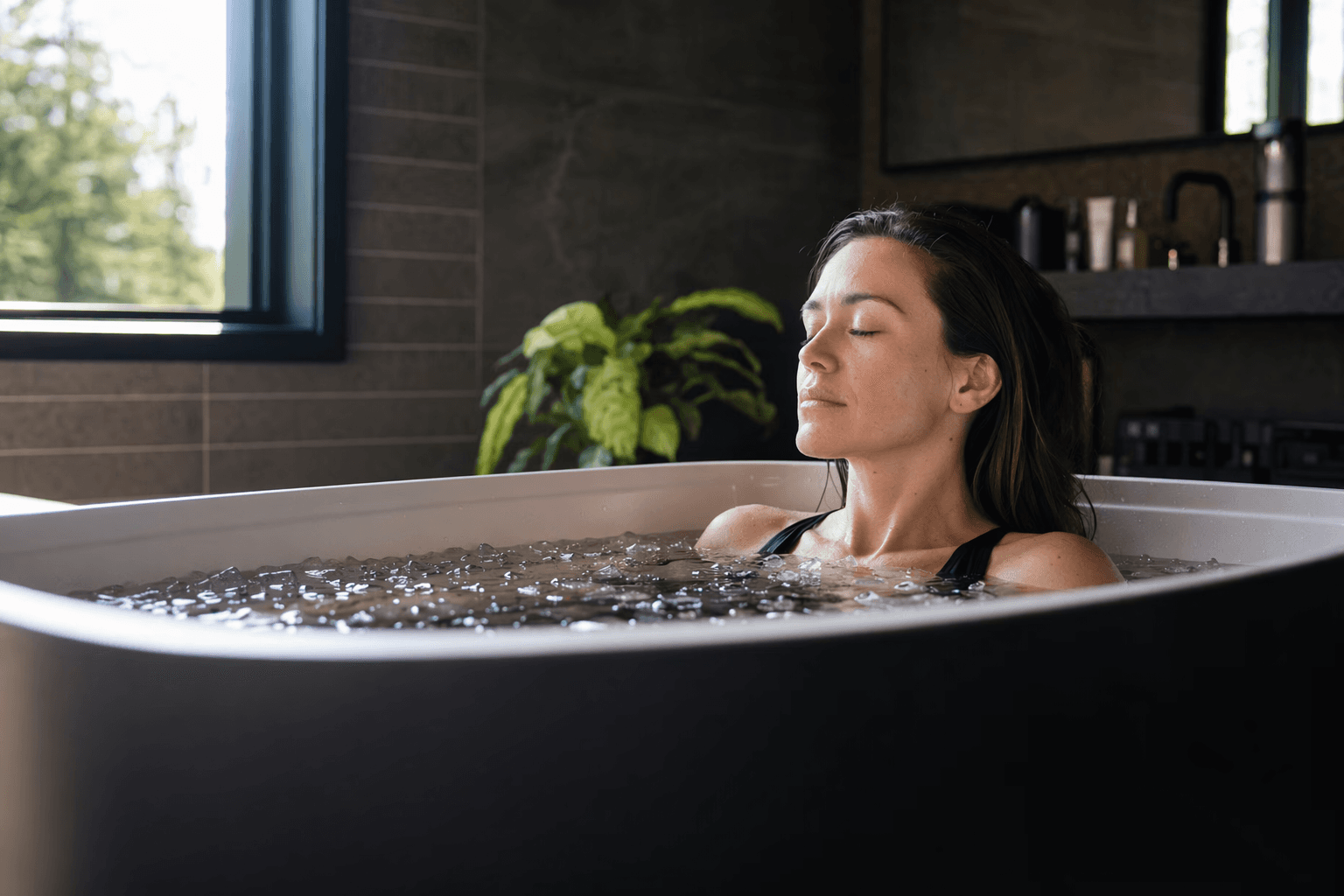
A cold plunge inside a full-body control system
A cold plunge pool in Austin is only one part of the story. In Kayla Barnes-Lentz’s home, it sits beside low-VOC furniture, warm lighting, a hyperbaric chamber, PEMF machines, saunas with built-in red light therapy, a home gym, and air purifiers, which makes the point immediately clear: this is not cold exposure as a standalone stunt, but cold exposure inside a fully engineered health environment.
That matters for anyone tracking ice baths, because it shows where the category is heading. The most attention-grabbing tub is no longer just about recovery after a workout. In Barnes-Lentz’s world, it is one node in a larger system built around measurement, environmental control, and repeated interventions that are meant to extend healthspan.
Why Barnes-Lentz has become a longevity reference point
Barnes-Lentz is 35, and she has built a public identity around tracking almost everything. Her own site says she is “widely recognized as the most publicly measured woman in health optimization,” and lists ovarian biological age, metabolic health, hormonal biomarkers, VO max, HRV, DEXA scans, inflammatory markers, micronutrients, and body composition among the metrics she has publicly tracked for more than a decade.
Her path helps explain why that level of control appeals to her. She studied nutrition after a college diet that reportedly leaned on Pop-Tarts and Toaster Strudel, opened the LYV clinic in Ohio in 2018, and left it in 2025. She began sharing her own results publicly in 2019, which helped build the image of a real-world biohacker rather than someone merely performing wellness online.
Her materials also make clear that she sees longevity through a female-specific lens. She argues that longevity research has historically been male-heavy and that women’s cyclical hormones, reproductive transitions, immune modulation, and metabolic shifts require different guidance. That framing runs through her work and helps explain why her cold plunge is never presented as a one-size-fits-all fix.
What the science says about cold plunges, and what it does not
The strongest part of the story is not a dramatic claim that ice baths cure aging. It is the tension between a powerful wellness ritual and a still-limited evidence base. A 2025 systematic review in PLOS ONE included 11 studies and 3,177 participants on cold-water immersion. The review found an acute inflammatory response immediately after immersion and a significant stress reduction 12 hours later.
Harvard’s summary of that analysis sharpened the takeaway: ice baths reduced stress, but the effect was delayed. It also noted that men, but not women, reported sleeping better after ice baths in the review. That detail matters in a market that often sells cold plunges as universally energizing, universally restorative, and universally transformational.
There is also a safety reality that the glossy wellness content rarely emphasizes enough. The National Weather Service warns that cold-water immersion can trigger cold shock, rapid breathing, spikes in heart rate and blood pressure, and drowning risk. It says those effects can be severe even in water that feels relatively mild, around 50 to 60 degrees Fahrenheit. In other words, the body does not need an arctic tub to react strongly.
A 2025 journal article on cold-water immersion adds another important caution: direct evidence for long-term human health benefits remains scarce. That does not mean ice baths have no value. It does mean the claims often travel faster than the data.
What the luxury package tells you about the market
Barnes-Lentz’s routine extends well beyond a cold plunge. Recent interviews and her own podcast materials describe a mix of biomarker tracking, wearable data, sleep routines, supplements, fasting, environmental-toxin reduction, and device-based therapies. She has also described using cold exposure during the day, including lunchtime plunges alongside hyperbaric sessions and whole-body vibration.
That is the real story here: the market is moving toward bundled longevity ecosystems, not single-purpose tools. Bryan Johnson, whom Barnes-Lentz has interviewed and whose materials describe him as the world’s most measured human, is the obvious comparison point. Both represent a version of longevity that depends on intense data collection, high-touch protocols, and enough resources to make optimization feel like infrastructure.
For readers in the ice bath world, the access question is where this story gets practical. You can separate some pieces from the luxury package:
- A cold plunge itself, used with care and an awareness of cold shock risk.
- Better sleep habits, which matter more than any single recovery tool.
- Air quality improvements, which may be more realistic than a hyperbaric chamber.
- Measurement that is simple and sustainable, rather than obsessive and expensive.
What is much harder to separate is the whole architecture around it: the home buildout, the climate control, the red-light saunas, the PEMF devices, the hyperbaric chamber, and the constant lab work. That is the escalation. The plunge becomes a symbol of a broader philosophy in which aging is treated less like a natural process and more like a system to be managed.
The real takeaway for ice bath culture
Barnes-Lentz’s home shows the direction of the longevity market with unusual clarity. Cold plunging is no longer just a recovery ritual at the edge of the gym. It is becoming part of a high-end, highly measured lifestyle that promises more control over aging, more personalization, and more data than most people will ever need.
That does not make the plunge irrelevant. It makes it easier to see for what it is: one tool in a larger protocol, useful in context, limited on its own, and increasingly tied to a wellness economy that sells access to control.
This article was produced by Prism’s automated news system from verified source data, official records, and press releases, then run through automated quality and moderation checks before publishing. The system is built and supervised by the people who set the standards it runs under. Read our full AI policy.
Did this article answer your question?