Kombucha microbes help create eco-friendly zinc oxide nanostructures
Kombucha yeasts helped make zinc oxide nanostructures that wiped out E. coli and Staph in two hours, pointing SCOBY microbes toward greener materials work.
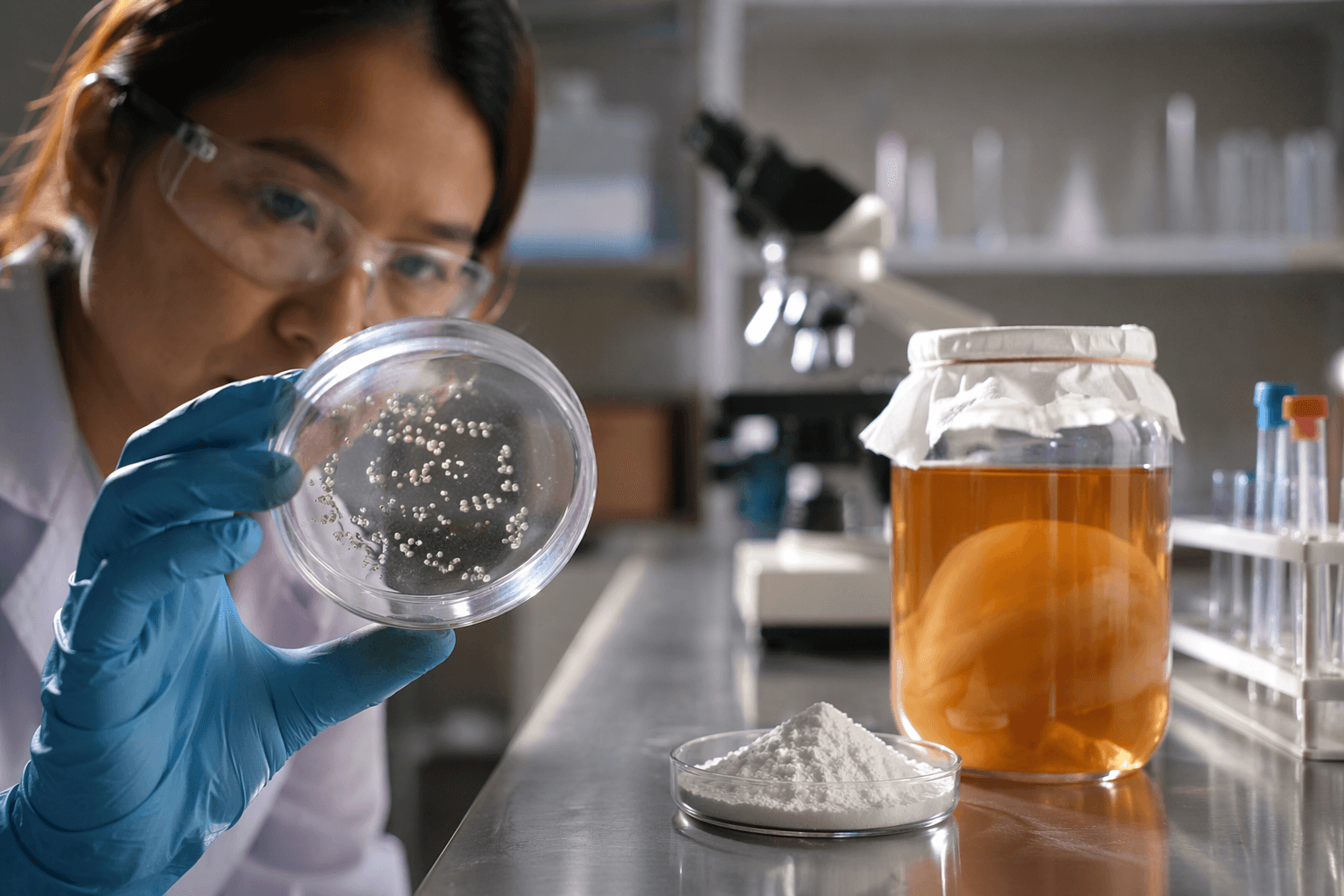
Yeasts pulled from kombucha and beetroot kvass helped researchers build zinc oxide nanostructures that stopped Staphylococcus aureus ATCC 6538P and Escherichia coli O157:H7 in their tracks. The June 25 paper in Bioprocess and Biosystems Engineering, by Gülden Kılıç, Gökhan Gurur Gökmen and Yogendra Kumar Mishra, frames the work as a green manufacturing study, not a home-brew upgrade, and uses fermented-food microbes as a route to antimicrobial materials.
The team used the isolates for extracellular biosynthesis of ZnO nanoparticles and then deposited them as thin films by spin coating. UV-Vis spectroscopy confirmed nanoparticle formation, scanning electron microscopy showed agglomerated particles alongside homogeneous nanoscale films, and energy-dispersive X-ray spectroscopy verified the composition. X-ray diffraction picked out monoclinic and cubic crystalline phases, with crystallite sizes ranging from 8.78 to 19.40 nm, while the thin films were described as predominantly amorphous. Water-contact-angle analysis showed hydrophilic surfaces, a trait that matters for how coatings behave once they meet moisture, proteins or cells.
The antibacterial readout was stark. In zone-of-inhibition tests, the free nanoparticles outperformed the thin films, but the coated surfaces still achieved complete bacterial inactivation within two hours under direct-contact conditions. That balance between stronger immediate kill from loose particles and easier deployment in film form is exactly the kind of tradeoff materials scientists chase when they talk about food packaging or biomedical coatings. The study’s own logic is built around replacing hazardous chemical routes with biological ones, and it notes that using unusual yeast strains for both nanoparticle production and film fabrication has been largely unexplored.
This is also not kombucha’s first turn in the zinc oxide literature. A 2023 Springer paper had already reported antibacterial activity from ZnO nanoparticles biosynthesized with kombucha extract, but the new work goes further by isolating the yeasts themselves and using them in a combined nanoparticle-plus-thin-film workflow. That fits a wider fermentation picture too: a 2026 kombucha study identified cultivable yeasts including Saccharomyces cerevisiae and Brettanomyces bruxellensis and argued that kombucha microbes can act as versatile biofactories, not just contributors to flavor and acidity.
The wider appeal is obvious in a world where bacterial antimicrobial resistance remains deadly, with the World Health Organization estimating 1.27 million direct deaths in 2019 and the Lancet’s GRAM project estimating 1.14 million direct deaths attributable to bacterial AMR in 2021. For kombucha readers, the takeaway is not that a SCOBY belongs in the lab at home, but that the microbes behind a fermented drink can also help build cleaner antimicrobial materials, from the first nanoparticle to the last thin film.
This article was produced by Prism’s automated news system from verified source data, official records, and press releases, then run through automated quality and moderation checks before publishing. The system is built and supervised by the people who set the standards it runs under. Read our full AI policy.
Did this article answer your question?