Kombucha yeast shows promise as a probiotic for functional foods
Kombucha yeast is moving beyond flavor into functional-food research. Zygosaccharomyces bailii UVI60 survived gut-like stress and stuck to intestinal cells.

Zygosaccharomyces bailii UVI60 survived at 98% in adverse synthetic gastric and duodenal conditions in a June 25 JoVE Visualize feature, emerging as the stronger probiotic candidate among two kombucha-derived yeasts alongside Zygosaccharomyces lentus.
Yeast is no longer the side story in the SCOBY
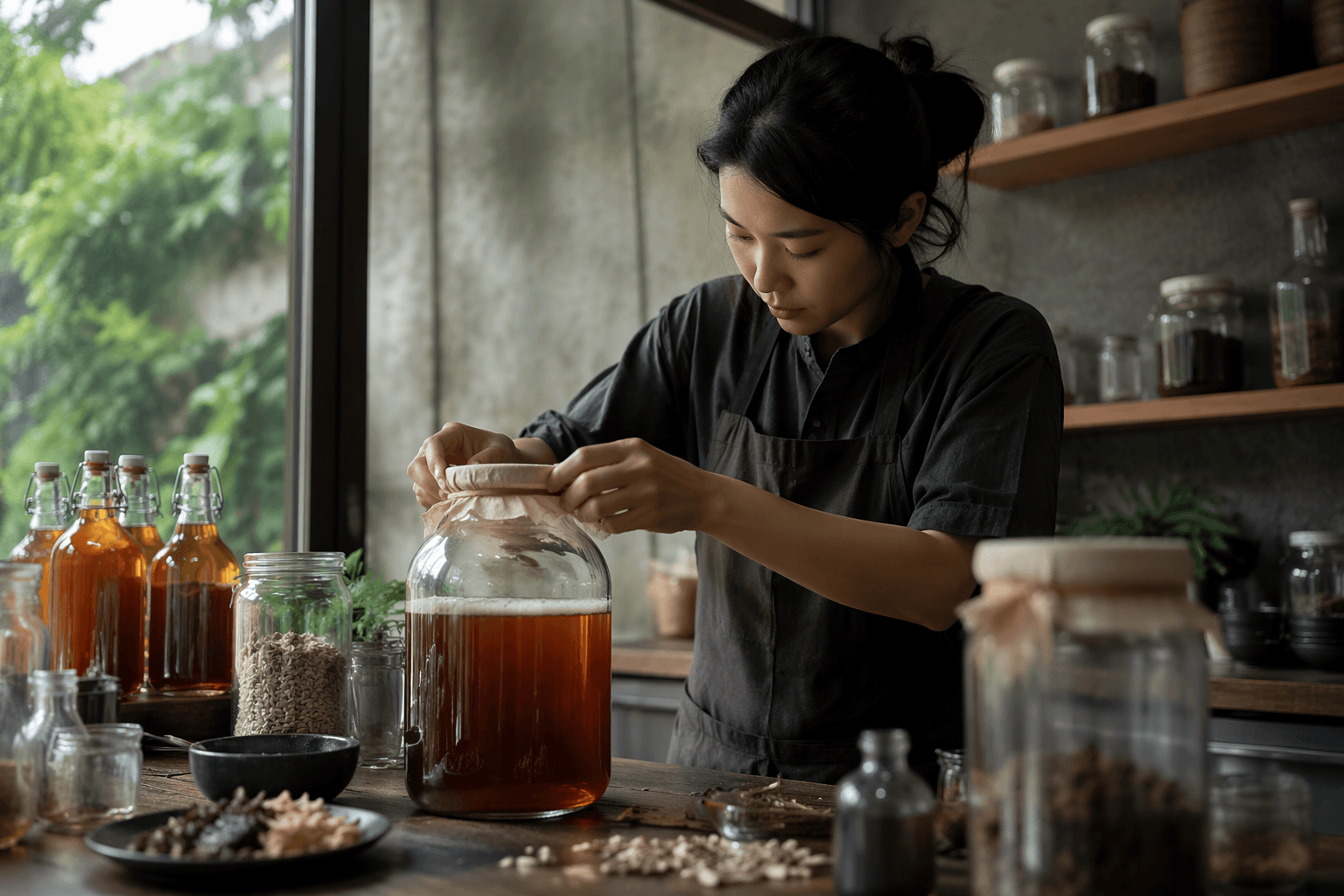
Kombucha brewers already know yeast drives a lot of the action inside the jar: it helps convert sugars, shapes carbonation, and sets up the conditions bacteria need to build a balanced ferment. This work adds a different lens, treating artisanal yeast isolates not just as fermentation helpers but as possible functional ingredients in their own right.
The kombucha ecosystem is not a single organism. It is a mixed culture, and the yeast side of that culture may hold more diversity, resilience, and biochemical range than many brewers have historically tracked. Kombucha-origin yeasts are a potential reservoir for next-generation functional foods, a far broader role than flavor development alone.
Why Zygosaccharomyces bailii UVI60 stands out
The headline strain is Zygosaccharomyces bailii UVI60. In the probiotic screen, it performed especially well under simulated gastrointestinal stress in adverse synthetic gastric and duodenal conditions.
UVI60 also showed significant adhesion to the intestinal epithelium, strong antioxidant activity, bile salt hydrolysis, co-aggregation with pathogens, and geroprotective effects in a Caenorhabditis elegans lifespan model.
The evaluation also included cytotoxicity assays against tumor cell lines and checks on viability in diverse food matrices, which pushes the work beyond a simple strain screen and into the territory of practical formulation.
The test panel behind the claim
Several specific measures of probiotic potential appeared in the evaluation:

- bile salt hydrolysis, which suggests how a microbe handles the digestive environment
- co-aggregation with pathogens, which can affect how microbes interact with unwanted organisms
- Caenorhabditis elegans lifespan-extension studies, used here as a geroprotective readout
- cytotoxicity assays against tumor cell lines, a separate safety and bioactivity check
- viability in diverse food matrices, which matters for real-world product use
Those tests show a yeast surviving stress while displaying multiple traits associated with functional-food development.
Why Z. lentus UVI61 still belongs in the conversation
Zygosaccharomyces lentus UVI61 takes a different place in the story. It did not grow at 37 °C, so the probiotic evaluation focused on UVI60 instead. Temperature tolerance can decide whether a strain is a realistic candidate for gut-facing applications.
Still, UVI61 was not treated as irrelevant. It has postbiotic potential, which keeps it in the functional-food conversation even without the same live-cell promise as UVI60.
What this means for kombucha brewing
Yeast diversity deserves more attention during selection and maintenance of starter cultures. If one kombucha-derived yeast can show resilience in synthetic gastric and duodenal conditions, strong adhesion, and antioxidant activity, then the yeast population in an artisanal batch may deserve as much scrutiny as the bacterial side of the SCOBY.
That has implications for strain banking, too. Keeping track of which isolates come from which batch, and preserving distinct yeasts instead of blending everything into one generalized starter, could matter if future nondairy functional foods are built around kombucha-origin microbes. The more carefully a brewer manages yeast diversity, the more room there is for distinct fermentation behavior, acidity profiles, and downstream functional potential.
It also affects how producers think about claims. A kombucha culture that supports a strong ferment is one thing; a strain that is being explored for probiotic or postbiotic use is another. The distinction rests on specific assays and specific isolates rather than treating all kombucha microbes as interchangeable.
This article was produced by Prism’s automated news system from verified source data, official records, and press releases, then run through automated quality and moderation checks before publishing. The system is built and supervised by the people who set the standards it runs under. Read our full AI policy.
Did this article answer your question?