Labubu cooldown tests China’s IP economy, Pop Mart’s next hit could decide it
Labubu's resale cool-down is the first real test: the fandom is still buying, but Pop Mart's next hit will decide whether China's IP boom keeps scaling.
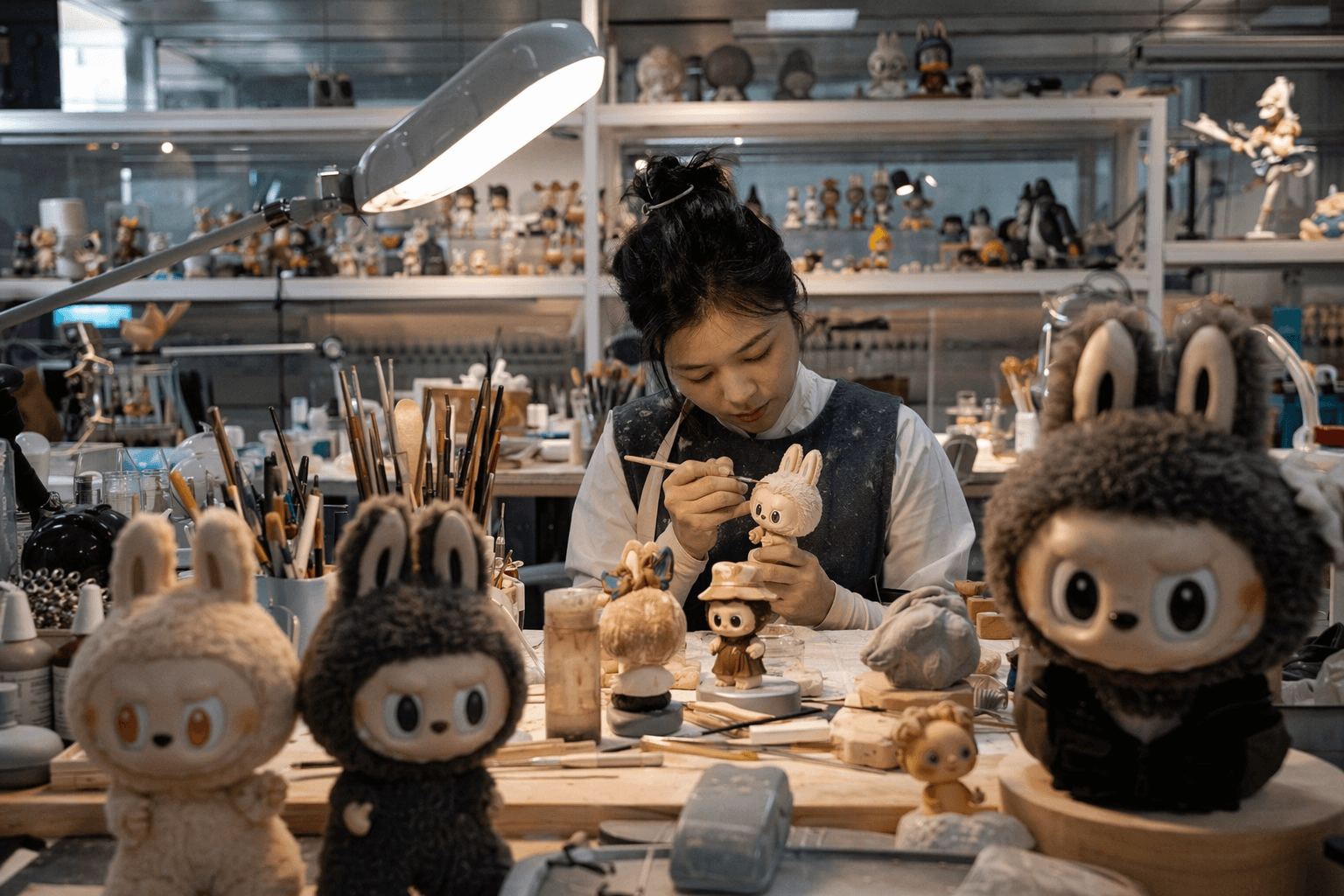
The first real test for Labubu
Labubu is no longer being judged only by how hard people line up for it. The sharper question now is whether softer resale signals mean the craze is ending, or whether the market is simply normalizing after a period of extreme heat. That distinction matters because Labubu has become the clearest collector shorthand for a bigger shift in China’s IP economy: the move from one-off viral demand to a system that can keep characters alive after the hype curve bends.
The evidence for the slowdown is easiest to see in the secondary market. Standard Labubu figures on Singapore’s Carousell were listed at around S$15, while only rare secret pulls were still drawing prices in the hundreds of dollars. Reseller premiums had narrowed by about 24% from their peak, a clean signal that speculative energy has cooled even if the fan base itself has not gone anywhere. For collectors, that changes the buying mood fast: the everyday figure is no longer behaving like a lottery ticket, but the chase pieces still carry enough scarcity to keep people watching every drop.
What the queues still tell you
The scale of the phenomenon is still visible in the body language of launches. At the Bangkok opening of what was billed as the world’s biggest Pop Mart store last August, the Labubu queue stretched past three shopfronts even in 35-degree heat, and buyers were capped at two per person. That kind of scene explains why Labubu became more than a toy story in the first place. It was never just about the figure in the blind box, but about the social ritual around getting one before the shelf emptied.
That launch image also makes the current cooldown easier to read. When a character can draw a line through multiple storefronts in punishing heat, a later softening in resale does not automatically mean collapse. It may simply mean the market has moved from panic buying to a more selective collector phase, where the common pulls settle and only the hardest-to-get variants keep a premium.
Pop Mart’s numbers show a bigger machine
The reason Labubu matters so much is that Pop Mart is not relying on one character to carry the company. In 2024, Pop Mart reported revenue of RMB 13.04 billion, up 106.9% year on year, and said THE MONSTERS, MOLLY, SKULLPANDA and CRYBABY each passed RMB 1 billion in revenue. That matters because it shows a portfolio, not a one-hit wonder. Labubu may be the face of the moment, but the business underneath is designed to keep more than one IP moving at once.
The growth did not stop there. In a first-quarter 2025 update, Pop Mart said total revenue rose 165% to 170% year on year, while overseas revenue climbed 475% to 480% and Asia-Pacific revenue rose 345% to 350%. By the first half of 2025, revenue had reached RMB 13.88 billion, up 204.4% year on year, and profit attributable to owners of the company had jumped 396.5%. The same filing showed the Asia-Pacific store count rising from 39 in H1 2024 to 69 in H1 2025, while retail stores accounted for 52.4% of Asia-Pacific revenue. That is the tell: Pop Mart is not just selling demand, it is scaling a retail-and-IP system that can keep monetizing characters after the initial frenzy fades.
Labubu sits inside a much older IP play
Labubu did not appear out of nowhere, and that history is part of why the character has staying power. Pop Mart’s official materials say Kasing Lung created The Monsters in 2015, inspired by Nordic mythology, and that Labubu is the most prominent character in that world. The company also frames Labubu as part of a fairy world that began in picture books before being turned into a three-dimensional art toy through later collaboration.
That background matters because it shows why collectors treat Labubu differently from a random trend character. It already has lore, a named creator, and a wider universe around it, which makes it easier for Pop Mart to keep extending the IP with new drops and character branches. The current slowdown in resale does not erase that structure; if anything, it tests whether a built-out universe can outlast the rush for the hottest variant.
Thailand shows what durable demand looks like
If Singapore’s resale pricing shows cooling, Thailand shows the other side of the story. A Nielsen report cited in 36Kr English/KR-Asia said Thailand led the world in TikTok mentions of Labubu and Pop Mart, with more than 365,000 comments in May. In July 2024, the Tourism Authority of Thailand named Labubu an “Amazing Thailand Experience Explorer,” and Pop Mart’s Labubu-themed store at Mega Bangna reportedly generated more than RMB 10 million on opening day. That is not the profile of a fad that disappeared after one social-media burst.
The Bangkok rollout kept reinforcing that point. Minor International said the August 13, 2025 opening of Pop Mart’s ICONSIAM flagship in Bangkok produced record-high first-day sales for Pop Mart in Thailand, even though the company already had eight free-standing stores and three pop-up units in the country. William E. Heinecke, who leads Minor International, has been part of the broader retail environment around that expansion, and the message from the market is clear: some regions are still absorbing Labubu as a live, growing retail event rather than a spent trend. In practice, that means the character still has plenty of room to move through mall traffic, tourism, and impulse buying even as reseller margins tighten.
What collectors should watch next
The most important shift is not whether Labubu is alive or dead. It is whether the next wave of Pop Mart IPs can generate the same combination of lineups, social proof, and repeat purchasing without needing Labubu-level mania first. Campaign US highlighted Twinkle Twinkle, Mokoko, and other emerging characters as the next candidates, and Jacob Cooke of WPIC Marketing + Technologies put the logic plainly: Pop Mart has benefited by building distribution, data, and repeatable monetization around IP incubation.
That is the real collector lesson. Labubu is still the benchmark, but the market is starting to value the architecture around it, not just the character itself. Miniso is chasing the same kidult collectibles audience, which means the competitive question is shifting from who can ignite the loudest craze to who can turn fandom into an ecosystem that keeps selling after the queue shortens. In that sense, Labubu’s cooldown is not the end of the story. It is the first serious test of whether China’s IP boom can survive the moment when every collector stops panic buying and starts asking what is worth keeping.
This article was produced by Prism’s automated news system from verified source data, official records, and press releases, then run through automated quality and moderation checks before publishing. The system is built and supervised by the people who set the standards it runs under. Read our full AI policy.
Did this article answer your question?


