Aether Flash turns into a deadly Commander build-around in red
Aether Flash is far more than old red hate. In Commander, it becomes a combo piece, a board-control engine, and a brutal answer to creature-heavy tables.
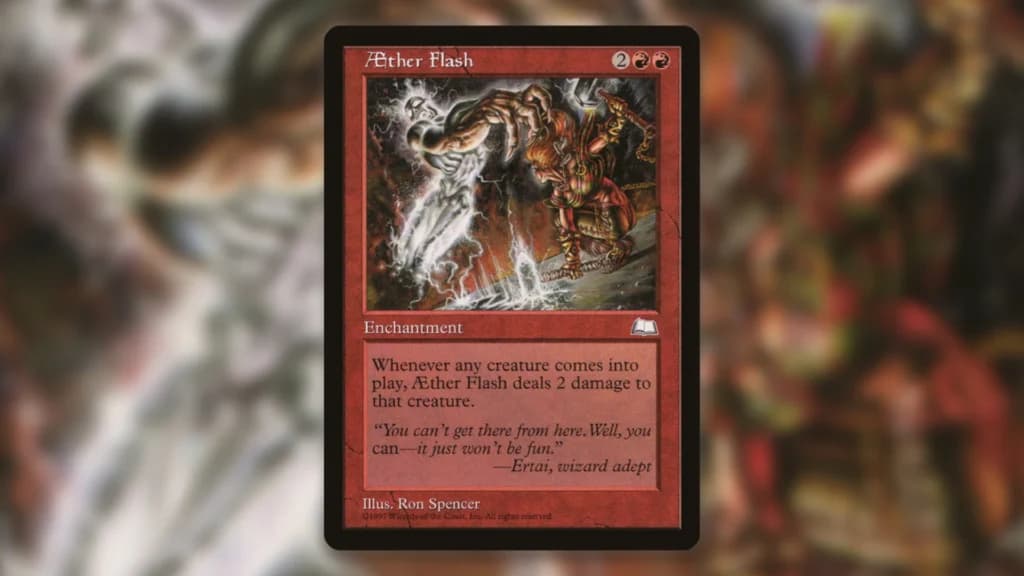
Aether Flash looks like a throwback until it hits the table and starts punishing every creature spell like it was built for modern Commander. At {2}{R}{R}, its Oracle text is brutally simple: “Whenever a creature enters, this enchantment deals 2 damage to it.” In a 100-card singleton format built around 99 cards plus a commander, that kind of blanket damage turns into real pressure fast.
Why Aether Flash still matters
This card is at its best when the table is doing what Commander tables always do, which is developing boards full of value creatures, tokens, and enter-the-battlefield creatures. Aether Flash functions like an inverted board wipe: it doesn’t reset the battlefield all at once, but it makes every new creature arrival painful, fragile, and often dead on contact. That is especially nasty against token decks, aggressive swarm shells, and utility creatures that are supposed to live just long enough to generate value.
The key thing to understand is that the damage is not targeted. That means Aether Flash can still tag creatures that can’t be targeted by spells and abilities, which widens its usefulness against otherwise annoying threats. In practice, it behaves less like a narrow hate card and more like a persistent tax on the entire creature-centric game plan.
The best shell is not “just punish creatures”
The obvious way to use Aether Flash is to sit behind it and watch the table stumble. The better way is to turn it into a build-around that multiplies damage and converts the enchantment into a real plan. Damage enhancers like Solphim, Mayhem Dominus and Furnace of Rath make every trigger hurt harder, while Panharmonicon-style trigger doubling can push the punishment even further into absurdity.
That is where the card starts feeling less like a relic and more like a red engine. If your deck is already leaning into red damage amplification, Aether Flash becomes a piece that can actually close games instead of just irritating people. It is the difference between “creatures enter tapped and die sometimes” and “the table is now playing through a permanent hazard zone.”
There is also a nasty equipment angle. If you animate Aether Flash with Opalescence or Starfield of Nyx, it can become a creature and wear Basilisk Collar. That turns its repeated 2-damage trigger into a deathtouch-based creature killer that also gains you life, which is exactly the kind of ugly board state red usually has to work harder to assemble.
The land-lock lines are real, and miserable
Aether Flash also gets much meaner when you stop thinking only about creatures and start thinking about lands as creatures. Pairing it with Living Plane or Nature’s Revolt creates a brutal land-denial setup, because lands entering the battlefield immediately get hit by the Flash trigger. With Living Plane specifically, the world rule adds another layer of baggage, since only one world permanent can stay on the battlefield at a time.
That is the kind of lock that can turn a casual multiplayer game into a long, unpleasant stall if nobody has an answer ready. It is powerful, but it is also the sort of line you need to choose deliberately, because it pushes the card from “strong pressure piece” into “the game may stop functioning normally.”
The dinosaur combo is the headline
The cleanest combo case for Aether Flash is the Polyraptor loop, and this is the interaction that most clearly justifies calling the card a build-around. Polyraptor plus Aether Flash is listed as a true two-card combo, and the outcomes can be infinite creature tokens, infinite enter-the-battlefield triggers, or even a draw depending on how the loop is handled. Polyraptor’s official rules note matters here: the token it creates also has Polyraptor’s ability, so the chain can sustain itself.
If you want that loop to actually end the game instead of just spinning forever, Impact Tremors turns every repeat token entry into damage and gives you a clean win condition. That is the important deckbuilding lesson here: Aether Flash is not just a weird dinosaur toy, it is a combo hub that rewards you for having an actual payoff in the 99.
Other combo shells give it more than one lane
The Polyraptor line is the famous one, but it is not the only way Aether Flash shows up in combo databases. EDHREC also lists it with Sprouting Phytohydra, Nature’s Revolt, Living Plane, Godhead of Awe, and a Kiki-Jiki, Mirror Breaker plus Thornbite Staff package. That breadth matters because it tells you the card is not locked into one narrow dinosaur build.
Two other lines are especially worth noting. Cacophodon plus Kiki-Jiki, Mirror Breaker gives you another way to exploit repeated triggers and copied creatures, while Ashcloud Phoenix plus Yarus, Roar of the Old Gods leans into recursion and face-down play patterns. Ashcloud Phoenix returns face down under your control when it dies, and when turned face up it deals 2 damage to each player, which means it already lives in the same kind of recursive, damage-heavy world that Aether Flash likes to exploit.
Yarus is the kind of commander that makes this style of card look smarter than it first appears. Because Yarus’s rules text cares about face-down creatures dealing combat damage, it naturally rewards odd creature states, and Aether Flash fits that environment by making the battlefield awkward for everyone else. That is exactly the sort of shell where an old enchantment can stop being ornamental and start feeling engineered.
When to play Aether Flash over the obvious red cards
This is not the card you jam into every red Commander deck. If you just want generic interaction, there are cleaner options. Aether Flash is worth testing when your list wants repeated creature punishment, when your commander or support package amplifies damage, or when you are already leaning into one of the specific combo shells that turns the trigger into a win.
It is also better than it looks in metas that flood the board with small creatures and ETB creatures, because those tables accidentally do half the work for you. The enchantment asks for patience, sequencing, and a deck that can profit from symmetrical pain. If you are already set up to break symmetry, Aether Flash stops being a nostalgia pick and becomes a very real red engine.
That is the real punch of the card: it looks like old hate, but in Commander it plays like a pressure valve, a combo starter, and sometimes a lock piece all at once. If your table keeps relying on creatures to do everything, this is one of the strangest old red enchantments you can sleeve up and still feel completely justified.
This article was produced by Prism’s automated news system from verified source data, official records, and press releases, then run through automated quality and moderation checks before publishing. The system is built and supervised by the people who set the standards it runs under. Read our full AI policy.
Know something we missed? Have a correction or additional information?
Submit a Tip