Commander Brackets, Game Changers, and Banlists Explained for Every Player
The Commander bracket system now spans five distinct tiers, and with 83 cards on the banlist and 53 Game Changers on the watchlist, knowing the difference is essential before your next game.
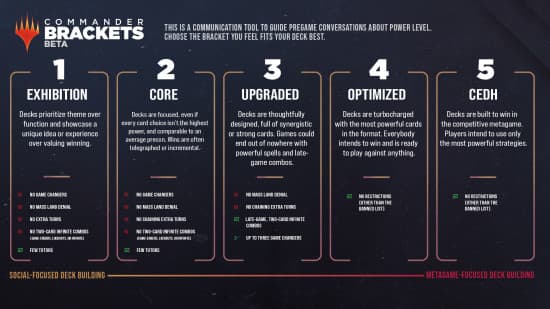
Three governance systems currently shape every Commander game you play: the banlist, the Game Changers watchlist, and the five-tier bracket system that the Commander Format Panel has been refining in beta since early 2025. Each one does a different job. Conflating them, or ignoring one entirely, is the fastest way to show up at your LGS with a deck that creates table problems before a single card is drawn.
The Banlist: Hard Stops
The banlist is the only system with teeth at a legal level. As of April 2026, there are 83 cards that cannot appear in any legal 100-card Commander deck at sanctioned play. No exceptions, no local carve-outs unless a tournament organizer explicitly states otherwise. Wizards' banned-and-restricted page is the authoritative source; community sites like Wargamer keep mirrored, frequently-updated versions for quick lookup.
The February 9, 2026 announcement delivered the most recent changes, and they were notably positive: two headline unbans went live immediately. Biorhythm returned to legality after a long absence (and was simultaneously added to the Game Changers list to moderate its effect at casual tables), and Lutri, the Spellchaser became legal for the first time in Commander's history. Gavin Verhey, representing the Commander Format Panel, emphasized that neither move was made lightly.
Lutri's unban comes with a significant asterisk and introduces a brand-new ban category: "banned as companion." Lutri can legally sit in the 99 or occupy the command zone, but it cannot be designated as a companion before the game starts. This is the first card in the format to receive this designation. The distinction matters more than it might seem; during a pre-game deck check or registration, you need to be clear about how Lutri appears in your list, because any attempt to companion it is still a violation.
The Game Changers List: Power Flags, Not Bans
The Game Changers list, maintained by Wizards and the Commander Format Panel, currently contains 53 cards. These are not banned. They are fully legal Magic cards that are identified as dramatically affecting multiplayer game balance. Well-known entries include Rhystic Study, Cyclonic Rift, Smothering Tithe, and Thassa's Oracle. Farewell joined the list in the February 2026 update; the Panel noted that at six mana it takes real effort to include, but its broad board-wiping effect warranted a Bracket 3-and-above designation.
Being on the Game Changers list does exactly one thing mechanically: it governs where your deck sits in the bracket system. A Game Changer in your list is a flag for what kind of table experience you're bringing, and repeated patterns of dominance from a particular card can eventually escalate it toward outright ban consideration. EDHREC's Top Game Changers page and Scryfall's "is:game-changer" search tag both let you audit cards quickly. Moxfield and Archidekt have built in-deck-builder warnings when a card you're adding triggers a bracket change.
The Bracket System: Finding Your Table
The five brackets, introduced in their current form on February 11, 2025 and refined through multiple updates, carve Commander into distinct play experiences rather than a vague one-to-ten scale:
- Bracket 1 (Exhibition): The most casual tier. No Game Changers, no intentional infinite combos, no mass land denial, no extra-turn cards. This is explicitly a space where stretching legality for fun, think Un-cards or unusual fan formats, is welcome at the pregame conversation stage.
- Bracket 2 (Core): Still no Game Changers. Social play focused on fun and interaction without the format's heaviest weapons.
- Bracket 3 (Upgraded): Up to three Game Changers are permitted, counting the commander itself if it appears on the list. This tier roughly maps to the old community shorthand of "power level 7" and is where the majority of active players land.
- Bracket 4 (Optimized): No restrictions on Game Changers. High-power, efficient strategies, strong resource engines. Gameplay is explosive.
- Bracket 5 (cEDH): Fully competitive, metagame-driven play. Win conditions are efficient and often instantaneous; fast mana, free disruption, and tutors are expected.
Crucially, the bracket system is self-assessed and voluntary. Wizards and the Panel have been explicit: it is not a calculator output that legally locks your deck. It is a communication tool for the pregame conversation. Bracket 2 playing against Bracket 3 isn't catastrophic; what matters is that both players know what the other is bringing and agree to sit down together. The system replaces the notoriously unreliable "my deck is a 7" shorthand with shared criteria both players can reference.
How to Check Your Deck Before an Event
If you're heading to a bracketed event, here is the practical workflow:
1. Run your list through a bracket calculator. Tools like BracketCheck.com, ScrollVault's calculator, Moxfield, EDHREC, and Archidekt all check Game Changers, flag banned cards, and return a starting-point bracket.
These are estimates, not official rulings, but they surface problems fast.
2. Cross-check the official banlist. Any card flagged as potentially problematic should be verified against Wizards' banned-and-restricted page directly.
Pay specific attention to the "banned as companion" category for Lutri; the designation is new and deck-building software may not handle it uniformly yet.
3. Check the event's specific rules. Local game stores and tournament organizers can apply local modifications.
Some smaller events omit certain Game Changers from enforcement, or they may enforce stricter bracket-specific bans. Ask the Tournament Organizer directly before match start, and if there is any contested card in your list, disclose it at deck check rather than wait for a dispute mid-game.
Best Practices for Players and Organizers
The single most effective habit a competitive player can build is running their decklist through a bracket calculator before every event, not just at deck construction. The Game Changers list is updated alongside major announcements, and a card that was unrestricted at your last event may have moved since. Carry a link or screenshot of your decklist for fast adjudication; disputes resolved by showing a timestamped decklist take seconds, while disputes argued from memory can derail a round.
For organizers, the community's experience has made one thing clear: ambiguity in event rules produces the most friction. Publishing your bracket enforcement policy alongside links to the official banlist and Game Changers list in your event pages is low-cost and high-impact. Pre-event deck checks for larger tournaments are increasingly standard practice, and players who know the rules in advance arrive with appropriate expectations.
The broader arc of these systems, from the original beta launch through the February 2026 refinements covering hybrid mana rules and the Farewell and Biorhythm decisions, shows a format infrastructure that is actively iterating. The Game Changers list will continue to evolve, bracket criteria will be refined based on community feedback, and the banlist will shift as the Panel gathers data. Staying current with Wizards' Commander announcements and bookmarking community resources like EDHREC's Game Changers page isn't optional anymore; for anyone playing in organized events, it's as fundamental as knowing what's in your deck.
This article was produced by Prism’s automated news system from verified source data, official records, and press releases, then run through automated quality and moderation checks before publishing. The system is built and supervised by the people who set the standards it runs under. Read our full AI policy.
Did this article answer your question?