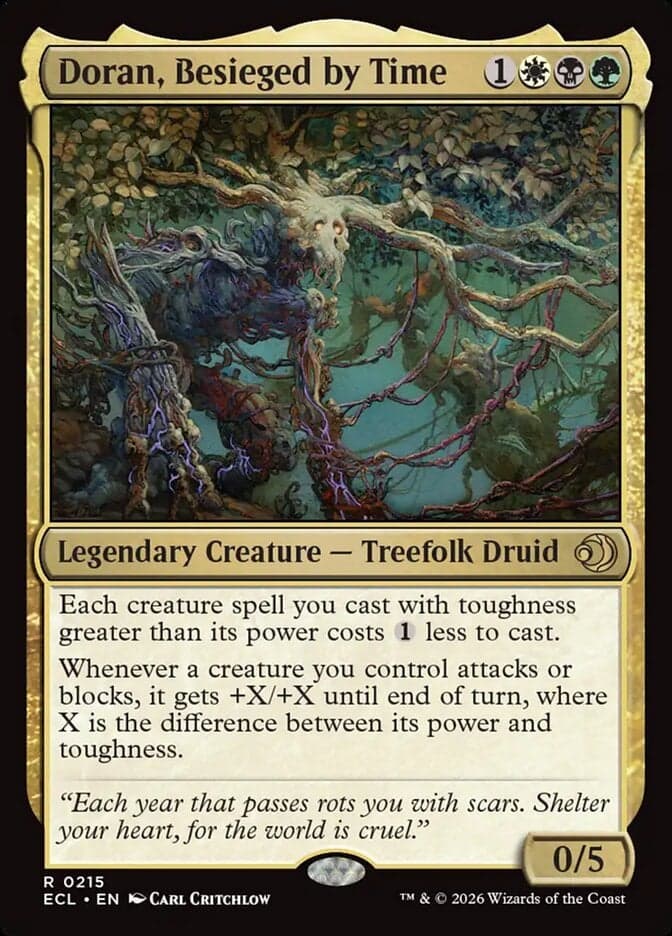
Emil, Vastlands Roamer turns land diversity into huge Fractal tokens
Emil turns land diversity into oversized Fractals, and the deck only works if the mana base is built like a machine. Field of the Dead is the real power spike.
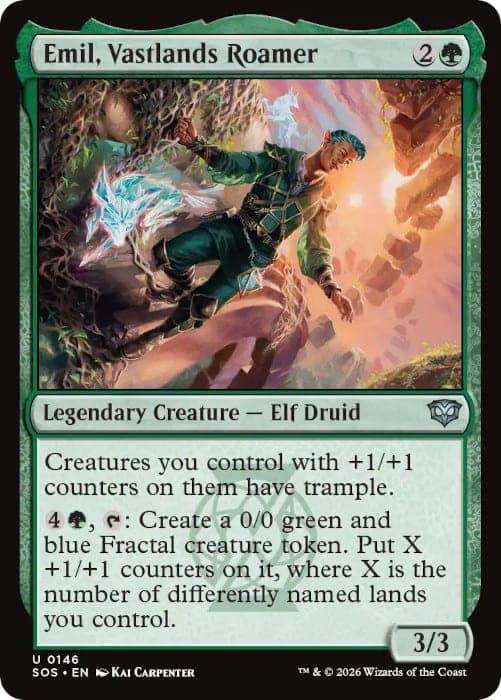
Emil, Vastlands Roamer looks like a straightforward green commander until you read the part that matters: the token gets bigger based on differently named lands. That changes the whole deck-building job, because the payoff is not just ramping hard, it is turning your land suite into the engine that makes Emil dangerous. If you build him like a normal mono-green value pile, he stays cute. If you build around land names, he becomes a real board plan.
Why Emil matters
Emil is a 3/3 legendary Elf Druid for {2}{G}, and both halves of his text push in the same direction. His activated ability costs {4}{G} and tapping him to create a 0/0 green and blue Fractal with X +1/+1 counters, where X equals the number of differently named lands you control. On top of that, creatures you control with +1/+1 counters gain trample, so the deck does not need to waste slots finding a separate finisher for the token once it is large enough.
That is the key payoff profile. Emil does not ask you to flood the board with random bodies; he asks you to make your land base count as a resource once, then count again when you activate him. The commander is at his best when the battlefield already looks unusual, because every distinct land name makes the next Fractal harder to ignore.
Build the mana base around names, not just colors
The cleanest version of this deck leans hard into land diversity with only seven basic lands, thirty nonbasic lands, and a pile of modal double-faced cards that can be played as lands. That is the right instinct. Emil does not care how many green sources you have if those lands all share the same name, so the mana base has to be treated like a toolbox, not a safety blanket.
The modal double-faced cards are especially important because they let you keep spell density without giving up land slots. Zendikar Rising rules clarified that modal double-faced cards have the characteristics of their front face while they are in hand, graveyard, or exile, and when you play them you choose which face to play. In practice, that means these cards help the deck feel less clunky while still feeding Emil the varied land package he wants.

The biggest trap here is overloading on lands that are technically nonbasic but do not actually improve the plan. A land slot should do at least one of three things: add a new name, fix the game plan, or unlock a payoff. If it does none of those, it is just taking up room in a commander shell that already needs to be disciplined.
The engines that turn the land count into a real board
Field of the Dead is the card that pushes this from interesting to legitimately scary. It enters tapped, taps for colorless, and makes a 2/2 black Zombie whenever it or another land enters under your control, as long as you control seven or more lands with different names. Field was originally printed in Core Set 2020, and in this shell it becomes a second commander in all but name.
Once you hit that seven-name threshold, every land drop starts paying you twice. The land itself advances Emil’s Fractal size, then Field adds another body to the board, which gives the deck a backup plan if Emil gets removed or taxed into the dirt. That is what separates a novelty build from a deck that can actually hang in a Commander pod: the commander does not have to be the only thing happening.
Crop Rotation is the clean tutor that makes the whole machine less fair. It is an instant that asks you to sacrifice a land as an additional cost, then searches your library for any land card and puts it onto the battlefield. In this list, that means you can turn the right land into Field of the Dead, or turn a spare land into whatever utility piece the table pressure demands.
Seedborn Muse is the other inclusion that makes Emil feel like a real threat instead of a once-a-turn gimmick. Untapping all your permanents during each other player’s untap step is absurd in a deck whose commander has a tap ability, because it means you can threaten Emil over and over across a full table cycle. When Seedborn Muse sticks, the deck stops playing fair turns and starts turning every opponent’s upkeep into another chance to cash in your land diversity.

Where the bracket conversation starts
This is where power level matters, and the deck does not get to pretend otherwise. The build leans toward Bracket 2 in spirit, but Field of the Dead and other premium lands push it toward Bracket 3. That is not a flaw, it is an honest read on what happens when you turn a land package into a win condition instead of a support system.
Wizards’ Commander Brackets beta was updated on April 22, 2025, which matters because this is an active framework for matchmaking and deck-power guidance, not a frozen label. Emil fits that reality perfectly. If you bring Field of the Dead, land tutors, and untap engines, you are making a deliberate decision about table expectations, and the deck should be built with that decision in mind.
What to keep, and what to cut without regret
The short version is simple: keep the lands that make your names count, keep the cards that tutor or untap those lands, and cut anything that is only cute. A pile of “good stuff” nonbasics can make the deck look clever while secretly blunting the commander, because Emil wants density and purpose more than novelty. Every basic you keep should be doing a job, and every nonbasic should justify itself by helping the land count, the token engine, or the payoff.
That is why Emil is more than a curiosity. The commander asks for a specific kind of discipline, and the reward for that discipline is huge Fractal tokens, trampling board presence, and a land package that can grind through removal better than most creature-based decks. Build the lands carefully, and the supposedly awkward mono-colored legend stops looking like a gimmick and starts looking like a very real way to win with the ground itself.
This article was produced by Prism’s automated news system from verified source data, official records, and press releases, then run through automated quality and moderation checks before publishing. The system is built and supervised by the people who set the standards it runs under. Read our full AI policy.
Know something we missed? Have a correction or additional information?
Submit a Tip