Glarb, Cecil, and Tasigur Lead Duel Commander League on March 27
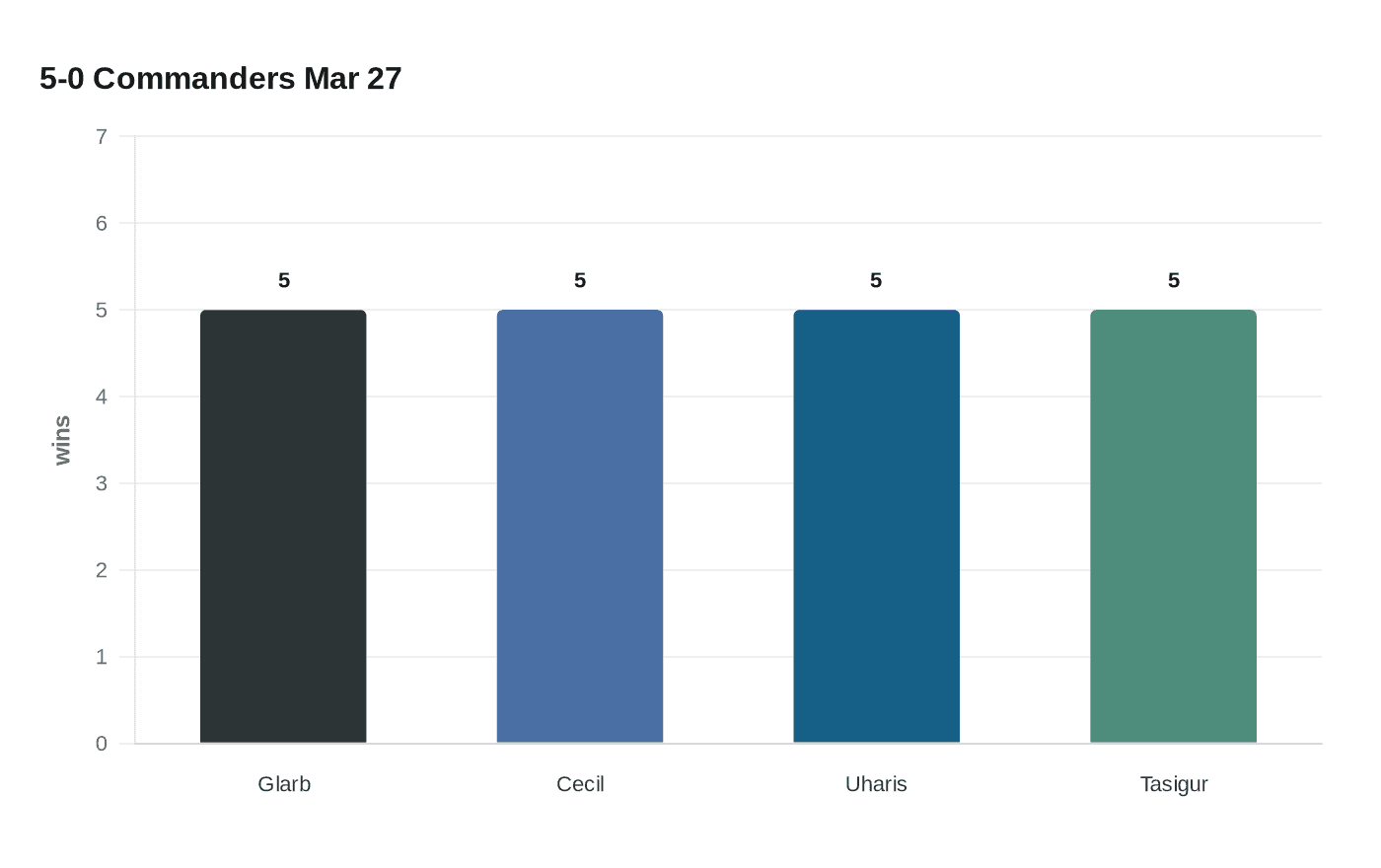
Tasigur went 5-0 in his first MTGO league appearances since rejoining Duel Commander's legal roster, confirming the format's blue control shift alongside Glarb, Cecil, and Uharis.

Tasigur, the Golden Fang spent years on the Duel Commander banned list. When the format's rules committee returned him to legal status in January 2026 on an experimental basis, the question wasn't whether he'd see play; it was how fast he'd prove the experiment correct. The March 27 Duel Commander League answered that with a 5-0 finish, as Tasigur joined Glarb, Calamity's Augur, Cecil, Dark Knight, and Uharis, the Stormspinner in going undefeated across a league weekend that confirmed the format's leaning toward blue shells without letting any single commander take full ownership of the top spot.
Four commanders, four distinct game plans, all going perfect on the same weekend. The spread itself matters. Glarb, Calamity's Augur operates in the combo-control tier, using the Thought Lash line to generate infinite card draw before closing the game, a pattern the rules committee had already flagged as one of the directions control decks were pushed before Tasigur's reinstatement gave the archetype a cleaner, less all-in option. Cecil, Dark Knight works from a different corner, pressing synergy-driven threats that punish opponents who stumble on mana or answers in the early turns. Uharis, the Stormspinner leans on mono-blue tempo, using spell triggers and bounce effects to keep opponents off their game plan without needing the same investment in a high-powered mana base. Tasigur, predictably, headlined Sultai control, the archetype his unban was explicitly designed to revitalize.
What connected all four wasn't color or strategy; it was infrastructure. Command Tower and City of Brass led the most-played lands list, and their presence across multiple 5-0 lists underscores the obvious lesson that Duel Commander rewards mana reliability before almost anything else. On the spells side, Bitterblossom and Demonic Tutor appeared as the standout staples of the weekend. Bitterblossom generates a threat every turn without requiring the pilot to tap out, which is the precise quality that makes it so good in 1v1: counters stay up while the board grows. Demonic Tutor handles variance in a 100-card singleton format where drawing the wrong half of your deck on a critical turn can cost you the match.

That four-card core, Command Tower and City of Brass as mana anchors, Bitterblossom as a threat engine that coexists with open counterspell mana, and Demonic Tutor as the flex slot that finds whatever the current game state demands, is directly transferable to multiplayer Commander. If you're building or tuning a Sultai or Dimir shell for pods, the March 27 results give you a data-backed justification for prioritizing those cards over flashier options. City of Brass specifically tends to be undervalued in multiplayer because the 1 life per activation feels more punishing than it actually is across games where you start at 40; the 5-0 mana bases suggest it belongs in any list that can't afford color inconsistency.
Where the translation breaks down is on the combo finishes. Glarb with Thought Lash is a two-card win in 1v1, where you're outrunning one player's interaction suite. In a pod of four, you're racing three separate stacks of countermagic, instant-speed hate, and graveyard disruption simultaneously. The same combo needs substantially more protection to function at a multiplayer table, and that protection adds slots that the Duel Commander version doesn't have to spend.
The tech swap that matters most against the current field: early graveyard interaction. Tasigur's activated ability, which costs two generic mana and exiles from your yard to return a random spell, is the engine that makes him resilient across longer games. His delve cost means he's landing on turn two or three even through disruption in Duel Commander, and his game plan leans heavily on the graveyard as a resource. Any multiplayer deck running black has a reason to reconsider its graveyard hate right now. Soul-Guide Lantern, Rest in Peace, and maindeck Leyline of the Void all spike in relevance when Tasigur lists represent the most-played control commander in the current league results. You're not just slowing Tasigur down; you're attacking the graveyard-centric combo lines that Glarb and other combo-control builds also rely on.
The finance signal from March 27 is worth tracking. MTGGoldfish published tabletop and MTGO price estimates alongside every 5-0 list, and the range is meaningful. Several of the top-performing decks reflect heavy investment in staples and Reserved List lands, while Uharis tempo builds clock in considerably lighter. When Demonic Tutor appears across multiple undefeated lists in the same weekend, secondary market demand for it follows. The same applies to Bitterblossom, which has seen recurring appearances in competitive Duel Commander results for years but still moves in price when league data reinforces its positioning.
Three days after the March 27 league closed, the Duel Commander rules committee published its own March 30 update noting that Tasigur had established itself as a prominent option in the command zone and that the unban was working as intended, reinvigorating control without crowding out other archetypes. The 5-0 from the previous Thursday was exactly the kind of league evidence the committee cited. Whether Tasigur holds that position as pilots develop more targeted answers or whether Glarb's combo-control angle reasserts itself is the question the next several league weekends will answer.
Know something we missed? Have a correction or additional information?
Submit a Tip