Phantom Steed deserves more Commander attention for value, protection, combos
Phantom Steed is quietly a value engine, a protection spell, and a combo piece. If you play ETB creatures, theft, or blink, this is a card worth watching.
Why Phantom Steed keeps sneaking under the radar
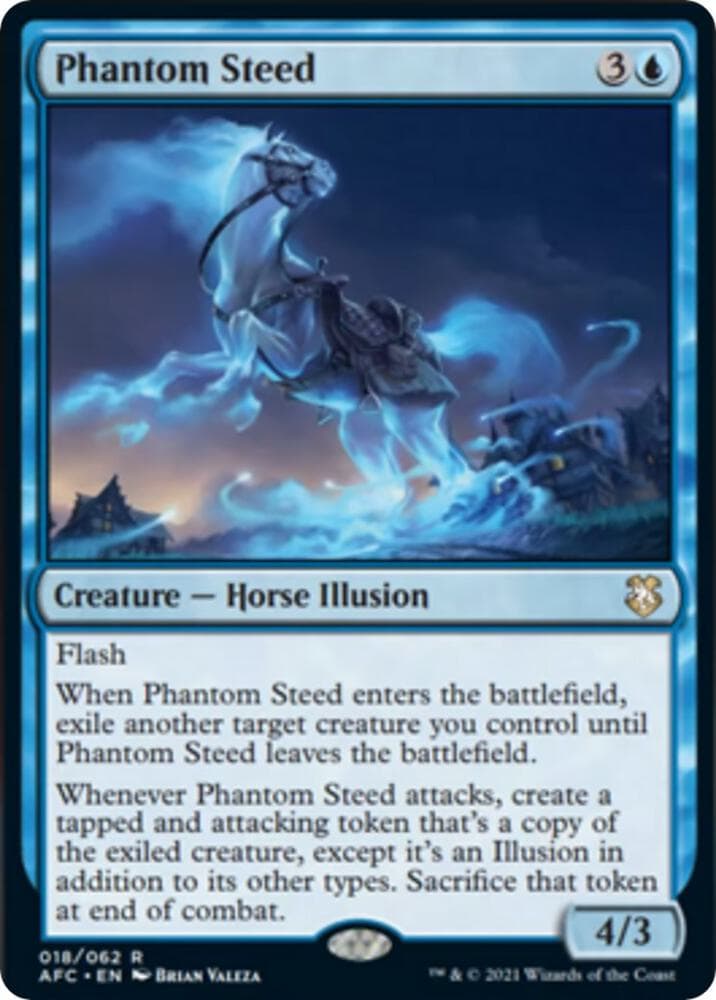
Phantom Steed looks like a niche trick until you read it the way a Commander player actually plays games. It is a blue Creature - Horse Illusion with flash, and its text does three things that matter immediately in multiplayer: it can tuck away one of your creatures, it can turn that creature into a temporary attacker, and it can keep doing both every combat step you survive. That mix is why it feels less like a novelty and more like a glue card for decks that already want value from creatures entering and leaving the battlefield.

The card also comes from a product that many players have already moved past. Phantom Steed was released in Adventures in the Forgotten Realms Commander, under the Commander Legends: Battle for Baldur’s Gate umbrella, and Wizards says that release hit on June 10, 2022. That timing matters because cards from that era often get misfiled as draft leftovers or casual curiosities, even when they have the exact kind of text Commander decks love: repeatable, flexible, and hard to punish if you build around them properly.
What Phantom Steed actually does for you
The cleanest way to understand Phantom Steed is as a self-contained protection spell that turns into a damage engine. When it enters, it exiles another target creature you control until Phantom Steed leaves the battlefield. Whenever Phantom Steed attacks, it makes a tapped and attacking token copy of the exiled card, and that token gets sacrificed at end of combat. Wizards also clarifies two important rules details: if the exiled card has X in its mana cost, X is 0, and the token is attacking even though it was never declared as an attacker.
That means the card does real work on both ends of the turn cycle. You can hide your best creature from spot removal or a board wipe by exiling it under Phantom Steed, then cash in repeated combat steps for extra enters-the-battlefield triggers and a fresh attacker every time. If the card you tucked is Thragtusk, Circuit Mender, or another creature that pays you when it enters, Phantom Steed turns one body into a recurring source of life, tokens, cards, or value without asking you to commit a pile of extra mana.
The fair value lines are already good
Phantom Steed does not need a combo finish to be worth considering. In a grindy midrange deck, it functions like a pseudo-blink engine that also protects your best permanent from getting picked off at the wrong moment. If your list already leans on creatures that want to be recast, blinked, or re-triggered, this is a clean way to keep those engines online while still pressuring life totals.
The card gets much better when you stop treating the token copy as a one-shot and start treating it as a trigger generator. A single attack with the right creature exiled can buy you a fresh enter-the-battlefield trigger, a combat trigger, and a body that forces the table to react. That is exactly the kind of sequence Commander decks are built to exploit.
Token doublers push the ceiling higher
If you want Phantom Steed to feel unfair instead of merely useful, token doublers are the easiest place to start. Anointed Procession and Parallel Lives both increase the number of tokens Phantom Steed creates, which means one attack can become a much larger board swing very quickly. In a deck that already wants a wide battlefield or repeated token production, that turns Phantom Steed from a value card into a pressure card.
This is the part many players underestimate. You are not just getting one temporary copy, you are getting a repeatable engine that scales with the same support pieces people already play for other token strategies. Once Phantom Steed is in a shell with token doublers, each combat step starts to look like a miniature overrun of value.
Theft shells are where the card gets nasty
Phantom Steed is especially strong in decks that steal creatures, because it lets you convert a temporary theft effect into a longer-term advantage. If you take an opponent’s creature with something like Act of Treason or Chamber of Manipulation and then exile it with Phantom Steed, you extend the theft effect while also making your own copy. That is exactly the kind of line that feels low-rent at first glance and then quietly wins the game because the original owner never really gets their threat back in a useful window.
This is also where support pieces like Panharmonicon and Firebender Ascension start making the card feel absurd. The more you multiply enters-the-battlefield value, token creation, or payoff triggers, the harder it becomes for the table to keep up with the chain of advantage. Phantom Steed slots neatly into that style of play because it rewards sequencing, not raw mana investment.
The combo lines are real, not Christmas-magic theory
Once you lean into the attack trigger, Phantom Steed stops being just a value card and starts feeding actual combo turns. Sundial of the Infinite or Obeka, Splitter of Seconds can preserve the token permanently by skipping the end-of-combat cleanup that would normally clear it away. Wizards’ release notes for Obeka, Splitter of Seconds say she gives you additional upkeep steps after combat, which makes her a particularly strange partner for the right attack-step engine.
From there, the lines get stronger very fast. Phantom Steed supports infinite turns with Medomai the Ageless, infinite combat steps with Port Razer, and blink loops involving Abdel Adrian, Gorion’s Ward plus another blink creature. Those are the kinds of sequences that tell you a card has moved beyond cute tech and into real deckbuilding territory.
Why this matters in Commander right now
Commander is a multiplayer free-for-all format, players start at 40 life, and each commander begins in the command zone. Wizards also describes it as the game’s largest format, and the Commander Format Panel beta, announced on February 11, 2025, was built to help players matchmake by power level. That environment rewards cards that are strong without being mindlessly explosive, because you want synergy that scales with your table instead of flattening it.
Phantom Steed fits that moment perfectly. It is the kind of card that looks like a clever include until you actually play it, then starts behaving like a hidden staple in the decks that want ETB creatures, theft lines, blink loops, or combat-step combo pieces. If you have been looking for a card that protects your best creature, doubles your value, and opens a path to real combo finishes, this is exactly the sort of underplayed rare that tends to get expensive after people catch on.
This article was produced by Prism’s automated news system from verified source data, official records, and press releases, then run through automated quality and moderation checks before publishing. The system is built and supervised by the people who set the standards it runs under. Read our full AI policy.
Know something we missed? Have a correction or additional information?
Submit a Tip